{"title":"从实验室的见解到工业应用的连续流声光催化减少持久性污染物的广谱s方案光催化剂","authors":"Rajamani Manju , Ganesh Masilamani , Bernaurdshaw Neppolian","doi":"10.1016/j.cjsc.2025.100845","DOIUrl":null,"url":null,"abstract":"<div><div>The rapid pace of industrialization has resulted in the alarming discharge of detrimental chemicals into the environment, prompting the scientific community to rethink conventional wastewater treatment technologies. Sonophotocatalysis, a synergistic green approach, harnessing the combined forces of ultrasound and visible light, has emerged as a promising frontier in environmental remediation. Leveraging the exceptional surface area, porosity, and coordination flexibility of zeolitic imidazole frameworks (ZIF-67), a type of metal-organic framework (MOF), makes it an excellent scaffold for catalyst design. Forming the core of this approach, a CoWO<sub>4</sub>-decorated ZIF-67 hybrid nanocomposite was developed and utilized as a sonophotocatalyst to degrade tetracycline (TC) under dual-energy exposure. The CoWO<sub>4</sub>/ZIF-67 catalyst achieved an unprecedented TC degradation efficiency of 98% within 75 min, outperforming standalone sonocatalytic and photocatalytic treatment, with excellent reusability. Mechanistic insights, supported by theoretical studies, revealed a strong interaction between the structural and physicochemical properties of the catalyst and energy-induced reactive oxygen species (ROS) generation. A large-scale continuous-flow sonophotocatalytic reactor of 20 L was fabricated to evaluate the performance of the synthesized catalyst on real wastewater samples containing interfering ions. The system achieved an 85% reduction in total organic carbon (TOC), demonstrating excellent scalability and practical applicability, offering a promising approach for treating emerging organic pollutants in an efficient and environmentally friendly manner.</div></div>","PeriodicalId":10151,"journal":{"name":"结构化学","volume":"45 4","pages":"Article 100845"},"PeriodicalIF":10.3000,"publicationDate":"2026-04-01","publicationTypes":"Journal Article","fieldsOfStudy":null,"isOpenAccess":false,"openAccessPdf":"","citationCount":"0","resultStr":"{\"title\":\"From laboratory insights to industrial applications in continuous flow sonophotocatalytic abatement of persistent pollutants enabled by a broad-spectrum S-scheme photocatalyst\",\"authors\":\"Rajamani Manju , Ganesh Masilamani , Bernaurdshaw Neppolian\",\"doi\":\"10.1016/j.cjsc.2025.100845\",\"DOIUrl\":null,\"url\":null,\"abstract\":\"<div><div>The rapid pace of industrialization has resulted in the alarming discharge of detrimental chemicals into the environment, prompting the scientific community to rethink conventional wastewater treatment technologies. Sonophotocatalysis, a synergistic green approach, harnessing the combined forces of ultrasound and visible light, has emerged as a promising frontier in environmental remediation. Leveraging the exceptional surface area, porosity, and coordination flexibility of zeolitic imidazole frameworks (ZIF-67), a type of metal-organic framework (MOF), makes it an excellent scaffold for catalyst design. Forming the core of this approach, a CoWO<sub>4</sub>-decorated ZIF-67 hybrid nanocomposite was developed and utilized as a sonophotocatalyst to degrade tetracycline (TC) under dual-energy exposure. The CoWO<sub>4</sub>/ZIF-67 catalyst achieved an unprecedented TC degradation efficiency of 98% within 75 min, outperforming standalone sonocatalytic and photocatalytic treatment, with excellent reusability. Mechanistic insights, supported by theoretical studies, revealed a strong interaction between the structural and physicochemical properties of the catalyst and energy-induced reactive oxygen species (ROS) generation. A large-scale continuous-flow sonophotocatalytic reactor of 20 L was fabricated to evaluate the performance of the synthesized catalyst on real wastewater samples containing interfering ions. The system achieved an 85% reduction in total organic carbon (TOC), demonstrating excellent scalability and practical applicability, offering a promising approach for treating emerging organic pollutants in an efficient and environmentally friendly manner.</div></div>\",\"PeriodicalId\":10151,\"journal\":{\"name\":\"结构化学\",\"volume\":\"45 4\",\"pages\":\"Article 100845\"},\"PeriodicalIF\":10.3000,\"publicationDate\":\"2026-04-01\",\"publicationTypes\":\"Journal Article\",\"fieldsOfStudy\":null,\"isOpenAccess\":false,\"openAccessPdf\":\"\",\"citationCount\":\"0\",\"resultStr\":null,\"platform\":\"Semanticscholar\",\"paperid\":null,\"PeriodicalName\":\"结构化学\",\"FirstCategoryId\":\"92\",\"ListUrlMain\":\"https://www.sciencedirect.com/science/article/pii/S0254586125003356\",\"RegionNum\":4,\"RegionCategory\":\"化学\",\"ArticlePicture\":[],\"TitleCN\":null,\"AbstractTextCN\":null,\"PMCID\":null,\"EPubDate\":\"2025/12/13 0:00:00\",\"PubModel\":\"Epub\",\"JCR\":\"Q1\",\"JCRName\":\"CHEMISTRY, INORGANIC & NUCLEAR\",\"Score\":null,\"Total\":0}","platform":"Semanticscholar","paperid":null,"PeriodicalName":"结构化学","FirstCategoryId":"92","ListUrlMain":"https://www.sciencedirect.com/science/article/pii/S0254586125003356","RegionNum":4,"RegionCategory":"化学","ArticlePicture":[],"TitleCN":null,"AbstractTextCN":null,"PMCID":null,"EPubDate":"2025/12/13 0:00:00","PubModel":"Epub","JCR":"Q1","JCRName":"CHEMISTRY, INORGANIC & NUCLEAR","Score":null,"Total":0}
From laboratory insights to industrial applications in continuous flow sonophotocatalytic abatement of persistent pollutants enabled by a broad-spectrum S-scheme photocatalyst
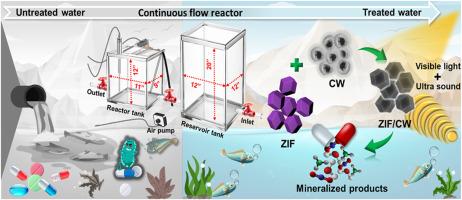
The rapid pace of industrialization has resulted in the alarming discharge of detrimental chemicals into the environment, prompting the scientific community to rethink conventional wastewater treatment technologies. Sonophotocatalysis, a synergistic green approach, harnessing the combined forces of ultrasound and visible light, has emerged as a promising frontier in environmental remediation. Leveraging the exceptional surface area, porosity, and coordination flexibility of zeolitic imidazole frameworks (ZIF-67), a type of metal-organic framework (MOF), makes it an excellent scaffold for catalyst design. Forming the core of this approach, a CoWO4-decorated ZIF-67 hybrid nanocomposite was developed and utilized as a sonophotocatalyst to degrade tetracycline (TC) under dual-energy exposure. The CoWO4/ZIF-67 catalyst achieved an unprecedented TC degradation efficiency of 98% within 75 min, outperforming standalone sonocatalytic and photocatalytic treatment, with excellent reusability. Mechanistic insights, supported by theoretical studies, revealed a strong interaction between the structural and physicochemical properties of the catalyst and energy-induced reactive oxygen species (ROS) generation. A large-scale continuous-flow sonophotocatalytic reactor of 20 L was fabricated to evaluate the performance of the synthesized catalyst on real wastewater samples containing interfering ions. The system achieved an 85% reduction in total organic carbon (TOC), demonstrating excellent scalability and practical applicability, offering a promising approach for treating emerging organic pollutants in an efficient and environmentally friendly manner.
期刊介绍:
Chinese Journal of Structural Chemistry “JIEGOU HUAXUE ”, an academic journal consisting of reviews, articles, communications and notes, provides a forum for the reporting and discussion of current novel research achievements in the fields of structural chemistry, crystallography, spectroscopy, quantum chemistry, pharmaceutical chemistry, biochemistry, material science, etc. Structural Chemistry has been indexed by SCI, CA, and some other prestigious publications.