Peijie Ma , Jiawei Song , Pan Zhang , Yaning Hu , Yuan-Zi Xu , Kaiwen Wang , Rui Zhang , Kun Zheng
{"title":"界面锚定与表面暴露:调整IrOx-Co3O4相互作用稳定的工业水分解","authors":"Peijie Ma , Jiawei Song , Pan Zhang , Yaning Hu , Yuan-Zi Xu , Kaiwen Wang , Rui Zhang , Kun Zheng","doi":"10.1016/j.cjsc.2025.100849","DOIUrl":null,"url":null,"abstract":"<div><div>Developing efficient and durable electrocatalysts that minimize or eliminate Ir usage is essential for large-scale hydrogen production through proton exchange membrane water electrolysis. In this work, two IrO<sub><em>x</em></sub>–Co<sub>3</sub>O<sub>4</sub> catalysts with distinct interfacial configurations were constructed to clarify the effect of structural coupling on activity and stability. The embedded IrO<sub><em>x</em></sub>–Co<sub>3</sub>O<sub>4</sub> was prepared via a galvanic replacement-induced embedding process, while the surface-exposed IrO<sub><em>x</em></sub>–Co<sub>3</sub>O<sub>4</sub> was obtained through photo-reduction deposition. Structural analyses confirm the formation of strong Co–O–Ir linkages in embedded IrO<sub><em>x</em></sub>–Co<sub>3</sub>O<sub>4</sub>, in contrast to discrete surface IrO<sub><em>x</em></sub> nanoparticles in the exposed sample. Electrochemical measurements show that exposed–IrO<sub><em>x</em></sub> delivers a lower overpotential of ≈ 331 mV at 10 mA cm<sup>−2</sup> but suffers from fast Ir dissolution, whereas embedded IrO<sub><em>x</em></sub> maintains stable operation with a voltage of 1.78 V at 1 A cm<sup>−2</sup> for over 200 h in a PEM cell. <em>In-situ</em> Raman and DEMS results reveal that embedded IrO<sub><em>x</em></sub> follows a dominating classical adsorbate-evolution mechanism (AEM), while exposed IrO<sub><em>x</em></sub>–Co<sub>3</sub>O<sub>4</sub> involves a lattice-oxygen-mediated mechanism (LOM), leading to its inferior stability. This work highlights that strengthening Co–O–Ir interface effectively suppresses Ir loss and provides a general strategy for designing robust Ir-based catalysts for acidic water electrolysis.</div></div>","PeriodicalId":10151,"journal":{"name":"结构化学","volume":"45 4","pages":"Article 100849"},"PeriodicalIF":10.3000,"publicationDate":"2026-04-01","publicationTypes":"Journal Article","fieldsOfStudy":null,"isOpenAccess":false,"openAccessPdf":"","citationCount":"0","resultStr":"{\"title\":\"Interfacial anchoring versus surface exposure: Tuning IrOx–Co3O4 interaction for stable industrial water splitting\",\"authors\":\"Peijie Ma , Jiawei Song , Pan Zhang , Yaning Hu , Yuan-Zi Xu , Kaiwen Wang , Rui Zhang , Kun Zheng\",\"doi\":\"10.1016/j.cjsc.2025.100849\",\"DOIUrl\":null,\"url\":null,\"abstract\":\"<div><div>Developing efficient and durable electrocatalysts that minimize or eliminate Ir usage is essential for large-scale hydrogen production through proton exchange membrane water electrolysis. In this work, two IrO<sub><em>x</em></sub>–Co<sub>3</sub>O<sub>4</sub> catalysts with distinct interfacial configurations were constructed to clarify the effect of structural coupling on activity and stability. The embedded IrO<sub><em>x</em></sub>–Co<sub>3</sub>O<sub>4</sub> was prepared via a galvanic replacement-induced embedding process, while the surface-exposed IrO<sub><em>x</em></sub>–Co<sub>3</sub>O<sub>4</sub> was obtained through photo-reduction deposition. Structural analyses confirm the formation of strong Co–O–Ir linkages in embedded IrO<sub><em>x</em></sub>–Co<sub>3</sub>O<sub>4</sub>, in contrast to discrete surface IrO<sub><em>x</em></sub> nanoparticles in the exposed sample. Electrochemical measurements show that exposed–IrO<sub><em>x</em></sub> delivers a lower overpotential of ≈ 331 mV at 10 mA cm<sup>−2</sup> but suffers from fast Ir dissolution, whereas embedded IrO<sub><em>x</em></sub> maintains stable operation with a voltage of 1.78 V at 1 A cm<sup>−2</sup> for over 200 h in a PEM cell. <em>In-situ</em> Raman and DEMS results reveal that embedded IrO<sub><em>x</em></sub> follows a dominating classical adsorbate-evolution mechanism (AEM), while exposed IrO<sub><em>x</em></sub>–Co<sub>3</sub>O<sub>4</sub> involves a lattice-oxygen-mediated mechanism (LOM), leading to its inferior stability. This work highlights that strengthening Co–O–Ir interface effectively suppresses Ir loss and provides a general strategy for designing robust Ir-based catalysts for acidic water electrolysis.</div></div>\",\"PeriodicalId\":10151,\"journal\":{\"name\":\"结构化学\",\"volume\":\"45 4\",\"pages\":\"Article 100849\"},\"PeriodicalIF\":10.3000,\"publicationDate\":\"2026-04-01\",\"publicationTypes\":\"Journal Article\",\"fieldsOfStudy\":null,\"isOpenAccess\":false,\"openAccessPdf\":\"\",\"citationCount\":\"0\",\"resultStr\":null,\"platform\":\"Semanticscholar\",\"paperid\":null,\"PeriodicalName\":\"结构化学\",\"FirstCategoryId\":\"92\",\"ListUrlMain\":\"https://www.sciencedirect.com/science/article/pii/S0254586125003393\",\"RegionNum\":4,\"RegionCategory\":\"化学\",\"ArticlePicture\":[],\"TitleCN\":null,\"AbstractTextCN\":null,\"PMCID\":null,\"EPubDate\":\"2025/12/22 0:00:00\",\"PubModel\":\"Epub\",\"JCR\":\"Q1\",\"JCRName\":\"CHEMISTRY, INORGANIC & NUCLEAR\",\"Score\":null,\"Total\":0}","platform":"Semanticscholar","paperid":null,"PeriodicalName":"结构化学","FirstCategoryId":"92","ListUrlMain":"https://www.sciencedirect.com/science/article/pii/S0254586125003393","RegionNum":4,"RegionCategory":"化学","ArticlePicture":[],"TitleCN":null,"AbstractTextCN":null,"PMCID":null,"EPubDate":"2025/12/22 0:00:00","PubModel":"Epub","JCR":"Q1","JCRName":"CHEMISTRY, INORGANIC & NUCLEAR","Score":null,"Total":0}
引用次数: 0
摘要
开发高效耐用的电催化剂,减少或消除Ir的使用,是通过质子交换膜电解大规模制氢的必要条件。本研究构建了两种界面构型不同的IrOx-Co3O4催化剂,以阐明结构耦合对活性和稳定性的影响。采用电取代诱导包埋法制备包埋IrOx-Co3O4,采用光还原沉积法制备表面暴露的IrOx-Co3O4。结构分析证实,与暴露样品中的离散表面IrOx纳米颗粒相比,嵌入IrOx - co3o4中形成了强Co-O-Ir键。电化学测量表明,暴露的IrOx在10 mA cm - 2时提供了较低的约331 mV过电位,但受到快速Ir溶解的影响,而嵌入的IrOx在PEM电池中保持稳定运行,电压为1.78 V,电压为1 a cm - 2超过200小时。原位Raman和dem结果表明,嵌入的IrOx遵循经典的吸附演化机制(AEM),而暴露的IrOx - co3o4则遵循晶格-氧介导机制(LOM),导致其稳定性较差。这项工作强调,加强Co-O-Ir界面有效地抑制了Ir损失,并为设计坚固的酸性水电解Ir基催化剂提供了一般策略。
Interfacial anchoring versus surface exposure: Tuning IrOx–Co3O4 interaction for stable industrial water splitting
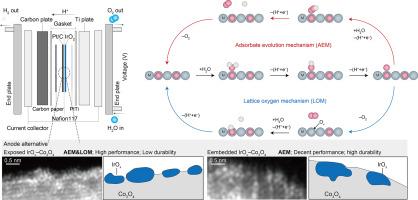
Developing efficient and durable electrocatalysts that minimize or eliminate Ir usage is essential for large-scale hydrogen production through proton exchange membrane water electrolysis. In this work, two IrOx–Co3O4 catalysts with distinct interfacial configurations were constructed to clarify the effect of structural coupling on activity and stability. The embedded IrOx–Co3O4 was prepared via a galvanic replacement-induced embedding process, while the surface-exposed IrOx–Co3O4 was obtained through photo-reduction deposition. Structural analyses confirm the formation of strong Co–O–Ir linkages in embedded IrOx–Co3O4, in contrast to discrete surface IrOx nanoparticles in the exposed sample. Electrochemical measurements show that exposed–IrOx delivers a lower overpotential of ≈ 331 mV at 10 mA cm−2 but suffers from fast Ir dissolution, whereas embedded IrOx maintains stable operation with a voltage of 1.78 V at 1 A cm−2 for over 200 h in a PEM cell. In-situ Raman and DEMS results reveal that embedded IrOx follows a dominating classical adsorbate-evolution mechanism (AEM), while exposed IrOx–Co3O4 involves a lattice-oxygen-mediated mechanism (LOM), leading to its inferior stability. This work highlights that strengthening Co–O–Ir interface effectively suppresses Ir loss and provides a general strategy for designing robust Ir-based catalysts for acidic water electrolysis.
期刊介绍:
Chinese Journal of Structural Chemistry “JIEGOU HUAXUE ”, an academic journal consisting of reviews, articles, communications and notes, provides a forum for the reporting and discussion of current novel research achievements in the fields of structural chemistry, crystallography, spectroscopy, quantum chemistry, pharmaceutical chemistry, biochemistry, material science, etc. Structural Chemistry has been indexed by SCI, CA, and some other prestigious publications.