{"title":"高强度铝合金复合增材制造中不同层间搅拌摩擦加工策略的空间异质结构工程及力学各向同性增强","authors":"Jiming Lv , Kaiyu Luo , Haifei Lu , Jinzhong Lu","doi":"10.1016/j.ijmachtools.2026.104389","DOIUrl":null,"url":null,"abstract":"<div><div>To address the dilemma between high-defect susceptibility of fusion-based additive manufacturing (AM) and the process-interruption sensitivity of solid-state AM for the high-strength AA7075 alloys, this study reports a hybrid manufacturing technology. It applies cyclic interlayer friction stir processing (C-IFSP) during laser directed energy deposition (LDED). The fundamental advancement lies in establishing a thermomechanical strategy that couples defect elimination and microstructural heterogeneity control, enabling in-situ architectural design of grain size and precipitate distributions across multiple length scales. Two contrasting C-IFSP strategies, unidirectional (UC-IFSP) and reciprocating (RC-IFSP), were systematically investigated. Both eliminated LDED-entrapped pores (porosity reduced by ∼4 and ∼7 orders of magnitude, respectively), but divergent thermomechanical transients yielded markedly different heterostructures: UC-IFSP produced laminated ultrafine/fine-grained layers along the build direction, whereas RC-IFSP established a bimodal grain structure with additional transverse heterogeneity. Consequently, RC-IFSP achieved synergetic enhancement of strength and ductility in the transverse direction while reducing strength anisotropy by 21.7%, reconstituting the strengthening mechanism from nanoprecipitate-dominated (wrought plate) to a synergistic strengthening of precipitate, dislocation, fine-grain, and heterogeneous deformation. This work establishes a pathway for defect-free, hierarchically controlled AM of high-strength Al alloys through spatially programmed thermomechanical processing.</div></div>","PeriodicalId":14011,"journal":{"name":"International Journal of Machine Tools & Manufacture","volume":"217 ","pages":"Article 104389"},"PeriodicalIF":18.8000,"publicationDate":"2026-04-01","publicationTypes":"Journal Article","fieldsOfStudy":null,"isOpenAccess":false,"openAccessPdf":"","citationCount":"0","resultStr":"{\"title\":\"Spatial heterostructure engineering and enhanced mechanical isotropy in hybrid additive manufacturing of high-strength aluminum alloys via different cyclic interlayer friction stir processing strategies\",\"authors\":\"Jiming Lv , Kaiyu Luo , Haifei Lu , Jinzhong Lu\",\"doi\":\"10.1016/j.ijmachtools.2026.104389\",\"DOIUrl\":null,\"url\":null,\"abstract\":\"<div><div>To address the dilemma between high-defect susceptibility of fusion-based additive manufacturing (AM) and the process-interruption sensitivity of solid-state AM for the high-strength AA7075 alloys, this study reports a hybrid manufacturing technology. It applies cyclic interlayer friction stir processing (C-IFSP) during laser directed energy deposition (LDED). The fundamental advancement lies in establishing a thermomechanical strategy that couples defect elimination and microstructural heterogeneity control, enabling in-situ architectural design of grain size and precipitate distributions across multiple length scales. Two contrasting C-IFSP strategies, unidirectional (UC-IFSP) and reciprocating (RC-IFSP), were systematically investigated. Both eliminated LDED-entrapped pores (porosity reduced by ∼4 and ∼7 orders of magnitude, respectively), but divergent thermomechanical transients yielded markedly different heterostructures: UC-IFSP produced laminated ultrafine/fine-grained layers along the build direction, whereas RC-IFSP established a bimodal grain structure with additional transverse heterogeneity. Consequently, RC-IFSP achieved synergetic enhancement of strength and ductility in the transverse direction while reducing strength anisotropy by 21.7%, reconstituting the strengthening mechanism from nanoprecipitate-dominated (wrought plate) to a synergistic strengthening of precipitate, dislocation, fine-grain, and heterogeneous deformation. This work establishes a pathway for defect-free, hierarchically controlled AM of high-strength Al alloys through spatially programmed thermomechanical processing.</div></div>\",\"PeriodicalId\":14011,\"journal\":{\"name\":\"International Journal of Machine Tools & Manufacture\",\"volume\":\"217 \",\"pages\":\"Article 104389\"},\"PeriodicalIF\":18.8000,\"publicationDate\":\"2026-04-01\",\"publicationTypes\":\"Journal Article\",\"fieldsOfStudy\":null,\"isOpenAccess\":false,\"openAccessPdf\":\"\",\"citationCount\":\"0\",\"resultStr\":null,\"platform\":\"Semanticscholar\",\"paperid\":null,\"PeriodicalName\":\"International Journal of Machine Tools & Manufacture\",\"FirstCategoryId\":\"5\",\"ListUrlMain\":\"https://www.sciencedirect.com/science/article/pii/S089069552600026X\",\"RegionNum\":1,\"RegionCategory\":\"工程技术\",\"ArticlePicture\":[],\"TitleCN\":null,\"AbstractTextCN\":null,\"PMCID\":null,\"EPubDate\":\"2026/3/30 0:00:00\",\"PubModel\":\"Epub\",\"JCR\":\"Q1\",\"JCRName\":\"ENGINEERING, MANUFACTURING\",\"Score\":null,\"Total\":0}","platform":"Semanticscholar","paperid":null,"PeriodicalName":"International Journal of Machine Tools & Manufacture","FirstCategoryId":"5","ListUrlMain":"https://www.sciencedirect.com/science/article/pii/S089069552600026X","RegionNum":1,"RegionCategory":"工程技术","ArticlePicture":[],"TitleCN":null,"AbstractTextCN":null,"PMCID":null,"EPubDate":"2026/3/30 0:00:00","PubModel":"Epub","JCR":"Q1","JCRName":"ENGINEERING, MANUFACTURING","Score":null,"Total":0}
Spatial heterostructure engineering and enhanced mechanical isotropy in hybrid additive manufacturing of high-strength aluminum alloys via different cyclic interlayer friction stir processing strategies
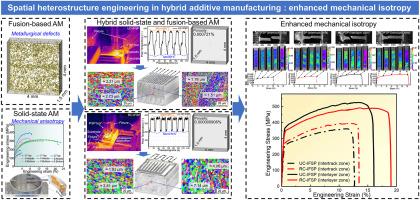
To address the dilemma between high-defect susceptibility of fusion-based additive manufacturing (AM) and the process-interruption sensitivity of solid-state AM for the high-strength AA7075 alloys, this study reports a hybrid manufacturing technology. It applies cyclic interlayer friction stir processing (C-IFSP) during laser directed energy deposition (LDED). The fundamental advancement lies in establishing a thermomechanical strategy that couples defect elimination and microstructural heterogeneity control, enabling in-situ architectural design of grain size and precipitate distributions across multiple length scales. Two contrasting C-IFSP strategies, unidirectional (UC-IFSP) and reciprocating (RC-IFSP), were systematically investigated. Both eliminated LDED-entrapped pores (porosity reduced by ∼4 and ∼7 orders of magnitude, respectively), but divergent thermomechanical transients yielded markedly different heterostructures: UC-IFSP produced laminated ultrafine/fine-grained layers along the build direction, whereas RC-IFSP established a bimodal grain structure with additional transverse heterogeneity. Consequently, RC-IFSP achieved synergetic enhancement of strength and ductility in the transverse direction while reducing strength anisotropy by 21.7%, reconstituting the strengthening mechanism from nanoprecipitate-dominated (wrought plate) to a synergistic strengthening of precipitate, dislocation, fine-grain, and heterogeneous deformation. This work establishes a pathway for defect-free, hierarchically controlled AM of high-strength Al alloys through spatially programmed thermomechanical processing.
期刊介绍:
The International Journal of Machine Tools and Manufacture is dedicated to advancing scientific comprehension of the fundamental mechanics involved in processes and machines utilized in the manufacturing of engineering components. While the primary focus is on metals, the journal also explores applications in composites, ceramics, and other structural or functional materials. The coverage includes a diverse range of topics:
- Essential mechanics of processes involving material removal, accretion, and deformation, encompassing solid, semi-solid, or particulate forms.
- Significant scientific advancements in existing or new processes and machines.
- In-depth characterization of workpiece materials (structure/surfaces) through advanced techniques (e.g., SEM, EDS, TEM, EBSD, AES, Raman spectroscopy) to unveil new phenomenological aspects governing manufacturing processes.
- Tool design, utilization, and comprehensive studies of failure mechanisms.
- Innovative concepts of machine tools, fixtures, and tool holders supported by modeling and demonstrations relevant to manufacturing processes within the journal's scope.
- Novel scientific contributions exploring interactions between the machine tool, control system, software design, and processes.
- Studies elucidating specific mechanisms governing niche processes (e.g., ultra-high precision, nano/atomic level manufacturing with either mechanical or non-mechanical "tools").
- Innovative approaches, underpinned by thorough scientific analysis, addressing emerging or breakthrough processes (e.g., bio-inspired manufacturing) and/or applications (e.g., ultra-high precision optics).