{"title":"四丁基溴化铵、四苯基硼酸钠和溴化钠在不同温度(298.15、303.15、308.15和313.15)K下二甲亚砜+水混合物存在下的电导率","authors":"Ambika Sharma, Ramesh Sharma, Chanchal Das","doi":"10.1134/S0036024425703480","DOIUrl":null,"url":null,"abstract":"<p>At (298.15, 303.15, 308.15, and 313.15) K, electrical conductances of the salts, namely, tetrabutylammonium bromide (Bu<sub>4</sub>NBr), sodium tetraphenylborate (NaBPh<sub>4</sub>), and sodium bromide (NaBr) in dimethyl sulfoxide (DMSO) + water (H<sub>2</sub>O) mixed solvent media with 0.10, 0.20, 0.30, and 0.40 mass fractions of DMSO were obtained. The 1978 Fuoss equation was used to analyze the experimental conductance data. The “reference electrolyte” tetrabutylammonium tertraphenylborate (Bu<sub>4</sub>NBPh<sub>4</sub>) was used to estimate the limiting ionic conductances. Our analysis found that all three electrolytes predominantly occur as free ions in solvent mixes at 298.15–313.15 K. The electrolyte association constant does not show noteworthy changes as the temperature varies. However, the electrolytes’ limiting molar conductances and single-ion conductivity values rise noticeably with the increase in temperature. A deviation form ideal behavior for Walden products of these salts were observed when the temperature or solvent composition were changed.</p>","PeriodicalId":767,"journal":{"name":"Russian Journal of Physical Chemistry A","volume":"100 2","pages":"251 - 261"},"PeriodicalIF":0.8000,"publicationDate":"2026-03-23","publicationTypes":"Journal Article","fieldsOfStudy":null,"isOpenAccess":false,"openAccessPdf":"","citationCount":"0","resultStr":"{\"title\":\"Electrical Conductivity of Tetrabutylammonium Bromide, Sodium Tetraphenylborate, and Sodium Bromide in the Presence of Dimethyl Sulfoxide + Water Mixtures at Different Temperatures (298.15, 303.15, 308.15, and 313.15) K\",\"authors\":\"Ambika Sharma, Ramesh Sharma, Chanchal Das\",\"doi\":\"10.1134/S0036024425703480\",\"DOIUrl\":null,\"url\":null,\"abstract\":\"<p>At (298.15, 303.15, 308.15, and 313.15) K, electrical conductances of the salts, namely, tetrabutylammonium bromide (Bu<sub>4</sub>NBr), sodium tetraphenylborate (NaBPh<sub>4</sub>), and sodium bromide (NaBr) in dimethyl sulfoxide (DMSO) + water (H<sub>2</sub>O) mixed solvent media with 0.10, 0.20, 0.30, and 0.40 mass fractions of DMSO were obtained. The 1978 Fuoss equation was used to analyze the experimental conductance data. The “reference electrolyte” tetrabutylammonium tertraphenylborate (Bu<sub>4</sub>NBPh<sub>4</sub>) was used to estimate the limiting ionic conductances. Our analysis found that all three electrolytes predominantly occur as free ions in solvent mixes at 298.15–313.15 K. The electrolyte association constant does not show noteworthy changes as the temperature varies. However, the electrolytes’ limiting molar conductances and single-ion conductivity values rise noticeably with the increase in temperature. A deviation form ideal behavior for Walden products of these salts were observed when the temperature or solvent composition were changed.</p>\",\"PeriodicalId\":767,\"journal\":{\"name\":\"Russian Journal of Physical Chemistry A\",\"volume\":\"100 2\",\"pages\":\"251 - 261\"},\"PeriodicalIF\":0.8000,\"publicationDate\":\"2026-03-23\",\"publicationTypes\":\"Journal Article\",\"fieldsOfStudy\":null,\"isOpenAccess\":false,\"openAccessPdf\":\"\",\"citationCount\":\"0\",\"resultStr\":null,\"platform\":\"Semanticscholar\",\"paperid\":null,\"PeriodicalName\":\"Russian Journal of Physical Chemistry A\",\"FirstCategoryId\":\"92\",\"ListUrlMain\":\"https://link.springer.com/article/10.1134/S0036024425703480\",\"RegionNum\":4,\"RegionCategory\":\"化学\",\"ArticlePicture\":[],\"TitleCN\":null,\"AbstractTextCN\":null,\"PMCID\":null,\"EPubDate\":\"\",\"PubModel\":\"\",\"JCR\":\"Q4\",\"JCRName\":\"CHEMISTRY, PHYSICAL\",\"Score\":null,\"Total\":0}","platform":"Semanticscholar","paperid":null,"PeriodicalName":"Russian Journal of Physical Chemistry A","FirstCategoryId":"92","ListUrlMain":"https://link.springer.com/article/10.1134/S0036024425703480","RegionNum":4,"RegionCategory":"化学","ArticlePicture":[],"TitleCN":null,"AbstractTextCN":null,"PMCID":null,"EPubDate":"","PubModel":"","JCR":"Q4","JCRName":"CHEMISTRY, PHYSICAL","Score":null,"Total":0}
Electrical Conductivity of Tetrabutylammonium Bromide, Sodium Tetraphenylborate, and Sodium Bromide in the Presence of Dimethyl Sulfoxide + Water Mixtures at Different Temperatures (298.15, 303.15, 308.15, and 313.15) K
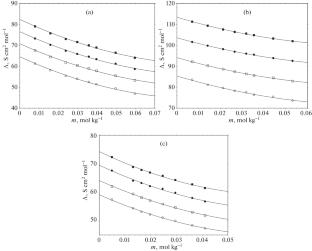
At (298.15, 303.15, 308.15, and 313.15) K, electrical conductances of the salts, namely, tetrabutylammonium bromide (Bu4NBr), sodium tetraphenylborate (NaBPh4), and sodium bromide (NaBr) in dimethyl sulfoxide (DMSO) + water (H2O) mixed solvent media with 0.10, 0.20, 0.30, and 0.40 mass fractions of DMSO were obtained. The 1978 Fuoss equation was used to analyze the experimental conductance data. The “reference electrolyte” tetrabutylammonium tertraphenylborate (Bu4NBPh4) was used to estimate the limiting ionic conductances. Our analysis found that all three electrolytes predominantly occur as free ions in solvent mixes at 298.15–313.15 K. The electrolyte association constant does not show noteworthy changes as the temperature varies. However, the electrolytes’ limiting molar conductances and single-ion conductivity values rise noticeably with the increase in temperature. A deviation form ideal behavior for Walden products of these salts were observed when the temperature or solvent composition were changed.
期刊介绍:
Russian Journal of Physical Chemistry A. Focus on Chemistry (Zhurnal Fizicheskoi Khimii), founded in 1930, offers a comprehensive review of theoretical and experimental research from the Russian Academy of Sciences, leading research and academic centers from Russia and from all over the world.
Articles are devoted to chemical thermodynamics and thermochemistry, biophysical chemistry, photochemistry and magnetochemistry, materials structure, quantum chemistry, physical chemistry of nanomaterials and solutions, surface phenomena and adsorption, and methods and techniques of physicochemical studies.

 求助内容:
求助内容: 应助结果提醒方式:

 京公网安备 11010802042870号


