Alex J Trompeter, Charlotte Brookes, Sara Dardak, Edward Allen, Billy Cho, Jonathan Lohn, Vijay Kolli
{"title":"创伤所致急性下肢截肢的再手术及并发症发生率。","authors":"Alex J Trompeter, Charlotte Brookes, Sara Dardak, Edward Allen, Billy Cho, Jonathan Lohn, Vijay Kolli","doi":"10.1302/2633-1462.73.BJO-2025-0307.R1","DOIUrl":null,"url":null,"abstract":"<p><strong>Aims: </strong>Lower limb amputation is associated with significant morbidity and mortality. Reflecting the predominance of vascular or diabetic disease as a cause for lower limb amputation, much of the available literature excludes lower limb amputation secondary to trauma in the reporting of complication rates. This paucity of literature represents a research gap in describing the incidence of complications in lower limb amputations due to trauma, which we aim to address.</p><p><strong>Methods: </strong>A retrospective analysis was undertaken of a prospectively collected database of lower limb amputations secondary to trauma from a regional multidisciplinary amputee service in London. Clinical records were consulted for evidence of reoperation, infection, phantom limb pain, neuroma, and contralateral limb arthritis. A multivariable regression model was created to establish risk factors for reoperation. A total of 213 amputations (200 patients) were included in the final analysis.</p><p><strong>Results: </strong>Mean age at amputation was 33 years (1 to 90), with a mean follow-up of 230 months (2 to 734). Overall, 35.2% of patients (n = 75) underwent reoperation, and 27.7% (n = 59) had at least one episode of infection. Of those who underwent reoperation, 44% (n = 33) had evidence of infection. Phantom limb pain and neuroma were reported in 39.9% (n = 85) and 10.8% (n = 23), respectively. Contralateral limb osteoarthritis was documented in 7%. Presence of infection is a statistically significant risk factor, conferring a 3.9 times increased risk of reoperation.</p><p><strong>Conclusion: </strong>Lower limb amputations secondary to trauma exhibit higher rates of reoperation and infection compared to vascular or diabetic amputees. This is the first and largest study to provide high-quality data describing the incidence of complications in patients with lower limb amputations due to trauma in the UK.</p>","PeriodicalId":34103,"journal":{"name":"Bone & Joint Open","volume":"7 3","pages":"442-447"},"PeriodicalIF":3.1000,"publicationDate":"2026-03-26","publicationTypes":"Journal Article","fieldsOfStudy":null,"isOpenAccess":false,"openAccessPdf":"https://www.ncbi.nlm.nih.gov/pmc/articles/PMC13019647/pdf/","citationCount":"0","resultStr":"{\"title\":\"Reoperation and complication rates in acute lower limb amputations due to trauma.\",\"authors\":\"Alex J Trompeter, Charlotte Brookes, Sara Dardak, Edward Allen, Billy Cho, Jonathan Lohn, Vijay Kolli\",\"doi\":\"10.1302/2633-1462.73.BJO-2025-0307.R1\",\"DOIUrl\":null,\"url\":null,\"abstract\":\"<p><strong>Aims: </strong>Lower limb amputation is associated with significant morbidity and mortality. Reflecting the predominance of vascular or diabetic disease as a cause for lower limb amputation, much of the available literature excludes lower limb amputation secondary to trauma in the reporting of complication rates. This paucity of literature represents a research gap in describing the incidence of complications in lower limb amputations due to trauma, which we aim to address.</p><p><strong>Methods: </strong>A retrospective analysis was undertaken of a prospectively collected database of lower limb amputations secondary to trauma from a regional multidisciplinary amputee service in London. Clinical records were consulted for evidence of reoperation, infection, phantom limb pain, neuroma, and contralateral limb arthritis. A multivariable regression model was created to establish risk factors for reoperation. A total of 213 amputations (200 patients) were included in the final analysis.</p><p><strong>Results: </strong>Mean age at amputation was 33 years (1 to 90), with a mean follow-up of 230 months (2 to 734). Overall, 35.2% of patients (n = 75) underwent reoperation, and 27.7% (n = 59) had at least one episode of infection. Of those who underwent reoperation, 44% (n = 33) had evidence of infection. Phantom limb pain and neuroma were reported in 39.9% (n = 85) and 10.8% (n = 23), respectively. Contralateral limb osteoarthritis was documented in 7%. Presence of infection is a statistically significant risk factor, conferring a 3.9 times increased risk of reoperation.</p><p><strong>Conclusion: </strong>Lower limb amputations secondary to trauma exhibit higher rates of reoperation and infection compared to vascular or diabetic amputees. This is the first and largest study to provide high-quality data describing the incidence of complications in patients with lower limb amputations due to trauma in the UK.</p>\",\"PeriodicalId\":34103,\"journal\":{\"name\":\"Bone & Joint Open\",\"volume\":\"7 3\",\"pages\":\"442-447\"},\"PeriodicalIF\":3.1000,\"publicationDate\":\"2026-03-26\",\"publicationTypes\":\"Journal Article\",\"fieldsOfStudy\":null,\"isOpenAccess\":false,\"openAccessPdf\":\"https://www.ncbi.nlm.nih.gov/pmc/articles/PMC13019647/pdf/\",\"citationCount\":\"0\",\"resultStr\":null,\"platform\":\"Semanticscholar\",\"paperid\":null,\"PeriodicalName\":\"Bone & Joint Open\",\"FirstCategoryId\":\"1085\",\"ListUrlMain\":\"https://doi.org/10.1302/2633-1462.73.BJO-2025-0307.R1\",\"RegionNum\":0,\"RegionCategory\":null,\"ArticlePicture\":[],\"TitleCN\":null,\"AbstractTextCN\":null,\"PMCID\":null,\"EPubDate\":\"\",\"PubModel\":\"\",\"JCR\":\"Q1\",\"JCRName\":\"ORTHOPEDICS\",\"Score\":null,\"Total\":0}","platform":"Semanticscholar","paperid":null,"PeriodicalName":"Bone & Joint Open","FirstCategoryId":"1085","ListUrlMain":"https://doi.org/10.1302/2633-1462.73.BJO-2025-0307.R1","RegionNum":0,"RegionCategory":null,"ArticlePicture":[],"TitleCN":null,"AbstractTextCN":null,"PMCID":null,"EPubDate":"","PubModel":"","JCR":"Q1","JCRName":"ORTHOPEDICS","Score":null,"Total":0}
Reoperation and complication rates in acute lower limb amputations due to trauma.
Aims: Lower limb amputation is associated with significant morbidity and mortality. Reflecting the predominance of vascular or diabetic disease as a cause for lower limb amputation, much of the available literature excludes lower limb amputation secondary to trauma in the reporting of complication rates. This paucity of literature represents a research gap in describing the incidence of complications in lower limb amputations due to trauma, which we aim to address.
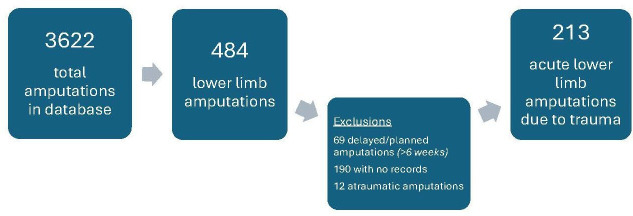
Methods: A retrospective analysis was undertaken of a prospectively collected database of lower limb amputations secondary to trauma from a regional multidisciplinary amputee service in London. Clinical records were consulted for evidence of reoperation, infection, phantom limb pain, neuroma, and contralateral limb arthritis. A multivariable regression model was created to establish risk factors for reoperation. A total of 213 amputations (200 patients) were included in the final analysis.
Results: Mean age at amputation was 33 years (1 to 90), with a mean follow-up of 230 months (2 to 734). Overall, 35.2% of patients (n = 75) underwent reoperation, and 27.7% (n = 59) had at least one episode of infection. Of those who underwent reoperation, 44% (n = 33) had evidence of infection. Phantom limb pain and neuroma were reported in 39.9% (n = 85) and 10.8% (n = 23), respectively. Contralateral limb osteoarthritis was documented in 7%. Presence of infection is a statistically significant risk factor, conferring a 3.9 times increased risk of reoperation.
Conclusion: Lower limb amputations secondary to trauma exhibit higher rates of reoperation and infection compared to vascular or diabetic amputees. This is the first and largest study to provide high-quality data describing the incidence of complications in patients with lower limb amputations due to trauma in the UK.



 求助内容:
求助内容: 应助结果提醒方式:

 京公网安备 11010802042870号


