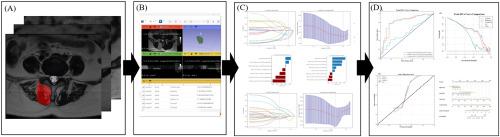
一种新的基于人工智能的多模式放射组学方法,用于精确评估慢性非特异性腰痛的疼痛强度。

IF 5.9 1区 医学 Q1 ORTHOPEDICS
Journal of Orthopaedic Translation Pub Date : 2026-03-01 Epub Date: 2026-02-26 DOI:10.1016/j.jot.2026.101062
Moran Suo , Changjun Ma , Xin Chen , Yu Guan , Xiulin Wang , Zhonghai Li
{"title":"一种新的基于人工智能的多模式放射组学方法,用于精确评估慢性非特异性腰痛的疼痛强度。","authors":"Moran Suo ,&nbsp;Changjun Ma ,&nbsp;Xin Chen ,&nbsp;Yu Guan ,&nbsp;Xiulin Wang ,&nbsp;Zhonghai Li","doi":"10.1016/j.jot.2026.101062","DOIUrl":null,"url":null,"abstract":"<div><h3>Background</h3><div>Chronic nonspecific low back pain (cNLBP) is a prevalent global health concern. Radiomics enables the extraction of high-dimensional quantitative features from medical images and has shown promise in disease diagnosis, prognostic assessment, and therapeutic response evaluation. To construct and validate an artificial intelligence (AI)-based evaluation model for clinical symptoms in cNLBP patients, leveraging both clinical and radiomics features. The clinical utility of this approach was evaluated in identifying patients at high risk for severe pain.</div></div><div><h3>Methods</h3><div>A total of 148 patients with cNLBP were enrolled and stratified by VAS into mild and severe pain groups. Radiomics features from the paraspinal muscles were extracted from lumbar MRI scans. Multiple AI algorithms were applied to construct evaluation models. Logistic regression was used to construct clinical models, radiomics models, and combined clinical - radiomics models, respectively, to compare the predictive power of different models. Model performance was evaluated by multiple methods.</div></div><div><h3>Results</h3><div>Fat infiltration rate of multifidus muscles as significant predictors of pain intensity. The Bagging decision tree model and random forest model achieved higher area under the ROC curve (AUC) values and F1 scores, respectively, in radiomics models. The combined models integrating radiomics and clinical features further increased AUCs.</div></div><div><h3>Conclusion</h3><div>AI algorithms have a significant advantage over traditional algorithms in improving the performance of predictive models. Integrating radiomics features with clinical variables significantly enhances the predictive performance for pain intensity in cNLBP. Multimodal data integration compensates for the limitations of single-modality models, improving both accuracy and stability.</div></div><div><h3>The translational potential of this article</h3><div>This study facilitates early risk stratification of cNLBP patients in clinical practice, enabling clinicians to prioritize intervention for high-risk individuals and optimize the allocation of medical resources. Moreover, the validated high-performance AI models and the multimodal integration strategy lay a foundation for the development of clinical auxiliary tools. Such tools can be integrated into existing clinical workflows to assist clinicians in accurately identifying patients with severe pain at high risk, thereby supporting early intervention and personalized treatment decision-making.</div></div>","PeriodicalId":16636,"journal":{"name":"Journal of Orthopaedic Translation","volume":"57 ","pages":"Article 101062"},"PeriodicalIF":5.9000,"publicationDate":"2026-03-01","publicationTypes":"Journal Article","fieldsOfStudy":null,"isOpenAccess":false,"openAccessPdf":"","citationCount":"0","resultStr":"{\"title\":\"A novel multimodal AI-based radiomics approach for precision assessment of pain intensity in chronic nonspecific low back pain\",\"authors\":\"Moran Suo ,&nbsp;Changjun Ma ,&nbsp;Xin Chen ,&nbsp;Yu Guan ,&nbsp;Xiulin Wang ,&nbsp;Zhonghai Li\",\"doi\":\"10.1016/j.jot.2026.101062\",\"DOIUrl\":null,\"url\":null,\"abstract\":\"<div><h3>Background</h3><div>Chronic nonspecific low back pain (cNLBP) is a prevalent global health concern. Radiomics enables the extraction of high-dimensional quantitative features from medical images and has shown promise in disease diagnosis, prognostic assessment, and therapeutic response evaluation. To construct and validate an artificial intelligence (AI)-based evaluation model for clinical symptoms in cNLBP patients, leveraging both clinical and radiomics features. The clinical utility of this approach was evaluated in identifying patients at high risk for severe pain.</div></div><div><h3>Methods</h3><div>A total of 148 patients with cNLBP were enrolled and stratified by VAS into mild and severe pain groups. Radiomics features from the paraspinal muscles were extracted from lumbar MRI scans. Multiple AI algorithms were applied to construct evaluation models. Logistic regression was used to construct clinical models, radiomics models, and combined clinical - radiomics models, respectively, to compare the predictive power of different models. Model performance was evaluated by multiple methods.</div></div><div><h3>Results</h3><div>Fat infiltration rate of multifidus muscles as significant predictors of pain intensity. The Bagging decision tree model and random forest model achieved higher area under the ROC curve (AUC) values and F1 scores, respectively, in radiomics models. The combined models integrating radiomics and clinical features further increased AUCs.</div></div><div><h3>Conclusion</h3><div>AI algorithms have a significant advantage over traditional algorithms in improving the performance of predictive models. Integrating radiomics features with clinical variables significantly enhances the predictive performance for pain intensity in cNLBP. Multimodal data integration compensates for the limitations of single-modality models, improving both accuracy and stability.</div></div><div><h3>The translational potential of this article</h3><div>This study facilitates early risk stratification of cNLBP patients in clinical practice, enabling clinicians to prioritize intervention for high-risk individuals and optimize the allocation of medical resources. Moreover, the validated high-performance AI models and the multimodal integration strategy lay a foundation for the development of clinical auxiliary tools. Such tools can be integrated into existing clinical workflows to assist clinicians in accurately identifying patients with severe pain at high risk, thereby supporting early intervention and personalized treatment decision-making.</div></div>\",\"PeriodicalId\":16636,\"journal\":{\"name\":\"Journal of Orthopaedic Translation\",\"volume\":\"57 \",\"pages\":\"Article 101062\"},\"PeriodicalIF\":5.9000,\"publicationDate\":\"2026-03-01\",\"publicationTypes\":\"Journal Article\",\"fieldsOfStudy\":null,\"isOpenAccess\":false,\"openAccessPdf\":\"\",\"citationCount\":\"0\",\"resultStr\":null,\"platform\":\"Semanticscholar\",\"paperid\":null,\"PeriodicalName\":\"Journal of Orthopaedic Translation\",\"FirstCategoryId\":\"3\",\"ListUrlMain\":\"https://www.sciencedirect.com/science/article/pii/S2214031X26000173\",\"RegionNum\":1,\"RegionCategory\":\"医学\",\"ArticlePicture\":[],\"TitleCN\":null,\"AbstractTextCN\":null,\"PMCID\":null,\"EPubDate\":\"2026/2/26 0:00:00\",\"PubModel\":\"Epub\",\"JCR\":\"Q1\",\"JCRName\":\"ORTHOPEDICS\",\"Score\":null,\"Total\":0}","platform":"Semanticscholar","paperid":null,"PeriodicalName":"Journal of Orthopaedic Translation","FirstCategoryId":"3","ListUrlMain":"https://www.sciencedirect.com/science/article/pii/S2214031X26000173","RegionNum":1,"RegionCategory":"医学","ArticlePicture":[],"TitleCN":null,"AbstractTextCN":null,"PMCID":null,"EPubDate":"2026/2/26 0:00:00","PubModel":"Epub","JCR":"Q1","JCRName":"ORTHOPEDICS","Score":null,"Total":0}
引用次数: 0

摘要

背景:慢性非特异性腰痛(cNLBP)是一个普遍的全球健康问题。放射组学能够从医学图像中提取高维定量特征,并在疾病诊断、预后评估和治疗反应评估方面显示出前景。利用临床和放射组学特征,构建并验证基于人工智能(AI)的cNLBP患者临床症状评估模型。这种方法的临床效用被评估,以确定患者在高风险的严重疼痛。方法:选取148例cNLBP患者,采用VAS分层法分为轻度和重度疼痛组。从腰椎MRI扫描中提取棘旁肌肉的放射组学特征。采用多种人工智能算法构建评价模型。采用Logistic回归分别构建临床模型、放射组学模型和临床-放射组学联合模型,比较不同模型的预测能力。采用多种方法对模型性能进行评价。结果:多裂肌脂肪浸润率是疼痛强度的重要预测因子。在放射组学模型中,Bagging决策树模型和随机森林模型分别获得了更高的ROC曲线下面积(AUC)值和F1分数。结合放射组学和临床特征的联合模型进一步增加了auc。结论:人工智能算法在提高预测模型性能方面比传统算法有明显优势。将放射组学特征与临床变量相结合可显著提高cNLBP疼痛强度的预测性能。多模态数据集成弥补了单模态模型的局限性,提高了精度和稳定性。本文的翻译潜力:本研究有助于临床实践中cNLBP患者的早期风险分层,使临床医生能够优先考虑高危人群的干预,优化医疗资源的配置。此外,经过验证的高性能人工智能模型和多模式集成策略为临床辅助工具的开发奠定了基础。这些工具可以整合到现有的临床工作流程中,以帮助临床医生准确识别高风险的严重疼痛患者,从而支持早期干预和个性化治疗决策。
本文章由计算机程序翻译,如有差异,请以英文原文为准。

A novel multimodal AI-based radiomics approach for precision assessment of pain intensity in chronic nonspecific low back pain

A novel multimodal AI-based radiomics approach for precision assessment of pain intensity in chronic nonspecific low back pain

Background

Chronic nonspecific low back pain (cNLBP) is a prevalent global health concern. Radiomics enables the extraction of high-dimensional quantitative features from medical images and has shown promise in disease diagnosis, prognostic assessment, and therapeutic response evaluation. To construct and validate an artificial intelligence (AI)-based evaluation model for clinical symptoms in cNLBP patients, leveraging both clinical and radiomics features. The clinical utility of this approach was evaluated in identifying patients at high risk for severe pain.

Methods

A total of 148 patients with cNLBP were enrolled and stratified by VAS into mild and severe pain groups. Radiomics features from the paraspinal muscles were extracted from lumbar MRI scans. Multiple AI algorithms were applied to construct evaluation models. Logistic regression was used to construct clinical models, radiomics models, and combined clinical - radiomics models, respectively, to compare the predictive power of different models. Model performance was evaluated by multiple methods.

Results

Fat infiltration rate of multifidus muscles as significant predictors of pain intensity. The Bagging decision tree model and random forest model achieved higher area under the ROC curve (AUC) values and F1 scores, respectively, in radiomics models. The combined models integrating radiomics and clinical features further increased AUCs.

Conclusion

AI algorithms have a significant advantage over traditional algorithms in improving the performance of predictive models. Integrating radiomics features with clinical variables significantly enhances the predictive performance for pain intensity in cNLBP. Multimodal data integration compensates for the limitations of single-modality models, improving both accuracy and stability.

The translational potential of this article

This study facilitates early risk stratification of cNLBP patients in clinical practice, enabling clinicians to prioritize intervention for high-risk individuals and optimize the allocation of medical resources. Moreover, the validated high-performance AI models and the multimodal integration strategy lay a foundation for the development of clinical auxiliary tools. Such tools can be integrated into existing clinical workflows to assist clinicians in accurately identifying patients with severe pain at high risk, thereby supporting early intervention and personalized treatment decision-making.
求助全文
通过发布文献求助,成功后即可免费获取论文全文。 去求助
来源期刊
Journal of Orthopaedic Translation
Journal of Orthopaedic Translation Medicine-Orthopedics and Sports Medicine
CiteScore
11.80
自引率
13.60%
发文量
91
审稿时长
29 days
期刊介绍: The Journal of Orthopaedic Translation (JOT) is the official peer-reviewed, open access journal of the Chinese Speaking Orthopaedic Society (CSOS) and the International Chinese Musculoskeletal Research Society (ICMRS). It is published quarterly, in January, April, July and October, by Elsevier.

×
引用
GB/T 7714-2015
复制
MLA
复制
APA
复制
导出至
BibTeX EndNote RefMan NoteFirst NoteExpress
×
提示
您的信息不完整,为了账户安全,请先补充。
现在去补充
×
提示
您因"违规操作"
具体请查看互助需知
我知道了
×
提示
确定
请完成安全验证×
copy
已复制链接
快去分享给好友吧!
我知道了
右上角分享
点击右上角分享
0
联系我们:info@booksci.cn Book学术提供免费学术资源搜索服务,方便国内外学者检索中英文文献。致力于提供最便捷和优质的服务体验。 Copyright © 2023 布克学术 All rights reserved.
京ICP备2023020795号-1
ghs 京公网安备 11010802042870号
Book学术文献互助
Book学术文献互助群
群 号:604180095
Book学术官方微信
小红书