Uma Pandey, Onkar Dikshit, B. Nagarajan, R. Nagarajan, S. Saharan, A. K. Singh
{"title":"太阳活动周期下降阶段电离层GPS-TEC对x级太阳耀斑的响应","authors":"Uma Pandey, Onkar Dikshit, B. Nagarajan, R. Nagarajan, S. Saharan, A. K. Singh","doi":"10.1134/S0016793225600225","DOIUrl":null,"url":null,"abstract":"<p>Ionospheric variability due to solar flares has been studied at different latitudes during the solar cycle 24. In the course of this cycle 24 on September 6, 2017, two powerful and intense solar flares of class X2.2 and X9.3 were emitted by the Sun at 0857 UT and 1153 UT respectively. To examine the ionospheric response simultaneously at low, mid, and high latitudes, total electron content (TEC) values derived from Global Navigation Satellite System (GNSS) receivers were investigated during the solar flare of September 6, 2017, which are the most remarkable flare events during the solar cycle-24. Our observations show a noticeable enlargement in TEC at low, mid, and high-latitude stations. Further, the mean method has been used to investigate TEC variations due to solar flares at low, mid, and high latitudes and considered all PRN which has a one-to-one correlation with the time of solar flares. We describe our findings in the context of earlier research which examined the correlation between change in VTEC (DVTEC) and solar fluxes in X-class solar flares. The aim of this study is to minimize the latitudinal variability of total electron content (TEC) during such events, although the extent of TEC increase seems to be influenced by the class of the solar flare. The results exhibited that X-class flare effects were more pronounced at low latitudes in comparison to mid and high latitudes.</p>","PeriodicalId":55597,"journal":{"name":"Geomagnetism and Aeronomy","volume":"65 7-8","pages":"146 - 158"},"PeriodicalIF":0.7000,"publicationDate":"2026-01-20","publicationTypes":"Journal Article","fieldsOfStudy":null,"isOpenAccess":false,"openAccessPdf":"","citationCount":"0","resultStr":"{\"title\":\"Ionospheric GPS-TEC Response to the X-Class Solar Flares during the Descending Phase of the Solar Cycle 24\",\"authors\":\"Uma Pandey, Onkar Dikshit, B. Nagarajan, R. Nagarajan, S. Saharan, A. K. Singh\",\"doi\":\"10.1134/S0016793225600225\",\"DOIUrl\":null,\"url\":null,\"abstract\":\"<p>Ionospheric variability due to solar flares has been studied at different latitudes during the solar cycle 24. In the course of this cycle 24 on September 6, 2017, two powerful and intense solar flares of class X2.2 and X9.3 were emitted by the Sun at 0857 UT and 1153 UT respectively. To examine the ionospheric response simultaneously at low, mid, and high latitudes, total electron content (TEC) values derived from Global Navigation Satellite System (GNSS) receivers were investigated during the solar flare of September 6, 2017, which are the most remarkable flare events during the solar cycle-24. Our observations show a noticeable enlargement in TEC at low, mid, and high-latitude stations. Further, the mean method has been used to investigate TEC variations due to solar flares at low, mid, and high latitudes and considered all PRN which has a one-to-one correlation with the time of solar flares. We describe our findings in the context of earlier research which examined the correlation between change in VTEC (DVTEC) and solar fluxes in X-class solar flares. The aim of this study is to minimize the latitudinal variability of total electron content (TEC) during such events, although the extent of TEC increase seems to be influenced by the class of the solar flare. The results exhibited that X-class flare effects were more pronounced at low latitudes in comparison to mid and high latitudes.</p>\",\"PeriodicalId\":55597,\"journal\":{\"name\":\"Geomagnetism and Aeronomy\",\"volume\":\"65 7-8\",\"pages\":\"146 - 158\"},\"PeriodicalIF\":0.7000,\"publicationDate\":\"2026-01-20\",\"publicationTypes\":\"Journal Article\",\"fieldsOfStudy\":null,\"isOpenAccess\":false,\"openAccessPdf\":\"\",\"citationCount\":\"0\",\"resultStr\":null,\"platform\":\"Semanticscholar\",\"paperid\":null,\"PeriodicalName\":\"Geomagnetism and Aeronomy\",\"FirstCategoryId\":\"89\",\"ListUrlMain\":\"https://link.springer.com/article/10.1134/S0016793225600225\",\"RegionNum\":4,\"RegionCategory\":\"地球科学\",\"ArticlePicture\":[],\"TitleCN\":null,\"AbstractTextCN\":null,\"PMCID\":null,\"EPubDate\":\"\",\"PubModel\":\"\",\"JCR\":\"Q4\",\"JCRName\":\"GEOCHEMISTRY & GEOPHYSICS\",\"Score\":null,\"Total\":0}","platform":"Semanticscholar","paperid":null,"PeriodicalName":"Geomagnetism and Aeronomy","FirstCategoryId":"89","ListUrlMain":"https://link.springer.com/article/10.1134/S0016793225600225","RegionNum":4,"RegionCategory":"地球科学","ArticlePicture":[],"TitleCN":null,"AbstractTextCN":null,"PMCID":null,"EPubDate":"","PubModel":"","JCR":"Q4","JCRName":"GEOCHEMISTRY & GEOPHYSICS","Score":null,"Total":0}
Ionospheric GPS-TEC Response to the X-Class Solar Flares during the Descending Phase of the Solar Cycle 24
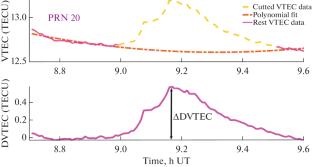
Ionospheric variability due to solar flares has been studied at different latitudes during the solar cycle 24. In the course of this cycle 24 on September 6, 2017, two powerful and intense solar flares of class X2.2 and X9.3 were emitted by the Sun at 0857 UT and 1153 UT respectively. To examine the ionospheric response simultaneously at low, mid, and high latitudes, total electron content (TEC) values derived from Global Navigation Satellite System (GNSS) receivers were investigated during the solar flare of September 6, 2017, which are the most remarkable flare events during the solar cycle-24. Our observations show a noticeable enlargement in TEC at low, mid, and high-latitude stations. Further, the mean method has been used to investigate TEC variations due to solar flares at low, mid, and high latitudes and considered all PRN which has a one-to-one correlation with the time of solar flares. We describe our findings in the context of earlier research which examined the correlation between change in VTEC (DVTEC) and solar fluxes in X-class solar flares. The aim of this study is to minimize the latitudinal variability of total electron content (TEC) during such events, although the extent of TEC increase seems to be influenced by the class of the solar flare. The results exhibited that X-class flare effects were more pronounced at low latitudes in comparison to mid and high latitudes.
期刊介绍:
Geomagnetism and Aeronomy is a bimonthly periodical that covers the fields of interplanetary space; geoeffective solar events; the magnetosphere; the ionosphere; the upper and middle atmosphere; the action of solar variability and activity on atmospheric parameters and climate; the main magnetic field and its secular variations, excursion, and inversion; and other related topics.

 求助内容:
求助内容: 应助结果提醒方式:

 京公网安备 11010802042870号


