Angel Kujur, Dayanand Bhaskar, Uma Pandey, Ajeet K Maurya
{"title":"太阳活动周期24和25最初六年太阳和地球物理参数的比较评估","authors":"Angel Kujur, Dayanand Bhaskar, Uma Pandey, Ajeet K Maurya","doi":"10.1134/S0016793225600262","DOIUrl":null,"url":null,"abstract":"<p>This study presents a comparative statistical analysis of solar activity during the first six years of Solar Cycles 24 (2008–2013) and 25 (2019–2024). The analysis focuses on key solar and geophysical parameters, including sunspot numbers, halo coronal mass ejections (CMEs), solar radio flux at 10.7 cm (F10.7), and geomagnetic storms, to assess differences in solar behavior between the two cycles. Sunspot numbers varied between 0 and 139.1 in Solar Cycle 24, whereas they ranged from 0.2 to 216 during the corresponding period of Solar Cycle 25. Similarly, the F10.7 cm radio flux fluctuated between 65.7 and 153.5 in solar flux unit (s.f.u.) during 2008–2013, and between 67.05 and 245.6 s.f.u. from 2019 to 2024, reflecting an overall increase in solar output. The study also includes an analysis of halo CMEs, with 192 events observed during Solar Cycle 24 and 227 during Solar Cycle 25, both characterized by an angular width of 360°. Geomagnetic activity was assessed using 104 events from Cycle 24 and 179 from Cycle 25, with disturbance storm time (Dst) index values ranging from –50 to –350 nT. The results indicate a significant increase in solar activity during the early phase of Solar Cycle 25 compared to Solar Cycle 24. This suggests a more intense and dynamic space weather environment in the current solar cycle, which may have important implications for space weather forecasting and satellite operations.</p>","PeriodicalId":55597,"journal":{"name":"Geomagnetism and Aeronomy","volume":"65 7-8","pages":"123 - 131"},"PeriodicalIF":0.7000,"publicationDate":"2026-01-09","publicationTypes":"Journal Article","fieldsOfStudy":null,"isOpenAccess":false,"openAccessPdf":"","citationCount":"0","resultStr":"{\"title\":\"Comparative Assessment of Solar and Geophysical Parameters during the Initial Six Years of Solar Cycles 24 and 25\",\"authors\":\"Angel Kujur, Dayanand Bhaskar, Uma Pandey, Ajeet K Maurya\",\"doi\":\"10.1134/S0016793225600262\",\"DOIUrl\":null,\"url\":null,\"abstract\":\"<p>This study presents a comparative statistical analysis of solar activity during the first six years of Solar Cycles 24 (2008–2013) and 25 (2019–2024). The analysis focuses on key solar and geophysical parameters, including sunspot numbers, halo coronal mass ejections (CMEs), solar radio flux at 10.7 cm (F10.7), and geomagnetic storms, to assess differences in solar behavior between the two cycles. Sunspot numbers varied between 0 and 139.1 in Solar Cycle 24, whereas they ranged from 0.2 to 216 during the corresponding period of Solar Cycle 25. Similarly, the F10.7 cm radio flux fluctuated between 65.7 and 153.5 in solar flux unit (s.f.u.) during 2008–2013, and between 67.05 and 245.6 s.f.u. from 2019 to 2024, reflecting an overall increase in solar output. The study also includes an analysis of halo CMEs, with 192 events observed during Solar Cycle 24 and 227 during Solar Cycle 25, both characterized by an angular width of 360°. Geomagnetic activity was assessed using 104 events from Cycle 24 and 179 from Cycle 25, with disturbance storm time (Dst) index values ranging from –50 to –350 nT. The results indicate a significant increase in solar activity during the early phase of Solar Cycle 25 compared to Solar Cycle 24. This suggests a more intense and dynamic space weather environment in the current solar cycle, which may have important implications for space weather forecasting and satellite operations.</p>\",\"PeriodicalId\":55597,\"journal\":{\"name\":\"Geomagnetism and Aeronomy\",\"volume\":\"65 7-8\",\"pages\":\"123 - 131\"},\"PeriodicalIF\":0.7000,\"publicationDate\":\"2026-01-09\",\"publicationTypes\":\"Journal Article\",\"fieldsOfStudy\":null,\"isOpenAccess\":false,\"openAccessPdf\":\"\",\"citationCount\":\"0\",\"resultStr\":null,\"platform\":\"Semanticscholar\",\"paperid\":null,\"PeriodicalName\":\"Geomagnetism and Aeronomy\",\"FirstCategoryId\":\"89\",\"ListUrlMain\":\"https://link.springer.com/article/10.1134/S0016793225600262\",\"RegionNum\":4,\"RegionCategory\":\"地球科学\",\"ArticlePicture\":[],\"TitleCN\":null,\"AbstractTextCN\":null,\"PMCID\":null,\"EPubDate\":\"\",\"PubModel\":\"\",\"JCR\":\"Q4\",\"JCRName\":\"GEOCHEMISTRY & GEOPHYSICS\",\"Score\":null,\"Total\":0}","platform":"Semanticscholar","paperid":null,"PeriodicalName":"Geomagnetism and Aeronomy","FirstCategoryId":"89","ListUrlMain":"https://link.springer.com/article/10.1134/S0016793225600262","RegionNum":4,"RegionCategory":"地球科学","ArticlePicture":[],"TitleCN":null,"AbstractTextCN":null,"PMCID":null,"EPubDate":"","PubModel":"","JCR":"Q4","JCRName":"GEOCHEMISTRY & GEOPHYSICS","Score":null,"Total":0}
Comparative Assessment of Solar and Geophysical Parameters during the Initial Six Years of Solar Cycles 24 and 25
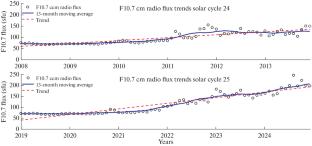
This study presents a comparative statistical analysis of solar activity during the first six years of Solar Cycles 24 (2008–2013) and 25 (2019–2024). The analysis focuses on key solar and geophysical parameters, including sunspot numbers, halo coronal mass ejections (CMEs), solar radio flux at 10.7 cm (F10.7), and geomagnetic storms, to assess differences in solar behavior between the two cycles. Sunspot numbers varied between 0 and 139.1 in Solar Cycle 24, whereas they ranged from 0.2 to 216 during the corresponding period of Solar Cycle 25. Similarly, the F10.7 cm radio flux fluctuated between 65.7 and 153.5 in solar flux unit (s.f.u.) during 2008–2013, and between 67.05 and 245.6 s.f.u. from 2019 to 2024, reflecting an overall increase in solar output. The study also includes an analysis of halo CMEs, with 192 events observed during Solar Cycle 24 and 227 during Solar Cycle 25, both characterized by an angular width of 360°. Geomagnetic activity was assessed using 104 events from Cycle 24 and 179 from Cycle 25, with disturbance storm time (Dst) index values ranging from –50 to –350 nT. The results indicate a significant increase in solar activity during the early phase of Solar Cycle 25 compared to Solar Cycle 24. This suggests a more intense and dynamic space weather environment in the current solar cycle, which may have important implications for space weather forecasting and satellite operations.
期刊介绍:
Geomagnetism and Aeronomy is a bimonthly periodical that covers the fields of interplanetary space; geoeffective solar events; the magnetosphere; the ionosphere; the upper and middle atmosphere; the action of solar variability and activity on atmospheric parameters and climate; the main magnetic field and its secular variations, excursion, and inversion; and other related topics.

 求助内容:
求助内容: 应助结果提醒方式:

 京公网安备 11010802042870号


