
人工智能集成传感和通信教程

IF 34.4 1区 计算机科学 Q1 COMPUTER SCIENCE, INFORMATION SYSTEMS
Mojtaba Vaezi;Gayan Amarasuriya Aruma Baduge;Esa Ollila;Sergiy A. Vorobyov
{"title":"人工智能集成传感和通信教程","authors":"Mojtaba Vaezi;Gayan Amarasuriya Aruma Baduge;Esa Ollila;Sergiy A. Vorobyov","doi":"10.1109/COMST.2026.3665143","DOIUrl":null,"url":null,"abstract":"Integrating sensing and communication (ISAC) can help overcome the challenges of limited spectrum and expensive hardware, leading to improved energy and cost efficiency. While full cooperation between sensing and communication can result in significant performance gains, achieving optimal performance requires efficient designs of unified waveforms and beamformers for joint sensing and communication. Sophisticated statistical signal processing and multi-objective optimization techniques are necessary to balance the competing design requirements of joint sensing and communication tasks. As model-based approaches can be suboptimal or too complex, deep learning offers a powerful data-driven alternative, especially when optimal algorithms are unknown or impractical for real-time use. Unified waveform and beamformer design problems for ISAC fall into this category, where fundamental design trade-offs exist between sensing and communication performance metrics, and the underlying models may be inadequate or incomplete. This tutorial paper explores the application of artificial intelligence (AI) to enhance efficiency or reduce complexity in ISAC designs. We emphasize the integration benefits through AI-driven ISAC designs, prioritizing the development of unified waveforms, constellations, and beamforming strategies for both sensing and communication. To illustrate the practical potential of AI-driven ISAC, we present three case studies on waveform, beamforming, and constellation design, demonstrating how unsupervised learning and neural network–based optimization can effectively balance performance, complexity, and implementation constraints.","PeriodicalId":55029,"journal":{"name":"IEEE Communications Surveys and Tutorials","volume":"28 ","pages":"4980-5013"},"PeriodicalIF":34.4000,"publicationDate":"2026-02-23","publicationTypes":"Journal Article","fieldsOfStudy":null,"isOpenAccess":false,"openAccessPdf":"","citationCount":"0","resultStr":"{\"title\":\"A Tutorial on AI-Empowered Integrated Sensing and Communications\",\"authors\":\"Mojtaba Vaezi;Gayan Amarasuriya Aruma Baduge;Esa Ollila;Sergiy A. Vorobyov\",\"doi\":\"10.1109/COMST.2026.3665143\",\"DOIUrl\":null,\"url\":null,\"abstract\":\"Integrating sensing and communication (ISAC) can help overcome the challenges of limited spectrum and expensive hardware, leading to improved energy and cost efficiency. While full cooperation between sensing and communication can result in significant performance gains, achieving optimal performance requires efficient designs of unified waveforms and beamformers for joint sensing and communication. Sophisticated statistical signal processing and multi-objective optimization techniques are necessary to balance the competing design requirements of joint sensing and communication tasks. As model-based approaches can be suboptimal or too complex, deep learning offers a powerful data-driven alternative, especially when optimal algorithms are unknown or impractical for real-time use. Unified waveform and beamformer design problems for ISAC fall into this category, where fundamental design trade-offs exist between sensing and communication performance metrics, and the underlying models may be inadequate or incomplete. This tutorial paper explores the application of artificial intelligence (AI) to enhance efficiency or reduce complexity in ISAC designs. We emphasize the integration benefits through AI-driven ISAC designs, prioritizing the development of unified waveforms, constellations, and beamforming strategies for both sensing and communication. To illustrate the practical potential of AI-driven ISAC, we present three case studies on waveform, beamforming, and constellation design, demonstrating how unsupervised learning and neural network–based optimization can effectively balance performance, complexity, and implementation constraints.\",\"PeriodicalId\":55029,\"journal\":{\"name\":\"IEEE Communications Surveys and Tutorials\",\"volume\":\"28 \",\"pages\":\"4980-5013\"},\"PeriodicalIF\":34.4000,\"publicationDate\":\"2026-02-23\",\"publicationTypes\":\"Journal Article\",\"fieldsOfStudy\":null,\"isOpenAccess\":false,\"openAccessPdf\":\"\",\"citationCount\":\"0\",\"resultStr\":null,\"platform\":\"Semanticscholar\",\"paperid\":null,\"PeriodicalName\":\"IEEE Communications Surveys and Tutorials\",\"FirstCategoryId\":\"94\",\"ListUrlMain\":\"https://ieeexplore.ieee.org/document/11407954/\",\"RegionNum\":1,\"RegionCategory\":\"计算机科学\",\"ArticlePicture\":[],\"TitleCN\":null,\"AbstractTextCN\":null,\"PMCID\":null,\"EPubDate\":\"\",\"PubModel\":\"\",\"JCR\":\"Q1\",\"JCRName\":\"COMPUTER SCIENCE, INFORMATION SYSTEMS\",\"Score\":null,\"Total\":0}","platform":"Semanticscholar","paperid":null,"PeriodicalName":"IEEE Communications Surveys and Tutorials","FirstCategoryId":"94","ListUrlMain":"https://ieeexplore.ieee.org/document/11407954/","RegionNum":1,"RegionCategory":"计算机科学","ArticlePicture":[],"TitleCN":null,"AbstractTextCN":null,"PMCID":null,"EPubDate":"","PubModel":"","JCR":"Q1","JCRName":"COMPUTER SCIENCE, INFORMATION SYSTEMS","Score":null,"Total":0}
引用次数: 0

摘要

集成传感和通信(ISAC)可以帮助克服有限频谱和昂贵硬件的挑战,从而提高能源和成本效率。虽然传感和通信之间的充分合作可以带来显着的性能提升,但要实现最佳性能,需要有效地设计统一的波形和波束形成器,以用于联合传感和通信。复杂的统计信号处理和多目标优化技术是平衡联合传感和通信任务的竞争设计要求所必需的。由于基于模型的方法可能不是最优的或过于复杂,深度学习提供了一个强大的数据驱动的替代方案,特别是当最佳算法未知或无法实时使用时。ISAC的统一波形和波束形成器设计问题属于这一类,其中存在传感和通信性能指标之间的基本设计权衡,并且底层模型可能不充分或不完整。本教程探讨了人工智能(AI)在ISAC设计中的应用,以提高效率或降低复杂性。我们强调通过人工智能驱动的ISAC设计的集成效益,优先开发用于传感和通信的统一波形、星座和波束形成策略。为了说明人工智能驱动的ISAC的实际潜力,我们提出了三个关于波形、波束形成和星座设计的案例研究,展示了无监督学习和基于神经网络的优化如何有效地平衡性能、复杂性和实现约束。
本文章由计算机程序翻译,如有差异,请以英文原文为准。
A Tutorial on AI-Empowered Integrated Sensing and Communications
Integrating sensing and communication (ISAC) can help overcome the challenges of limited spectrum and expensive hardware, leading to improved energy and cost efficiency. While full cooperation between sensing and communication can result in significant performance gains, achieving optimal performance requires efficient designs of unified waveforms and beamformers for joint sensing and communication. Sophisticated statistical signal processing and multi-objective optimization techniques are necessary to balance the competing design requirements of joint sensing and communication tasks. As model-based approaches can be suboptimal or too complex, deep learning offers a powerful data-driven alternative, especially when optimal algorithms are unknown or impractical for real-time use. Unified waveform and beamformer design problems for ISAC fall into this category, where fundamental design trade-offs exist between sensing and communication performance metrics, and the underlying models may be inadequate or incomplete. This tutorial paper explores the application of artificial intelligence (AI) to enhance efficiency or reduce complexity in ISAC designs. We emphasize the integration benefits through AI-driven ISAC designs, prioritizing the development of unified waveforms, constellations, and beamforming strategies for both sensing and communication. To illustrate the practical potential of AI-driven ISAC, we present three case studies on waveform, beamforming, and constellation design, demonstrating how unsupervised learning and neural network–based optimization can effectively balance performance, complexity, and implementation constraints.
求助全文
通过发布文献求助,成功后即可免费获取论文全文。 去求助
来源期刊
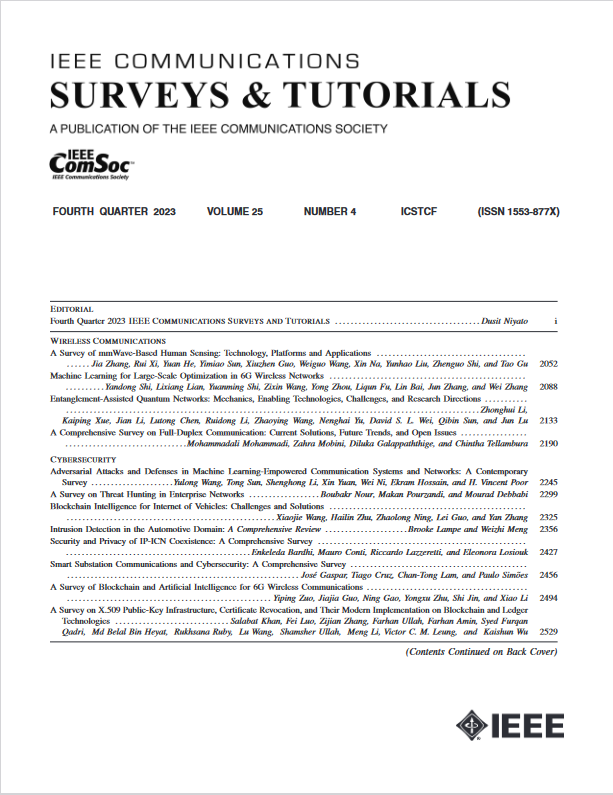
IEEE Communications Surveys and Tutorials
IEEE Communications Surveys and Tutorials COMPUTER SCIENCE, INFORMATION SYSTEMS-TELECOMMUNICATIONS
CiteScore
80.20
自引率
2.50%
发文量
84
审稿时长
6 months
期刊介绍: IEEE Communications Surveys & Tutorials is an online journal published by the IEEE Communications Society for tutorials and surveys covering all aspects of the communications field. Telecommunications technology is progressing at a rapid pace, and the IEEE Communications Society is committed to providing researchers and other professionals the information and tools to stay abreast. IEEE Communications Surveys and Tutorials focuses on integrating and adding understanding to the existing literature on communications, putting results in context. Whether searching for in-depth information about a familiar area or an introduction into a new area, IEEE Communications Surveys & Tutorials aims to be the premier source of peer-reviewed, comprehensive tutorials and surveys, and pointers to further sources. IEEE Communications Surveys & Tutorials publishes only articles exclusively written for IEEE Communications Surveys & Tutorials and go through a rigorous review process before their publication in the quarterly issues. A tutorial article in the IEEE Communications Surveys & Tutorials should be designed to help the reader to become familiar with and learn something specific about a chosen topic. In contrast, the term survey, as applied here, is defined to mean a survey of the literature. A survey article in IEEE Communications Surveys & Tutorials should provide a comprehensive review of developments in a selected area, covering its development from its inception to its current state and beyond, and illustrating its development through liberal citations from the literature. Both tutorials and surveys should be tutorial in nature and should be written in a style comprehensible to readers outside the specialty of the article.

×
引用
GB/T 7714-2015
复制
MLA
复制
APA
复制
导出至
BibTeX EndNote RefMan NoteFirst NoteExpress
×
提示
您的信息不完整,为了账户安全,请先补充。
现在去补充
×
提示
您因"违规操作"
具体请查看互助需知
我知道了
×
提示
确定
请完成安全验证×
copy
已复制链接
快去分享给好友吧!
我知道了
右上角分享
点击右上角分享
0
联系我们:info@booksci.cn Book学术提供免费学术资源搜索服务,方便国内外学者检索中英文文献。致力于提供最便捷和优质的服务体验。 Copyright © 2023 布克学术 All rights reserved.
京ICP备2023020795号-1
ghs 京公网安备 11010802042870号
Book学术文献互助
Book学术文献互助群
群 号:604180095
Book学术官方微信
小红书


