利用三维参考相互作用位点模型自洽场法和溶剂化自由能分解法分析cu催化叠氮化物-炔环加成反应中的溶剂效应

IF 5.2 2区 化学 Q2 CHEMISTRY, PHYSICAL
Journal of Molecular Liquids Pub Date : 2026-04-15 Epub Date: 2026-02-04 DOI:10.1016/j.molliq.2026.129355
Hikaru Oshimo , Yuki Nukumi , Leonardo Sabattini , Kanami Sugiyama , Hirofumi Sato , Masahiro Higashi
{"title":"利用三维参考相互作用位点模型自洽场法和溶剂化自由能分解法分析cu催化叠氮化物-炔环加成反应中的溶剂效应","authors":"Hikaru Oshimo ,&nbsp;Yuki Nukumi ,&nbsp;Leonardo Sabattini ,&nbsp;Kanami Sugiyama ,&nbsp;Hirofumi Sato ,&nbsp;Masahiro Higashi","doi":"10.1016/j.molliq.2026.129355","DOIUrl":null,"url":null,"abstract":"<div><div>The reaction rate of the Cu-catalyzed azide-alkyne cycloaddition (CuAAC) exhibits a unique solvent dependence that cannot be rationalized by solvent polarity alone; the reaction proceeds faster in glycerol, followed by water, and then CH<sub>2</sub>Cl<sub>2</sub>. In the present study, this characteristic solvent dependence is elucidated in detail using the three-dimensional reference interaction site model self-consistent field (3D-RISM-SCF) method, which combines quantum chemical calculation of the solute and statistical mechanical description of the solvent molecules. It is found that the calculated free energy profiles in the three solvents are consistent with the experimental results. A decomposition analysis of the relative solvation free energy in the rate-determining step reveals that the energetic contribution arising from solute-solvent electrostatic interactions is substantial in water, whereas the entropic contribution caused by associative reaction plays a dominant role in glycerol. The latter attenuates the destabilization of solute electronic energy, resulting in the greatest stabilization of the transition state in glycerol.</div></div>","PeriodicalId":371,"journal":{"name":"Journal of Molecular Liquids","volume":"448 ","pages":"Article 129355"},"PeriodicalIF":5.2000,"publicationDate":"2026-04-15","publicationTypes":"Journal Article","fieldsOfStudy":null,"isOpenAccess":false,"openAccessPdf":"","citationCount":"0","resultStr":"{\"title\":\"Analysis of solvent effects on the Cu-catalyzed azide-alkyne cycloaddition reaction via three-dimensional reference interaction site model self-consistent field method and solvation free energy decomposition\",\"authors\":\"Hikaru Oshimo ,&nbsp;Yuki Nukumi ,&nbsp;Leonardo Sabattini ,&nbsp;Kanami Sugiyama ,&nbsp;Hirofumi Sato ,&nbsp;Masahiro Higashi\",\"doi\":\"10.1016/j.molliq.2026.129355\",\"DOIUrl\":null,\"url\":null,\"abstract\":\"<div><div>The reaction rate of the Cu-catalyzed azide-alkyne cycloaddition (CuAAC) exhibits a unique solvent dependence that cannot be rationalized by solvent polarity alone; the reaction proceeds faster in glycerol, followed by water, and then CH<sub>2</sub>Cl<sub>2</sub>. In the present study, this characteristic solvent dependence is elucidated in detail using the three-dimensional reference interaction site model self-consistent field (3D-RISM-SCF) method, which combines quantum chemical calculation of the solute and statistical mechanical description of the solvent molecules. It is found that the calculated free energy profiles in the three solvents are consistent with the experimental results. A decomposition analysis of the relative solvation free energy in the rate-determining step reveals that the energetic contribution arising from solute-solvent electrostatic interactions is substantial in water, whereas the entropic contribution caused by associative reaction plays a dominant role in glycerol. The latter attenuates the destabilization of solute electronic energy, resulting in the greatest stabilization of the transition state in glycerol.</div></div>\",\"PeriodicalId\":371,\"journal\":{\"name\":\"Journal of Molecular Liquids\",\"volume\":\"448 \",\"pages\":\"Article 129355\"},\"PeriodicalIF\":5.2000,\"publicationDate\":\"2026-04-15\",\"publicationTypes\":\"Journal Article\",\"fieldsOfStudy\":null,\"isOpenAccess\":false,\"openAccessPdf\":\"\",\"citationCount\":\"0\",\"resultStr\":null,\"platform\":\"Semanticscholar\",\"paperid\":null,\"PeriodicalName\":\"Journal of Molecular Liquids\",\"FirstCategoryId\":\"92\",\"ListUrlMain\":\"https://www.sciencedirect.com/science/article/pii/S016773222600125X\",\"RegionNum\":2,\"RegionCategory\":\"化学\",\"ArticlePicture\":[],\"TitleCN\":null,\"AbstractTextCN\":null,\"PMCID\":null,\"EPubDate\":\"2026/2/4 0:00:00\",\"PubModel\":\"Epub\",\"JCR\":\"Q2\",\"JCRName\":\"CHEMISTRY, PHYSICAL\",\"Score\":null,\"Total\":0}","platform":"Semanticscholar","paperid":null,"PeriodicalName":"Journal of Molecular Liquids","FirstCategoryId":"92","ListUrlMain":"https://www.sciencedirect.com/science/article/pii/S016773222600125X","RegionNum":2,"RegionCategory":"化学","ArticlePicture":[],"TitleCN":null,"AbstractTextCN":null,"PMCID":null,"EPubDate":"2026/2/4 0:00:00","PubModel":"Epub","JCR":"Q2","JCRName":"CHEMISTRY, PHYSICAL","Score":null,"Total":0}
引用次数: 0

摘要

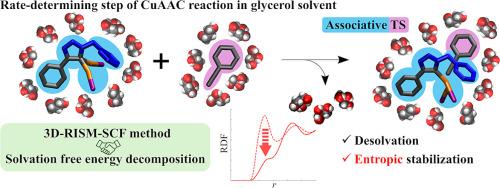
cu催化叠氮化物-炔环加成(CuAAC)的反应速率表现出独特的溶剂依赖性,不能仅用溶剂极性来解释;反应在甘油中进行得更快,其次是水,然后是CH2Cl2。在本研究中,使用三维参考相互作用位点模型自洽场(3D-RISM-SCF)方法详细阐明了这种特征的溶剂依赖性,该方法结合了溶质的量子化学计算和溶剂分子的统计力学描述。计算得到的三种溶剂的自由能分布与实验结果一致。在速率决定步骤中对相对溶剂化自由能的分解分析表明,溶质-溶剂静电相互作用产生的能量贡献在水中是相当大的,而在甘油中由缔合反应引起的熵贡献起主导作用。后者减弱了溶质电子能量的不稳定性,导致甘油中过渡态的最大稳定。
本文章由计算机程序翻译,如有差异,请以英文原文为准。

Analysis of solvent effects on the Cu-catalyzed azide-alkyne cycloaddition reaction via three-dimensional reference interaction site model self-consistent field method and solvation free energy decomposition

Analysis of solvent effects on the Cu-catalyzed azide-alkyne cycloaddition reaction via three-dimensional reference interaction site model self-consistent field method and solvation free energy decomposition
The reaction rate of the Cu-catalyzed azide-alkyne cycloaddition (CuAAC) exhibits a unique solvent dependence that cannot be rationalized by solvent polarity alone; the reaction proceeds faster in glycerol, followed by water, and then CH2Cl2. In the present study, this characteristic solvent dependence is elucidated in detail using the three-dimensional reference interaction site model self-consistent field (3D-RISM-SCF) method, which combines quantum chemical calculation of the solute and statistical mechanical description of the solvent molecules. It is found that the calculated free energy profiles in the three solvents are consistent with the experimental results. A decomposition analysis of the relative solvation free energy in the rate-determining step reveals that the energetic contribution arising from solute-solvent electrostatic interactions is substantial in water, whereas the entropic contribution caused by associative reaction plays a dominant role in glycerol. The latter attenuates the destabilization of solute electronic energy, resulting in the greatest stabilization of the transition state in glycerol.
求助全文
通过发布文献求助,成功后即可免费获取论文全文。 去求助
来源期刊
Journal of Molecular Liquids
Journal of Molecular Liquids 化学-物理:原子、分子和化学物理
CiteScore
10.30
自引率
16.70%
发文量
2597
审稿时长
78 days
期刊介绍: The journal includes papers in the following areas: – Simple organic liquids and mixtures – Ionic liquids – Surfactant solutions (including micelles and vesicles) and liquid interfaces – Colloidal solutions and nanoparticles – Thermotropic and lyotropic liquid crystals – Ferrofluids – Water, aqueous solutions and other hydrogen-bonded liquids – Lubricants, polymer solutions and melts – Molten metals and salts – Phase transitions and critical phenomena in liquids and confined fluids – Self assembly in complex liquids.– Biomolecules in solution The emphasis is on the molecular (or microscopic) understanding of particular liquids or liquid systems, especially concerning structure, dynamics and intermolecular forces. The experimental techniques used may include: – Conventional spectroscopy (mid-IR and far-IR, Raman, NMR, etc.) – Non-linear optics and time resolved spectroscopy (psec, fsec, asec, ISRS, etc.) – Light scattering (Rayleigh, Brillouin, PCS, etc.) – Dielectric relaxation – X-ray and neutron scattering and diffraction. Experimental studies, computer simulations (MD or MC) and analytical theory will be considered for publication; papers just reporting experimental results that do not contribute to the understanding of the fundamentals of molecular and ionic liquids will not be accepted. Only papers of a non-routine nature and advancing the field will be considered for publication.

×
引用
GB/T 7714-2015
复制
MLA
复制
APA
复制
导出至
BibTeX EndNote RefMan NoteFirst NoteExpress
×
提示
您的信息不完整,为了账户安全,请先补充。
现在去补充
×
提示
您因"违规操作"
具体请查看互助需知
我知道了
×
提示
确定
请完成安全验证×
copy
已复制链接
快去分享给好友吧!
我知道了
右上角分享
点击右上角分享
0
联系我们:info@booksci.cn Book学术提供免费学术资源搜索服务,方便国内外学者检索中英文文献。致力于提供最便捷和优质的服务体验。 Copyright © 2023 布克学术 All rights reserved.
京ICP备2023020795号-1
ghs 京公网安备 11010802042870号
Book学术文献互助
Book学术文献互助群
群 号:604180095
Book学术官方微信
小红书