Georg W. Wurschi , Melanie Schneider , Jan-Niklas Becker , Bernd Frerker , Samuel M. Vorbach , Felix Ehret , Markus Diefenhardt , Fabian Schunn , Maria-Elena von Gruben , Marcel Büttner , Elgin Hoffmann , Alexander Rühle , Josephine Beier , Simone Ferdinandus , Maike Trommer , Ezgi Ceren Sahin , Julian Hlouschek , Kynann Aninditha , Daphne Schepers von Ohlen , Justus Kaufmann , Klaus Pietschmann
{"title":"在一项大型多中心分析中,直肠癌全新辅助治疗后完全缓解的临床和治疗相关预测因素","authors":"Georg W. Wurschi , Melanie Schneider , Jan-Niklas Becker , Bernd Frerker , Samuel M. Vorbach , Felix Ehret , Markus Diefenhardt , Fabian Schunn , Maria-Elena von Gruben , Marcel Büttner , Elgin Hoffmann , Alexander Rühle , Josephine Beier , Simone Ferdinandus , Maike Trommer , Ezgi Ceren Sahin , Julian Hlouschek , Kynann Aninditha , Daphne Schepers von Ohlen , Justus Kaufmann , Klaus Pietschmann","doi":"10.1016/j.ctro.2026.101120","DOIUrl":null,"url":null,"abstract":"<div><h3>Introduction</h3><div>Complete response (CR) after total neoadjuvant therapy (TNT) in rectal cancer is linked to favorable local control and enables non-operative management (NOM). Achieving high CR rates is crucial. As no standard TNT protocol exists, we aimed to assess the impact of clinical factors and different protocols on CR rates.</div></div><div><h3>Methods</h3><div>Rectal cancer patients undergoing TNT with curative intent between 2015 and 2024 were included in this retrospective multicenter analysis (DRKS00033000). The primary endpoint was CR. Predefined clinical and therapeutic variables were treated as covariates and evaluated as potential predictors of CR in a multivariable logistic regression model.</div></div><div><h3>Results</h3><div>Among 245 included patients (181 men) with a median age of 62 (Q1-Q3: 54–67) years, 113 (46.1%) reached a CR. Of those, 69 (28.2%) were active smokers. Short-course radiotherapy (SCRT) was applied in 107 (43.7%) patients. Chemoradiotherapy with pyrimidine-based monotherapy or concomitant oxaliplatin was used in 65 (26.5%) and 73 (29.8%) of patients, respectively. A median of 8 (Q1-Q3: 6–9) cycles of consolidation chemotherapy was administered. The CR likelihood increased with each additional chemotherapy cycle (OR 1.19, 95%-CI: 1.04–1.38). SCRT was associated with lower CR rates (OR 0.34, 95%-CI: 0.16–0.74) compared with concomitant pyrimidine-based chemoradiotherapy. Adding concomitant oxaliplatin to 5-FU did not further increase CR rates (OR 1.06, 95%-CI: 0.50–2.27). CR was more likely in non-smokers (OR 1.92, 95%-CI: 1.03–3.57). ESMO tumor classification and treatment duration were not associated with CR.</div></div><div><h3>Conclusion</h3><div>More intensive TNT protocols were associated with higher CR rates. Smoking cessation may be beneficial but requires external validation.</div></div>","PeriodicalId":10342,"journal":{"name":"Clinical and Translational Radiation Oncology","volume":"58 ","pages":"Article 101120"},"PeriodicalIF":2.7000,"publicationDate":"2026-05-01","publicationTypes":"Journal Article","fieldsOfStudy":null,"isOpenAccess":false,"openAccessPdf":"","citationCount":"0","resultStr":"{\"title\":\"Clinical and treatment-related predictors of complete response after total neoadjuvant therapy for rectal cancer in a large multicenter analysis\",\"authors\":\"Georg W. Wurschi , Melanie Schneider , Jan-Niklas Becker , Bernd Frerker , Samuel M. Vorbach , Felix Ehret , Markus Diefenhardt , Fabian Schunn , Maria-Elena von Gruben , Marcel Büttner , Elgin Hoffmann , Alexander Rühle , Josephine Beier , Simone Ferdinandus , Maike Trommer , Ezgi Ceren Sahin , Julian Hlouschek , Kynann Aninditha , Daphne Schepers von Ohlen , Justus Kaufmann , Klaus Pietschmann\",\"doi\":\"10.1016/j.ctro.2026.101120\",\"DOIUrl\":null,\"url\":null,\"abstract\":\"<div><h3>Introduction</h3><div>Complete response (CR) after total neoadjuvant therapy (TNT) in rectal cancer is linked to favorable local control and enables non-operative management (NOM). Achieving high CR rates is crucial. As no standard TNT protocol exists, we aimed to assess the impact of clinical factors and different protocols on CR rates.</div></div><div><h3>Methods</h3><div>Rectal cancer patients undergoing TNT with curative intent between 2015 and 2024 were included in this retrospective multicenter analysis (DRKS00033000). The primary endpoint was CR. Predefined clinical and therapeutic variables were treated as covariates and evaluated as potential predictors of CR in a multivariable logistic regression model.</div></div><div><h3>Results</h3><div>Among 245 included patients (181 men) with a median age of 62 (Q1-Q3: 54–67) years, 113 (46.1%) reached a CR. Of those, 69 (28.2%) were active smokers. Short-course radiotherapy (SCRT) was applied in 107 (43.7%) patients. Chemoradiotherapy with pyrimidine-based monotherapy or concomitant oxaliplatin was used in 65 (26.5%) and 73 (29.8%) of patients, respectively. A median of 8 (Q1-Q3: 6–9) cycles of consolidation chemotherapy was administered. The CR likelihood increased with each additional chemotherapy cycle (OR 1.19, 95%-CI: 1.04–1.38). SCRT was associated with lower CR rates (OR 0.34, 95%-CI: 0.16–0.74) compared with concomitant pyrimidine-based chemoradiotherapy. Adding concomitant oxaliplatin to 5-FU did not further increase CR rates (OR 1.06, 95%-CI: 0.50–2.27). CR was more likely in non-smokers (OR 1.92, 95%-CI: 1.03–3.57). ESMO tumor classification and treatment duration were not associated with CR.</div></div><div><h3>Conclusion</h3><div>More intensive TNT protocols were associated with higher CR rates. Smoking cessation may be beneficial but requires external validation.</div></div>\",\"PeriodicalId\":10342,\"journal\":{\"name\":\"Clinical and Translational Radiation Oncology\",\"volume\":\"58 \",\"pages\":\"Article 101120\"},\"PeriodicalIF\":2.7000,\"publicationDate\":\"2026-05-01\",\"publicationTypes\":\"Journal Article\",\"fieldsOfStudy\":null,\"isOpenAccess\":false,\"openAccessPdf\":\"\",\"citationCount\":\"0\",\"resultStr\":null,\"platform\":\"Semanticscholar\",\"paperid\":null,\"PeriodicalName\":\"Clinical and Translational Radiation Oncology\",\"FirstCategoryId\":\"3\",\"ListUrlMain\":\"https://www.sciencedirect.com/science/article/pii/S2405630826000157\",\"RegionNum\":3,\"RegionCategory\":\"医学\",\"ArticlePicture\":[],\"TitleCN\":null,\"AbstractTextCN\":null,\"PMCID\":null,\"EPubDate\":\"2026/2/5 0:00:00\",\"PubModel\":\"Epub\",\"JCR\":\"Q3\",\"JCRName\":\"ONCOLOGY\",\"Score\":null,\"Total\":0}","platform":"Semanticscholar","paperid":null,"PeriodicalName":"Clinical and Translational Radiation Oncology","FirstCategoryId":"3","ListUrlMain":"https://www.sciencedirect.com/science/article/pii/S2405630826000157","RegionNum":3,"RegionCategory":"医学","ArticlePicture":[],"TitleCN":null,"AbstractTextCN":null,"PMCID":null,"EPubDate":"2026/2/5 0:00:00","PubModel":"Epub","JCR":"Q3","JCRName":"ONCOLOGY","Score":null,"Total":0}
Clinical and treatment-related predictors of complete response after total neoadjuvant therapy for rectal cancer in a large multicenter analysis
Introduction
Complete response (CR) after total neoadjuvant therapy (TNT) in rectal cancer is linked to favorable local control and enables non-operative management (NOM). Achieving high CR rates is crucial. As no standard TNT protocol exists, we aimed to assess the impact of clinical factors and different protocols on CR rates.
Methods
Rectal cancer patients undergoing TNT with curative intent between 2015 and 2024 were included in this retrospective multicenter analysis (DRKS00033000). The primary endpoint was CR. Predefined clinical and therapeutic variables were treated as covariates and evaluated as potential predictors of CR in a multivariable logistic regression model.
Results
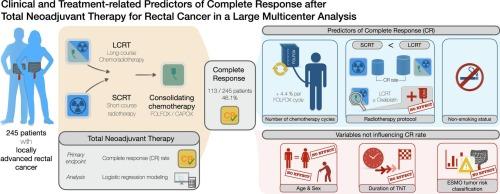
Among 245 included patients (181 men) with a median age of 62 (Q1-Q3: 54–67) years, 113 (46.1%) reached a CR. Of those, 69 (28.2%) were active smokers. Short-course radiotherapy (SCRT) was applied in 107 (43.7%) patients. Chemoradiotherapy with pyrimidine-based monotherapy or concomitant oxaliplatin was used in 65 (26.5%) and 73 (29.8%) of patients, respectively. A median of 8 (Q1-Q3: 6–9) cycles of consolidation chemotherapy was administered. The CR likelihood increased with each additional chemotherapy cycle (OR 1.19, 95%-CI: 1.04–1.38). SCRT was associated with lower CR rates (OR 0.34, 95%-CI: 0.16–0.74) compared with concomitant pyrimidine-based chemoradiotherapy. Adding concomitant oxaliplatin to 5-FU did not further increase CR rates (OR 1.06, 95%-CI: 0.50–2.27). CR was more likely in non-smokers (OR 1.92, 95%-CI: 1.03–3.57). ESMO tumor classification and treatment duration were not associated with CR.
Conclusion
More intensive TNT protocols were associated with higher CR rates. Smoking cessation may be beneficial but requires external validation.