变形-恢复扩散模型(DRDM):用于图像处理和合成的实例变形

IF 11.8 1区 医学 Q1 COMPUTER SCIENCE, ARTIFICIAL INTELLIGENCE
Medical image analysis Pub Date : 2026-05-01 Epub Date: 2026-02-11 DOI:10.1016/j.media.2026.103987
Jian-Qing Zheng , Yuanhan Mo , Yang Sun , Jiahua Li , Fuping Wu , Ziyang Wang , Tonia Vincent , Bartłomiej W Papież
{"title":"变形-恢复扩散模型(DRDM):用于图像处理和合成的实例变形","authors":"Jian-Qing Zheng ,&nbsp;Yuanhan Mo ,&nbsp;Yang Sun ,&nbsp;Jiahua Li ,&nbsp;Fuping Wu ,&nbsp;Ziyang Wang ,&nbsp;Tonia Vincent ,&nbsp;Bartłomiej W Papież","doi":"10.1016/j.media.2026.103987","DOIUrl":null,"url":null,"abstract":"<div><div>In medical imaging, diffusion models have shown great potential for synthetic image generation. However, these approaches often lack interpretable correspondence between generated and real images and can create anatomically implausible structures or illusions. To address these limitations, we propose the Deformation-Recovery Diffusion Model (DRDM), a novel diffusion-based generative model that emphasizes morphological transformation through deformation fields rather than direct image synthesis. DRDM introduces a topology-preserving deformation field generation strategy, which randomly samples and integrates multi-scale Deformation Velocity Fields (DVFs). DRDM is trained to learn to recover unrealistic deformation components, thus restoring randomly deformed images to a realistic distribution. This formulation enables the generation of diverse yet anatomically plausible deformations that preserve structural integrity, thereby improving data augmentation and synthesis for downstream tasks such as few-shot learning and image registration. Experiments on cardiac Magnetic Resonance Imaging and pulmonary Computed Tomography show that DRDM is capable of creating diverse, large-scale deformations, while maintaining anatomical plausibility of deformation fields. Additional evaluations on 2D image segmentation and 3D image registration tasks indicate notable performance gains, underscoring DRDM’s potential to enhance both image manipulation and generative modeling in medical imaging applications.</div><div>The project page: <span><span>https://jianqingzheng.github.io/def_diff_rec/</span><svg><path></path></svg></span>.</div></div>","PeriodicalId":18328,"journal":{"name":"Medical image analysis","volume":"110 ","pages":"Article 103987"},"PeriodicalIF":11.8000,"publicationDate":"2026-05-01","publicationTypes":"Journal Article","fieldsOfStudy":null,"isOpenAccess":false,"openAccessPdf":"","citationCount":"0","resultStr":"{\"title\":\"Deformation-Recovery diffusion model (DRDM): Instance deformation for image manipulation and synthesis\",\"authors\":\"Jian-Qing Zheng ,&nbsp;Yuanhan Mo ,&nbsp;Yang Sun ,&nbsp;Jiahua Li ,&nbsp;Fuping Wu ,&nbsp;Ziyang Wang ,&nbsp;Tonia Vincent ,&nbsp;Bartłomiej W Papież\",\"doi\":\"10.1016/j.media.2026.103987\",\"DOIUrl\":null,\"url\":null,\"abstract\":\"<div><div>In medical imaging, diffusion models have shown great potential for synthetic image generation. However, these approaches often lack interpretable correspondence between generated and real images and can create anatomically implausible structures or illusions. To address these limitations, we propose the Deformation-Recovery Diffusion Model (DRDM), a novel diffusion-based generative model that emphasizes morphological transformation through deformation fields rather than direct image synthesis. DRDM introduces a topology-preserving deformation field generation strategy, which randomly samples and integrates multi-scale Deformation Velocity Fields (DVFs). DRDM is trained to learn to recover unrealistic deformation components, thus restoring randomly deformed images to a realistic distribution. This formulation enables the generation of diverse yet anatomically plausible deformations that preserve structural integrity, thereby improving data augmentation and synthesis for downstream tasks such as few-shot learning and image registration. Experiments on cardiac Magnetic Resonance Imaging and pulmonary Computed Tomography show that DRDM is capable of creating diverse, large-scale deformations, while maintaining anatomical plausibility of deformation fields. Additional evaluations on 2D image segmentation and 3D image registration tasks indicate notable performance gains, underscoring DRDM’s potential to enhance both image manipulation and generative modeling in medical imaging applications.</div><div>The project page: <span><span>https://jianqingzheng.github.io/def_diff_rec/</span><svg><path></path></svg></span>.</div></div>\",\"PeriodicalId\":18328,\"journal\":{\"name\":\"Medical image analysis\",\"volume\":\"110 \",\"pages\":\"Article 103987\"},\"PeriodicalIF\":11.8000,\"publicationDate\":\"2026-05-01\",\"publicationTypes\":\"Journal Article\",\"fieldsOfStudy\":null,\"isOpenAccess\":false,\"openAccessPdf\":\"\",\"citationCount\":\"0\",\"resultStr\":null,\"platform\":\"Semanticscholar\",\"paperid\":null,\"PeriodicalName\":\"Medical image analysis\",\"FirstCategoryId\":\"5\",\"ListUrlMain\":\"https://www.sciencedirect.com/science/article/pii/S1361841526000563\",\"RegionNum\":1,\"RegionCategory\":\"医学\",\"ArticlePicture\":[],\"TitleCN\":null,\"AbstractTextCN\":null,\"PMCID\":null,\"EPubDate\":\"2026/2/11 0:00:00\",\"PubModel\":\"Epub\",\"JCR\":\"Q1\",\"JCRName\":\"COMPUTER SCIENCE, ARTIFICIAL INTELLIGENCE\",\"Score\":null,\"Total\":0}","platform":"Semanticscholar","paperid":null,"PeriodicalName":"Medical image analysis","FirstCategoryId":"5","ListUrlMain":"https://www.sciencedirect.com/science/article/pii/S1361841526000563","RegionNum":1,"RegionCategory":"医学","ArticlePicture":[],"TitleCN":null,"AbstractTextCN":null,"PMCID":null,"EPubDate":"2026/2/11 0:00:00","PubModel":"Epub","JCR":"Q1","JCRName":"COMPUTER SCIENCE, ARTIFICIAL INTELLIGENCE","Score":null,"Total":0}
引用次数: 0

摘要

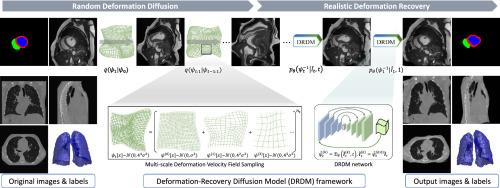
在医学成像中,扩散模型在合成图像生成方面显示出巨大的潜力。然而,这些方法通常缺乏生成图像和真实图像之间的可解释对应关系,并可能产生解剖学上难以置信的结构或错觉。为了解决这些限制,我们提出了变形-恢复扩散模型(DRDM),这是一种新的基于扩散的生成模型,强调通过变形场进行形态转换,而不是直接进行图像合成。DRDM引入了一种保持拓扑的变形场生成策略,该策略对多尺度变形速度场(deformation Velocity Fields, dvf)进行随机采样和集成。训练DRDM学习恢复不真实的变形分量,从而将随机变形的图像恢复到真实的分布。该配方能够生成多样且解剖学上合理的变形,从而保持结构完整性,从而改善下游任务(如少拍学习和图像配准)的数据增强和合成。心脏磁共振成像和肺部计算机断层扫描实验表明,DRDM能够产生多种大规模变形,同时保持变形场的解剖学合理性。对2D图像分割和3D图像配准任务的额外评估表明,性能显著提高,强调了DRDM在医学成像应用中增强图像处理和生成建模的潜力。项目页面:https://jianqingzheng.github.io/def_diff_rec/。
本文章由计算机程序翻译,如有差异,请以英文原文为准。

Deformation-Recovery diffusion model (DRDM): Instance deformation for image manipulation and synthesis

Deformation-Recovery diffusion model (DRDM): Instance deformation for image manipulation and synthesis
In medical imaging, diffusion models have shown great potential for synthetic image generation. However, these approaches often lack interpretable correspondence between generated and real images and can create anatomically implausible structures or illusions. To address these limitations, we propose the Deformation-Recovery Diffusion Model (DRDM), a novel diffusion-based generative model that emphasizes morphological transformation through deformation fields rather than direct image synthesis. DRDM introduces a topology-preserving deformation field generation strategy, which randomly samples and integrates multi-scale Deformation Velocity Fields (DVFs). DRDM is trained to learn to recover unrealistic deformation components, thus restoring randomly deformed images to a realistic distribution. This formulation enables the generation of diverse yet anatomically plausible deformations that preserve structural integrity, thereby improving data augmentation and synthesis for downstream tasks such as few-shot learning and image registration. Experiments on cardiac Magnetic Resonance Imaging and pulmonary Computed Tomography show that DRDM is capable of creating diverse, large-scale deformations, while maintaining anatomical plausibility of deformation fields. Additional evaluations on 2D image segmentation and 3D image registration tasks indicate notable performance gains, underscoring DRDM’s potential to enhance both image manipulation and generative modeling in medical imaging applications.
The project page: https://jianqingzheng.github.io/def_diff_rec/.
求助全文
通过发布文献求助,成功后即可免费获取论文全文。 去求助
来源期刊
Medical image analysis
Medical image analysis 工程技术-工程:生物医学
CiteScore
22.10
自引率
6.40%
发文量
309
审稿时长
6.6 months
期刊介绍: Medical Image Analysis serves as a platform for sharing new research findings in the realm of medical and biological image analysis, with a focus on applications of computer vision, virtual reality, and robotics to biomedical imaging challenges. The journal prioritizes the publication of high-quality, original papers contributing to the fundamental science of processing, analyzing, and utilizing medical and biological images. It welcomes approaches utilizing biomedical image datasets across all spatial scales, from molecular/cellular imaging to tissue/organ imaging.

×
引用
GB/T 7714-2015
复制
MLA
复制
APA
复制
导出至
BibTeX EndNote RefMan NoteFirst NoteExpress
×
提示
您的信息不完整,为了账户安全,请先补充。
现在去补充
×
提示
您因"违规操作"
具体请查看互助需知
我知道了
×
提示
确定
请完成安全验证×
copy
已复制链接
快去分享给好友吧!
我知道了
右上角分享
点击右上角分享
0
联系我们:info@booksci.cn Book学术提供免费学术资源搜索服务,方便国内外学者检索中英文文献。致力于提供最便捷和优质的服务体验。 Copyright © 2023 布克学术 All rights reserved.
京ICP备2023020795号-1
ghs 京公网安备 11010802042870号
Book学术文献互助
Book学术文献互助群
群 号:604180095
Book学术官方微信
小红书