{"title":"磷酸镁诱导模型膜在维生素D 2存在和不存在时的结构和动态调节:来自FTIR分析的见解","authors":"Neslihan Toyran , Feride Severcan","doi":"10.1016/j.bpc.2026.107589","DOIUrl":null,"url":null,"abstract":"<div><div>Biological membranes are complex structures whose structure and dynamics are modulated by various biomolecules, including ionic and sterol-like compounds. In this study, we investigated the molecular interactions of magnesium phosphate, in the absence and presence of vitamin D<sub>2,</sub> with simplified models of biological membranes composed of dipalmitoylphosphatidylcholine (DPPC). We aimed to elucidate their individual and combined effects on the order and dynamics (fluidity) of the hydrophobic part and the interfacial region using Fourier Transform Infrared (FTIR) spectroscopy. Our findings show that the phase transition temperature of the model membrane is not measurably affected by the presence of magnesium phosphate and/or vitamin D<sub>2</sub>. Our results also demonstrate that magnesium phosphate disrupts membrane integrity by decreasing the order of the pure DPPC and increasing the flexibility of the acyl chains in the deep interior of the bilayer, but, interestingly, it decreases membrane fluidity. These contradictory results on the order and dynamics of DPPC suggest a magnesium phosphate-induced phase separation in the membrane. Our findings also reveal that vitamin D<sub>2</sub> enhances lipid order and reduces acyl chain mobility of the pure DPPC. In the joint presence of magnesium phosphate and vitamin D<sub>2</sub>, vitamin D<sub>2</sub> counteracts the disordering effects of magnesium phosphate and restores membrane stability. Consequently, it abolishes the magnesium phosphate-induced phase separation. In addition, our findings reveal a decrease in the strength of hydrogen bonding in the interfacial region, which is explained by the presence of free carbonyl groups in all model membrane combinations. Overall, this study advances our understanding of how multivalent ion–phosphate species and hydrophobic micronutrients jointly regulate membrane organization, extending prior findings on free ion–vitamin D interactions to the less-explored case of magnesium phosphate.</div></div>","PeriodicalId":8979,"journal":{"name":"Biophysical chemistry","volume":"332 ","pages":"Article 107589"},"PeriodicalIF":2.2000,"publicationDate":"2026-05-01","publicationTypes":"Journal Article","fieldsOfStudy":null,"isOpenAccess":false,"openAccessPdf":"","citationCount":"0","resultStr":"{\"title\":\"Magnesium phosphate-induced structural and dynamic modulation of model membranes in the presence and absence of vitamin D₂: Insights from FTIR analyses\",\"authors\":\"Neslihan Toyran , Feride Severcan\",\"doi\":\"10.1016/j.bpc.2026.107589\",\"DOIUrl\":null,\"url\":null,\"abstract\":\"<div><div>Biological membranes are complex structures whose structure and dynamics are modulated by various biomolecules, including ionic and sterol-like compounds. In this study, we investigated the molecular interactions of magnesium phosphate, in the absence and presence of vitamin D<sub>2,</sub> with simplified models of biological membranes composed of dipalmitoylphosphatidylcholine (DPPC). We aimed to elucidate their individual and combined effects on the order and dynamics (fluidity) of the hydrophobic part and the interfacial region using Fourier Transform Infrared (FTIR) spectroscopy. Our findings show that the phase transition temperature of the model membrane is not measurably affected by the presence of magnesium phosphate and/or vitamin D<sub>2</sub>. Our results also demonstrate that magnesium phosphate disrupts membrane integrity by decreasing the order of the pure DPPC and increasing the flexibility of the acyl chains in the deep interior of the bilayer, but, interestingly, it decreases membrane fluidity. These contradictory results on the order and dynamics of DPPC suggest a magnesium phosphate-induced phase separation in the membrane. Our findings also reveal that vitamin D<sub>2</sub> enhances lipid order and reduces acyl chain mobility of the pure DPPC. In the joint presence of magnesium phosphate and vitamin D<sub>2</sub>, vitamin D<sub>2</sub> counteracts the disordering effects of magnesium phosphate and restores membrane stability. Consequently, it abolishes the magnesium phosphate-induced phase separation. In addition, our findings reveal a decrease in the strength of hydrogen bonding in the interfacial region, which is explained by the presence of free carbonyl groups in all model membrane combinations. Overall, this study advances our understanding of how multivalent ion–phosphate species and hydrophobic micronutrients jointly regulate membrane organization, extending prior findings on free ion–vitamin D interactions to the less-explored case of magnesium phosphate.</div></div>\",\"PeriodicalId\":8979,\"journal\":{\"name\":\"Biophysical chemistry\",\"volume\":\"332 \",\"pages\":\"Article 107589\"},\"PeriodicalIF\":2.2000,\"publicationDate\":\"2026-05-01\",\"publicationTypes\":\"Journal Article\",\"fieldsOfStudy\":null,\"isOpenAccess\":false,\"openAccessPdf\":\"\",\"citationCount\":\"0\",\"resultStr\":null,\"platform\":\"Semanticscholar\",\"paperid\":null,\"PeriodicalName\":\"Biophysical chemistry\",\"FirstCategoryId\":\"99\",\"ListUrlMain\":\"https://www.sciencedirect.com/science/article/pii/S0301462226000220\",\"RegionNum\":3,\"RegionCategory\":\"生物学\",\"ArticlePicture\":[],\"TitleCN\":null,\"AbstractTextCN\":null,\"PMCID\":null,\"EPubDate\":\"2026/2/4 0:00:00\",\"PubModel\":\"Epub\",\"JCR\":\"Q2\",\"JCRName\":\"BIOCHEMISTRY & MOLECULAR BIOLOGY\",\"Score\":null,\"Total\":0}","platform":"Semanticscholar","paperid":null,"PeriodicalName":"Biophysical chemistry","FirstCategoryId":"99","ListUrlMain":"https://www.sciencedirect.com/science/article/pii/S0301462226000220","RegionNum":3,"RegionCategory":"生物学","ArticlePicture":[],"TitleCN":null,"AbstractTextCN":null,"PMCID":null,"EPubDate":"2026/2/4 0:00:00","PubModel":"Epub","JCR":"Q2","JCRName":"BIOCHEMISTRY & MOLECULAR BIOLOGY","Score":null,"Total":0}
Magnesium phosphate-induced structural and dynamic modulation of model membranes in the presence and absence of vitamin D₂: Insights from FTIR analyses
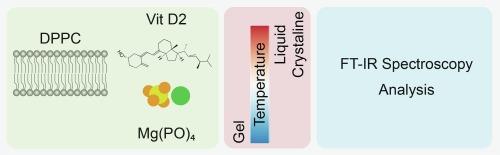
Biological membranes are complex structures whose structure and dynamics are modulated by various biomolecules, including ionic and sterol-like compounds. In this study, we investigated the molecular interactions of magnesium phosphate, in the absence and presence of vitamin D2, with simplified models of biological membranes composed of dipalmitoylphosphatidylcholine (DPPC). We aimed to elucidate their individual and combined effects on the order and dynamics (fluidity) of the hydrophobic part and the interfacial region using Fourier Transform Infrared (FTIR) spectroscopy. Our findings show that the phase transition temperature of the model membrane is not measurably affected by the presence of magnesium phosphate and/or vitamin D2. Our results also demonstrate that magnesium phosphate disrupts membrane integrity by decreasing the order of the pure DPPC and increasing the flexibility of the acyl chains in the deep interior of the bilayer, but, interestingly, it decreases membrane fluidity. These contradictory results on the order and dynamics of DPPC suggest a magnesium phosphate-induced phase separation in the membrane. Our findings also reveal that vitamin D2 enhances lipid order and reduces acyl chain mobility of the pure DPPC. In the joint presence of magnesium phosphate and vitamin D2, vitamin D2 counteracts the disordering effects of magnesium phosphate and restores membrane stability. Consequently, it abolishes the magnesium phosphate-induced phase separation. In addition, our findings reveal a decrease in the strength of hydrogen bonding in the interfacial region, which is explained by the presence of free carbonyl groups in all model membrane combinations. Overall, this study advances our understanding of how multivalent ion–phosphate species and hydrophobic micronutrients jointly regulate membrane organization, extending prior findings on free ion–vitamin D interactions to the less-explored case of magnesium phosphate.
期刊介绍:
Biophysical Chemistry publishes original work and reviews in the areas of chemistry and physics directly impacting biological phenomena. Quantitative analysis of the properties of biological macromolecules, biologically active molecules, macromolecular assemblies and cell components in terms of kinetics, thermodynamics, spatio-temporal organization, NMR and X-ray structural biology, as well as single-molecule detection represent a major focus of the journal. Theoretical and computational treatments of biomacromolecular systems, macromolecular interactions, regulatory control and systems biology are also of interest to the journal.