Pablo Bastante, , , Ross J. Davidson, , , Yahia Chelli, , , Abdalghani H. S. Daaoub, , , Pilar Cea, , , Santiago Martin, , , Andrei S. Batsanov, , , Sara Sangtarash, , , Hatef Sadeghi*, , , Martin R. Bryce*, , and , Nicolas Agrait*,
{"title":"金属(N^C^N)Cl配位配合物(金属= Pt, Pd)在单分子结中多电导通路的实验与理论研究","authors":"Pablo Bastante, , , Ross J. Davidson, , , Yahia Chelli, , , Abdalghani H. S. Daaoub, , , Pilar Cea, , , Santiago Martin, , , Andrei S. Batsanov, , , Sara Sangtarash, , , Hatef Sadeghi*, , , Martin R. Bryce*, , and , Nicolas Agrait*, ","doi":"10.1021/acs.jpcc.5c07119","DOIUrl":null,"url":null,"abstract":"<p >The present work provides insight into the effect of connectivity within isomeric 3,5-bis(pyridin-2-yl)phenyl (N^C^N) platinum and palladium complexes on their electron transmission properties within gold|molecule|gold junctions. The ligands 3,5-bis(4-(methylthio)pyridin-2-yl)phenyl hexanoate (<b>L</b><sup><b>m</b></sup>H) and 3,5-bis(5-(methylthio)pyridin-2-yl)phenyl hexanoate (<b>L</b><sup><b>p</b></sup>H) were synthesized and coordinated with either PtCl or PdCl to form complexes <b>Pt</b><sup><b>m</b></sup>, <b>Pt</b><sup><b>p</b></sup>, <b>Pd</b><sup><b>m</b></sup> and <b>Pd</b><sup><b>p</b></sup>. X-ray photoelectron spectroscopy (XPS) measurements evaluated the contacting modes of the molecules in the junctions. A combination of scanning tunneling microscopy-break junction (STM-BJ) measurements and density functional theory (DFT) calculations demonstrate that for the single-molecule S···S contacted junctions metal coordination enhanced the conductance compared with the free ligands. Notably, the higher degree of orbital mixing between the metal center and the ligand π-orbitals in the metal complexes plays a greater role than quantum interference to the extent that the complexes that incorporate ligands substituted with thiomethyl groups in <i>meta</i> positions relative to the pyridine-benzene linkages have a higher conductance than their <i>para</i>-analogs, e.g., <b>Pt</b><sup><b>p</b></sup> −3.8 log(<i>G</i>/<i>G</i><sub>0</sub>) and <b>Pt</b><sup><b>m</b></sup> −3.3 log(<i>G</i>/<i>G</i><sub>0</sub>), in contrast to the usual conductance trend (<i>para</i> > <i>meta</i>) for purely organic π-electron systems.</p>","PeriodicalId":61,"journal":{"name":"The Journal of Physical Chemistry C","volume":"130 7","pages":"2763–2772"},"PeriodicalIF":3.2000,"publicationDate":"2026-02-06","publicationTypes":"Journal Article","fieldsOfStudy":null,"isOpenAccess":false,"openAccessPdf":"https://pubs.acs.org/doi/pdf/10.1021/acs.jpcc.5c07119","citationCount":"0","resultStr":"{\"title\":\"Experimental and Theoretical Studies of Isomeric Metal (N^C^N)Cl Coordination Complexes (Metal = Pt, Pd) with Multiple Conductance Pathways in Single-Molecule Junctions\",\"authors\":\"Pablo Bastante, , , Ross J. Davidson, , , Yahia Chelli, , , Abdalghani H. S. Daaoub, , , Pilar Cea, , , Santiago Martin, , , Andrei S. Batsanov, , , Sara Sangtarash, , , Hatef Sadeghi*, , , Martin R. Bryce*, , and , Nicolas Agrait*, \",\"doi\":\"10.1021/acs.jpcc.5c07119\",\"DOIUrl\":null,\"url\":null,\"abstract\":\"<p >The present work provides insight into the effect of connectivity within isomeric 3,5-bis(pyridin-2-yl)phenyl (N^C^N) platinum and palladium complexes on their electron transmission properties within gold|molecule|gold junctions. The ligands 3,5-bis(4-(methylthio)pyridin-2-yl)phenyl hexanoate (<b>L</b><sup><b>m</b></sup>H) and 3,5-bis(5-(methylthio)pyridin-2-yl)phenyl hexanoate (<b>L</b><sup><b>p</b></sup>H) were synthesized and coordinated with either PtCl or PdCl to form complexes <b>Pt</b><sup><b>m</b></sup>, <b>Pt</b><sup><b>p</b></sup>, <b>Pd</b><sup><b>m</b></sup> and <b>Pd</b><sup><b>p</b></sup>. X-ray photoelectron spectroscopy (XPS) measurements evaluated the contacting modes of the molecules in the junctions. A combination of scanning tunneling microscopy-break junction (STM-BJ) measurements and density functional theory (DFT) calculations demonstrate that for the single-molecule S···S contacted junctions metal coordination enhanced the conductance compared with the free ligands. Notably, the higher degree of orbital mixing between the metal center and the ligand π-orbitals in the metal complexes plays a greater role than quantum interference to the extent that the complexes that incorporate ligands substituted with thiomethyl groups in <i>meta</i> positions relative to the pyridine-benzene linkages have a higher conductance than their <i>para</i>-analogs, e.g., <b>Pt</b><sup><b>p</b></sup> −3.8 log(<i>G</i>/<i>G</i><sub>0</sub>) and <b>Pt</b><sup><b>m</b></sup> −3.3 log(<i>G</i>/<i>G</i><sub>0</sub>), in contrast to the usual conductance trend (<i>para</i> > <i>meta</i>) for purely organic π-electron systems.</p>\",\"PeriodicalId\":61,\"journal\":{\"name\":\"The Journal of Physical Chemistry C\",\"volume\":\"130 7\",\"pages\":\"2763–2772\"},\"PeriodicalIF\":3.2000,\"publicationDate\":\"2026-02-06\",\"publicationTypes\":\"Journal Article\",\"fieldsOfStudy\":null,\"isOpenAccess\":false,\"openAccessPdf\":\"https://pubs.acs.org/doi/pdf/10.1021/acs.jpcc.5c07119\",\"citationCount\":\"0\",\"resultStr\":null,\"platform\":\"Semanticscholar\",\"paperid\":null,\"PeriodicalName\":\"The Journal of Physical Chemistry C\",\"FirstCategoryId\":\"1\",\"ListUrlMain\":\"https://pubs.acs.org/doi/10.1021/acs.jpcc.5c07119\",\"RegionNum\":3,\"RegionCategory\":\"化学\",\"ArticlePicture\":[],\"TitleCN\":null,\"AbstractTextCN\":null,\"PMCID\":null,\"EPubDate\":\"\",\"PubModel\":\"\",\"JCR\":\"Q2\",\"JCRName\":\"CHEMISTRY, PHYSICAL\",\"Score\":null,\"Total\":0}","platform":"Semanticscholar","paperid":null,"PeriodicalName":"The Journal of Physical Chemistry C","FirstCategoryId":"1","ListUrlMain":"https://pubs.acs.org/doi/10.1021/acs.jpcc.5c07119","RegionNum":3,"RegionCategory":"化学","ArticlePicture":[],"TitleCN":null,"AbstractTextCN":null,"PMCID":null,"EPubDate":"","PubModel":"","JCR":"Q2","JCRName":"CHEMISTRY, PHYSICAL","Score":null,"Total":0}
Experimental and Theoretical Studies of Isomeric Metal (N^C^N)Cl Coordination Complexes (Metal = Pt, Pd) with Multiple Conductance Pathways in Single-Molecule Junctions
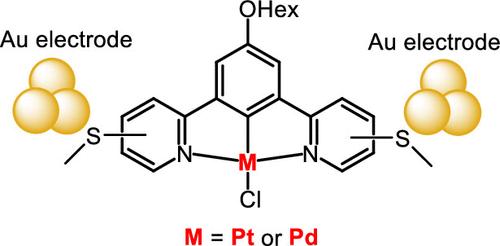
The present work provides insight into the effect of connectivity within isomeric 3,5-bis(pyridin-2-yl)phenyl (N^C^N) platinum and palladium complexes on their electron transmission properties within gold|molecule|gold junctions. The ligands 3,5-bis(4-(methylthio)pyridin-2-yl)phenyl hexanoate (LmH) and 3,5-bis(5-(methylthio)pyridin-2-yl)phenyl hexanoate (LpH) were synthesized and coordinated with either PtCl or PdCl to form complexes Ptm, Ptp, Pdm and Pdp. X-ray photoelectron spectroscopy (XPS) measurements evaluated the contacting modes of the molecules in the junctions. A combination of scanning tunneling microscopy-break junction (STM-BJ) measurements and density functional theory (DFT) calculations demonstrate that for the single-molecule S···S contacted junctions metal coordination enhanced the conductance compared with the free ligands. Notably, the higher degree of orbital mixing between the metal center and the ligand π-orbitals in the metal complexes plays a greater role than quantum interference to the extent that the complexes that incorporate ligands substituted with thiomethyl groups in meta positions relative to the pyridine-benzene linkages have a higher conductance than their para-analogs, e.g., Ptp −3.8 log(G/G0) and Ptm −3.3 log(G/G0), in contrast to the usual conductance trend (para > meta) for purely organic π-electron systems.
期刊介绍:
The Journal of Physical Chemistry A/B/C is devoted to reporting new and original experimental and theoretical basic research of interest to physical chemists, biophysical chemists, and chemical physicists.

 求助内容:
求助内容: 应助结果提醒方式:

 京公网安备 11010802042870号


