Rehin Sulay, Sneha Anna Sunny, S. Bushramol, A. N. Arshana, Abdullah Yahya Abdullah Alzahrani, Renjith Thomas
{"title":"聚乳酸的水合蓝图:预测生物降解的非共价相互作用的计算解码。","authors":"Rehin Sulay, Sneha Anna Sunny, S. Bushramol, A. N. Arshana, Abdullah Yahya Abdullah Alzahrani, Renjith Thomas","doi":"10.1002/jcc.70322","DOIUrl":null,"url":null,"abstract":"<div>\n \n <p>The biodegradation of polylactic acid (PLA) is essentially controlled by its interaction with water although little is known about the molecular-level mechanisms that trigger hydrolysis. This limitation hinders the rational design of polymers with desired degradation kinetics. In this work, we unveil the hydration-induced degradation of PLA using a multilevel computational approach, combining DFT with M06-2X functional and cc-pVDZ basis set along with the estimation of solvent effect using solvation model density (SMD), natural bond orbital (NBO) analysis, noncovalent interaction (NCI) index and Quantum Theory of Atoms in Molecules (QTAIM). Our findings demonstrate that the aqueous stability of PLA is determined by a delicate interplay between opposing forces: strong, directional hydrogen bonds to water carbonyls complemented by widespread van der Waals interactions, which in turn are partly countered by intrinsic steric repulsion within the polymer. The AIM analysis finds that all hydrogen bonds are quantitatively classified as weak, closed-shell interactions and thus exhibit an electrostatic character of the hydration network. In addition, AIMD simulations provide insights into the early-stage process of hydrolytic chain scission, revealing a proton transfer facilitated by water and an ester bond cleavage. Supported by molecular docking, key microbial enzymes are identified and binding affinities (up to −5.8 kcal mol<sup>−1</sup>) transpire through comprehensive hydrogen bonding networks. The work offers a first-ever electronic-level blueprint of PLA, providing a mechanistic basis for predictions of degradation kinetics and aiding in the design of the next generation of environmentally benign degradable polymers. By unmasking the molecular inception of water-induced PLA degradation, this study demonstrates coherent tuning of polymer stability as well as lifetime. The insights provide the design and development of next-generation biodegradable polymers with regulated breakdown behavior for industrial and environmental interests.</p>\n </div>","PeriodicalId":188,"journal":{"name":"Journal of Computational Chemistry","volume":"47 4","pages":""},"PeriodicalIF":4.8000,"publicationDate":"2026-02-02","publicationTypes":"Journal Article","fieldsOfStudy":null,"isOpenAccess":false,"openAccessPdf":"","citationCount":"0","resultStr":"{\"title\":\"The Hydration Blueprint of Polylactic Acid: Computational Decoding of Noncovalent Interactions for Predictive Biodegradation\",\"authors\":\"Rehin Sulay, Sneha Anna Sunny, S. Bushramol, A. N. Arshana, Abdullah Yahya Abdullah Alzahrani, Renjith Thomas\",\"doi\":\"10.1002/jcc.70322\",\"DOIUrl\":null,\"url\":null,\"abstract\":\"<div>\\n \\n <p>The biodegradation of polylactic acid (PLA) is essentially controlled by its interaction with water although little is known about the molecular-level mechanisms that trigger hydrolysis. This limitation hinders the rational design of polymers with desired degradation kinetics. In this work, we unveil the hydration-induced degradation of PLA using a multilevel computational approach, combining DFT with M06-2X functional and cc-pVDZ basis set along with the estimation of solvent effect using solvation model density (SMD), natural bond orbital (NBO) analysis, noncovalent interaction (NCI) index and Quantum Theory of Atoms in Molecules (QTAIM). Our findings demonstrate that the aqueous stability of PLA is determined by a delicate interplay between opposing forces: strong, directional hydrogen bonds to water carbonyls complemented by widespread van der Waals interactions, which in turn are partly countered by intrinsic steric repulsion within the polymer. The AIM analysis finds that all hydrogen bonds are quantitatively classified as weak, closed-shell interactions and thus exhibit an electrostatic character of the hydration network. In addition, AIMD simulations provide insights into the early-stage process of hydrolytic chain scission, revealing a proton transfer facilitated by water and an ester bond cleavage. Supported by molecular docking, key microbial enzymes are identified and binding affinities (up to −5.8 kcal mol<sup>−1</sup>) transpire through comprehensive hydrogen bonding networks. The work offers a first-ever electronic-level blueprint of PLA, providing a mechanistic basis for predictions of degradation kinetics and aiding in the design of the next generation of environmentally benign degradable polymers. By unmasking the molecular inception of water-induced PLA degradation, this study demonstrates coherent tuning of polymer stability as well as lifetime. The insights provide the design and development of next-generation biodegradable polymers with regulated breakdown behavior for industrial and environmental interests.</p>\\n </div>\",\"PeriodicalId\":188,\"journal\":{\"name\":\"Journal of Computational Chemistry\",\"volume\":\"47 4\",\"pages\":\"\"},\"PeriodicalIF\":4.8000,\"publicationDate\":\"2026-02-02\",\"publicationTypes\":\"Journal Article\",\"fieldsOfStudy\":null,\"isOpenAccess\":false,\"openAccessPdf\":\"\",\"citationCount\":\"0\",\"resultStr\":null,\"platform\":\"Semanticscholar\",\"paperid\":null,\"PeriodicalName\":\"Journal of Computational Chemistry\",\"FirstCategoryId\":\"92\",\"ListUrlMain\":\"https://onlinelibrary.wiley.com/doi/10.1002/jcc.70322\",\"RegionNum\":3,\"RegionCategory\":\"化学\",\"ArticlePicture\":[],\"TitleCN\":null,\"AbstractTextCN\":null,\"PMCID\":null,\"EPubDate\":\"\",\"PubModel\":\"\",\"JCR\":\"Q2\",\"JCRName\":\"CHEMISTRY, MULTIDISCIPLINARY\",\"Score\":null,\"Total\":0}","platform":"Semanticscholar","paperid":null,"PeriodicalName":"Journal of Computational Chemistry","FirstCategoryId":"92","ListUrlMain":"https://onlinelibrary.wiley.com/doi/10.1002/jcc.70322","RegionNum":3,"RegionCategory":"化学","ArticlePicture":[],"TitleCN":null,"AbstractTextCN":null,"PMCID":null,"EPubDate":"","PubModel":"","JCR":"Q2","JCRName":"CHEMISTRY, MULTIDISCIPLINARY","Score":null,"Total":0}
The Hydration Blueprint of Polylactic Acid: Computational Decoding of Noncovalent Interactions for Predictive Biodegradation
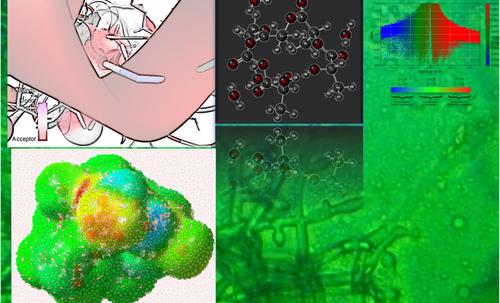
The biodegradation of polylactic acid (PLA) is essentially controlled by its interaction with water although little is known about the molecular-level mechanisms that trigger hydrolysis. This limitation hinders the rational design of polymers with desired degradation kinetics. In this work, we unveil the hydration-induced degradation of PLA using a multilevel computational approach, combining DFT with M06-2X functional and cc-pVDZ basis set along with the estimation of solvent effect using solvation model density (SMD), natural bond orbital (NBO) analysis, noncovalent interaction (NCI) index and Quantum Theory of Atoms in Molecules (QTAIM). Our findings demonstrate that the aqueous stability of PLA is determined by a delicate interplay between opposing forces: strong, directional hydrogen bonds to water carbonyls complemented by widespread van der Waals interactions, which in turn are partly countered by intrinsic steric repulsion within the polymer. The AIM analysis finds that all hydrogen bonds are quantitatively classified as weak, closed-shell interactions and thus exhibit an electrostatic character of the hydration network. In addition, AIMD simulations provide insights into the early-stage process of hydrolytic chain scission, revealing a proton transfer facilitated by water and an ester bond cleavage. Supported by molecular docking, key microbial enzymes are identified and binding affinities (up to −5.8 kcal mol−1) transpire through comprehensive hydrogen bonding networks. The work offers a first-ever electronic-level blueprint of PLA, providing a mechanistic basis for predictions of degradation kinetics and aiding in the design of the next generation of environmentally benign degradable polymers. By unmasking the molecular inception of water-induced PLA degradation, this study demonstrates coherent tuning of polymer stability as well as lifetime. The insights provide the design and development of next-generation biodegradable polymers with regulated breakdown behavior for industrial and environmental interests.
期刊介绍:
This distinguished journal publishes articles concerned with all aspects of computational chemistry: analytical, biological, inorganic, organic, physical, and materials. The Journal of Computational Chemistry presents original research, contemporary developments in theory and methodology, and state-of-the-art applications. Computational areas that are featured in the journal include ab initio and semiempirical quantum mechanics, density functional theory, molecular mechanics, molecular dynamics, statistical mechanics, cheminformatics, biomolecular structure prediction, molecular design, and bioinformatics.





 求助内容:
求助内容: 应助结果提醒方式:

 京公网安备 11010802042870号


