锂离子电池生态友好型富镍阴极浆料系统的最新进展与挑战

IF 13.5 2区 化学 Q1 CHEMISTRY, PHYSICAL
物理化学学报 Pub Date : 2026-04-01 Epub Date: 2025-11-20 DOI:10.1016/j.actphy.2025.100222
Rongrong Wang , Chen Li , Xiang Ren , Keliang Zhang , Yu Sun , Xianzhong Sun , Kai Wang , Xiong Zhang , Yanwei Ma
{"title":"锂离子电池生态友好型富镍阴极浆料系统的最新进展与挑战","authors":"Rongrong Wang ,&nbsp;Chen Li ,&nbsp;Xiang Ren ,&nbsp;Keliang Zhang ,&nbsp;Yu Sun ,&nbsp;Xianzhong Sun ,&nbsp;Kai Wang ,&nbsp;Xiong Zhang ,&nbsp;Yanwei Ma","doi":"10.1016/j.actphy.2025.100222","DOIUrl":null,"url":null,"abstract":"<div><div>Ni-rich layered cathodes have become the mainstream choice to meet the growing demand for high-energy lithium-ion batteries (LIBs), which typically involves the use of highly polar <em>N</em>-methyl-2-pyrrolidone (NMP) to dissolve polymeric binders and form rheologically stable slurries for strong mechanical adhesion within the electrode. However, growing health and environmental concerns over NMP have triggered increasingly stringent regulations for sustainable development of LIB industries, thereby accelerating a long-overdue paradigm shift toward greener and safer solvent systems. In this context, this review first establishes a comprehensive theoretical framework for green solvent selection and slurry evaluation, including key concepts of solvent-binder compatibility, such as solubility theory, Hansen solubility parameters, Flory-Huggins interactions, and rheological characterization. Subsequently, the review highlights recent research progress in the development of green solvent-based slurries, covering a variety of solvent systems such as lactones, sulfoxides, phosphates, amides, and bio-based alternatives. Special emphasis is placed on elucidating how the processing behavior of green slurry influences the architecture of electrodes and determines their key performance indicators. Binder solubility, dispersion stability, rheological properties, and drying dynamics are analyzed in relation to their effects on electrode morphology, mechanical cohesion, capacity retention, and cycling stability. Despite encouraging laboratory results, these green slurry systems still face several practical barriers, including incomplete binder dissolution, binder migration during drying, and limited adaptability to high-solid-content formulations and accelerated drying protocols. To address these challenges, this review also proposes corresponding mitigation strategies and design recommendations, including thermodynamic-based solvent screening, rheological optimization, and drying kinetics control tailored to Ni-rich electrode systems. Finally, by integrating the latest advances in artificial intelligence, this review outlines future directions for predictable green slurry systems enabled by techniques such as machine learning-assisted solubility prediction, data-driven rheology modeling, and numerical model-enhanced drying simulations. By combining classical theoretical insights with advanced computational strategies, this review is expected to provide new perspectives for the sustainable manufacturing of next-generation high-energy batteries.</div></div>","PeriodicalId":6964,"journal":{"name":"物理化学学报","volume":"42 4","pages":"Article 100222"},"PeriodicalIF":13.5000,"publicationDate":"2026-04-01","publicationTypes":"Journal Article","fieldsOfStudy":null,"isOpenAccess":false,"openAccessPdf":"","citationCount":"0","resultStr":"{\"title\":\"Recent advances and challenges of eco-friendly Ni-rich cathode slurry systems in lithium-ion batteries\",\"authors\":\"Rongrong Wang ,&nbsp;Chen Li ,&nbsp;Xiang Ren ,&nbsp;Keliang Zhang ,&nbsp;Yu Sun ,&nbsp;Xianzhong Sun ,&nbsp;Kai Wang ,&nbsp;Xiong Zhang ,&nbsp;Yanwei Ma\",\"doi\":\"10.1016/j.actphy.2025.100222\",\"DOIUrl\":null,\"url\":null,\"abstract\":\"<div><div>Ni-rich layered cathodes have become the mainstream choice to meet the growing demand for high-energy lithium-ion batteries (LIBs), which typically involves the use of highly polar <em>N</em>-methyl-2-pyrrolidone (NMP) to dissolve polymeric binders and form rheologically stable slurries for strong mechanical adhesion within the electrode. However, growing health and environmental concerns over NMP have triggered increasingly stringent regulations for sustainable development of LIB industries, thereby accelerating a long-overdue paradigm shift toward greener and safer solvent systems. In this context, this review first establishes a comprehensive theoretical framework for green solvent selection and slurry evaluation, including key concepts of solvent-binder compatibility, such as solubility theory, Hansen solubility parameters, Flory-Huggins interactions, and rheological characterization. Subsequently, the review highlights recent research progress in the development of green solvent-based slurries, covering a variety of solvent systems such as lactones, sulfoxides, phosphates, amides, and bio-based alternatives. Special emphasis is placed on elucidating how the processing behavior of green slurry influences the architecture of electrodes and determines their key performance indicators. Binder solubility, dispersion stability, rheological properties, and drying dynamics are analyzed in relation to their effects on electrode morphology, mechanical cohesion, capacity retention, and cycling stability. Despite encouraging laboratory results, these green slurry systems still face several practical barriers, including incomplete binder dissolution, binder migration during drying, and limited adaptability to high-solid-content formulations and accelerated drying protocols. To address these challenges, this review also proposes corresponding mitigation strategies and design recommendations, including thermodynamic-based solvent screening, rheological optimization, and drying kinetics control tailored to Ni-rich electrode systems. Finally, by integrating the latest advances in artificial intelligence, this review outlines future directions for predictable green slurry systems enabled by techniques such as machine learning-assisted solubility prediction, data-driven rheology modeling, and numerical model-enhanced drying simulations. By combining classical theoretical insights with advanced computational strategies, this review is expected to provide new perspectives for the sustainable manufacturing of next-generation high-energy batteries.</div></div>\",\"PeriodicalId\":6964,\"journal\":{\"name\":\"物理化学学报\",\"volume\":\"42 4\",\"pages\":\"Article 100222\"},\"PeriodicalIF\":13.5000,\"publicationDate\":\"2026-04-01\",\"publicationTypes\":\"Journal Article\",\"fieldsOfStudy\":null,\"isOpenAccess\":false,\"openAccessPdf\":\"\",\"citationCount\":\"0\",\"resultStr\":null,\"platform\":\"Semanticscholar\",\"paperid\":null,\"PeriodicalName\":\"物理化学学报\",\"FirstCategoryId\":\"92\",\"ListUrlMain\":\"https://www.sciencedirect.com/science/article/pii/S100068182500178X\",\"RegionNum\":2,\"RegionCategory\":\"化学\",\"ArticlePicture\":[],\"TitleCN\":null,\"AbstractTextCN\":null,\"PMCID\":null,\"EPubDate\":\"2025/11/20 0:00:00\",\"PubModel\":\"Epub\",\"JCR\":\"Q1\",\"JCRName\":\"CHEMISTRY, PHYSICAL\",\"Score\":null,\"Total\":0}","platform":"Semanticscholar","paperid":null,"PeriodicalName":"物理化学学报","FirstCategoryId":"92","ListUrlMain":"https://www.sciencedirect.com/science/article/pii/S100068182500178X","RegionNum":2,"RegionCategory":"化学","ArticlePicture":[],"TitleCN":null,"AbstractTextCN":null,"PMCID":null,"EPubDate":"2025/11/20 0:00:00","PubModel":"Epub","JCR":"Q1","JCRName":"CHEMISTRY, PHYSICAL","Score":null,"Total":0}
引用次数: 0

摘要

富镍层状阴极已成为满足高能锂离子电池(lib)日益增长的需求的主流选择,这通常涉及使用高极性n -甲基-2-吡罗烷酮(NMP)来溶解聚合物粘合剂并形成流变稳定的浆料,从而在电极内形成强机械粘附。然而,对NMP日益增长的健康和环境担忧引发了LIB行业可持续发展的越来越严格的法规,从而加速了向更环保、更安全的溶剂系统的长期范式转变。在此背景下,本文首先建立了绿色溶剂选择和浆料评价的综合理论框架,包括溶剂-粘合剂相容性的关键概念,如溶解度理论、Hansen溶解度参数、Flory-Huggins相互作用和流变表征。随后,综述了绿色溶剂基浆料的最新研究进展,涵盖了各种溶剂体系,如内酯、亚砜、磷酸盐、酰胺和生物基替代品。特别强调的是阐明绿色浆液的处理行为如何影响电极的结构并决定其关键性能指标。结合剂的溶解度、分散稳定性、流变性能和干燥动力学分析了它们对电极形态、机械内聚、容量保持和循环稳定性的影响。尽管实验结果令人鼓舞,但这些绿色浆液体系仍然面临着一些实际障碍,包括粘合剂溶解不完全、干燥过程中粘合剂迁移、对高固含量配方和加速干燥方案的适应性有限。为了应对这些挑战,本综述还提出了相应的缓解策略和设计建议,包括基于热力学的溶剂筛选、流变学优化和针对富镍电极系统的干燥动力学控制。最后,通过整合人工智能的最新进展,本文概述了可预测的绿色泥浆系统的未来发展方向,这些系统由机器学习辅助的溶解度预测、数据驱动的流变建模和数值模型增强的干燥模拟等技术实现。通过将经典的理论见解与先进的计算策略相结合,本综述有望为下一代高能电池的可持续制造提供新的视角。
本文章由计算机程序翻译,如有差异,请以英文原文为准。

Recent advances and challenges of eco-friendly Ni-rich cathode slurry systems in lithium-ion batteries

Recent advances and challenges of eco-friendly Ni-rich cathode slurry systems in lithium-ion batteries
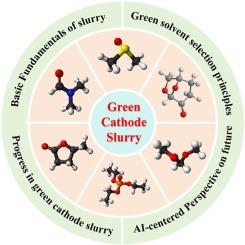
Ni-rich layered cathodes have become the mainstream choice to meet the growing demand for high-energy lithium-ion batteries (LIBs), which typically involves the use of highly polar N-methyl-2-pyrrolidone (NMP) to dissolve polymeric binders and form rheologically stable slurries for strong mechanical adhesion within the electrode. However, growing health and environmental concerns over NMP have triggered increasingly stringent regulations for sustainable development of LIB industries, thereby accelerating a long-overdue paradigm shift toward greener and safer solvent systems. In this context, this review first establishes a comprehensive theoretical framework for green solvent selection and slurry evaluation, including key concepts of solvent-binder compatibility, such as solubility theory, Hansen solubility parameters, Flory-Huggins interactions, and rheological characterization. Subsequently, the review highlights recent research progress in the development of green solvent-based slurries, covering a variety of solvent systems such as lactones, sulfoxides, phosphates, amides, and bio-based alternatives. Special emphasis is placed on elucidating how the processing behavior of green slurry influences the architecture of electrodes and determines their key performance indicators. Binder solubility, dispersion stability, rheological properties, and drying dynamics are analyzed in relation to their effects on electrode morphology, mechanical cohesion, capacity retention, and cycling stability. Despite encouraging laboratory results, these green slurry systems still face several practical barriers, including incomplete binder dissolution, binder migration during drying, and limited adaptability to high-solid-content formulations and accelerated drying protocols. To address these challenges, this review also proposes corresponding mitigation strategies and design recommendations, including thermodynamic-based solvent screening, rheological optimization, and drying kinetics control tailored to Ni-rich electrode systems. Finally, by integrating the latest advances in artificial intelligence, this review outlines future directions for predictable green slurry systems enabled by techniques such as machine learning-assisted solubility prediction, data-driven rheology modeling, and numerical model-enhanced drying simulations. By combining classical theoretical insights with advanced computational strategies, this review is expected to provide new perspectives for the sustainable manufacturing of next-generation high-energy batteries.
求助全文
通过发布文献求助,成功后即可免费获取论文全文。 去求助
来源期刊
物理化学学报
物理化学学报 化学-物理化学
CiteScore
16.60
自引率
5.50%
发文量
9754
审稿时长
1.2 months
期刊介绍:
×
引用
GB/T 7714-2015
复制
MLA
复制
APA
复制
导出至
BibTeX EndNote RefMan NoteFirst NoteExpress
×
提示
您的信息不完整,为了账户安全,请先补充。
现在去补充
×
提示
您因"违规操作"
具体请查看互助需知
我知道了
×
提示
确定
请完成安全验证×
copy
已复制链接
快去分享给好友吧!
我知道了
右上角分享
点击右上角分享
0
联系我们:info@booksci.cn Book学术提供免费学术资源搜索服务,方便国内外学者检索中英文文献。致力于提供最便捷和优质的服务体验。 Copyright © 2023 布克学术 All rights reserved.
京ICP备2023020795号-1
ghs 京公网安备 11010802042870号
Book学术文献互助
Book学术文献互助群
群 号:604180095
Book学术官方微信
小红书