{"title":"利用中药开发抗病毒药物:一种对抗人偏肺病毒(HMPV)的计算方法","authors":"Amit Dubey , Manish Kumar , Aisha Tufail , Vivek Dhar Dwivedi","doi":"10.1016/j.jmgm.2026.109290","DOIUrl":null,"url":null,"abstract":"<div><div>Human metapneumovirus (HMPV) remains a major respiratory pathogen without approved antivirals, highlighting the urgent need for novel therapeutics. This study implemented an integrative computational pipeline combining virtual screening, molecular docking, 2 μs molecular dynamics (MD) simulations, density functional theory (DFT), pharmacophore modeling, and ADMET profiling to identify potent HMPV inhibitors from Traditional Chinese Medicine. Among 180 screened phytoconstituents, <strong>glycyrrhizin (–9.3 kcal mol<sup>−1</sup>)</strong>, <strong>hesperidin (–9.1 kcal mol<sup>−1</sup>)</strong>, and <strong>saikosaponins (–9.0 kcal mol<sup>−1</sup>)</strong> exhibited strong binding affinities toward the HMPV matrix protein (<strong>PDB ID: 5WB0</strong>). Extended MD simulations confirmed complex stability with <strong>RMSD 0.17</strong>–<strong>0.22 nm</strong>, average of <strong>3</strong>–<strong>5 persistent H-bonds</strong>, and <strong>DCCM correlation coefficient = 0.86</strong> for glycyrrhizin. <strong>MM-PBSA</strong> binding free energies (ΔG_bind) of <strong>–46.2 ± 2.5</strong>, <strong>–44.7 ± 2.8</strong>, and <strong>–43.9 ± 2.2 kJ mol<sup>−1</sup></strong> for glycyrrhizin, hesperidin, and oseltamivir respectively, validated strong and stable interactions. <strong>DFT</strong> results indicated favorable electronic reactivity (HOMO–LUMO gap = 3.86 eV; electrophilicity = 2.74 eV), enhancing ligand-target complementarity. <strong>ADMET</strong> analysis predicted low systemic toxicity (<strong>LD<sub>50</sub></strong> <strong>= 380</strong>–<strong>530 mg kg<sup>−1</sup></strong>) but revealed moderate <strong>CYP3A4/CYP2C9 inhibition</strong>, suggesting the need for metabolic stability evaluation. Compared with reported fusion inhibitors such as EGCG and rutin, this <strong>matrix-targeted strategy</strong> introduces a distinct therapeutic mechanism. Overall, these findings establish a robust computational foundation for developing and experimentally validating potent natural inhibitors against HMPV.</div></div>","PeriodicalId":16361,"journal":{"name":"Journal of molecular graphics & modelling","volume":"144 ","pages":"Article 109290"},"PeriodicalIF":3.0000,"publicationDate":"2026-05-01","publicationTypes":"Journal Article","fieldsOfStudy":null,"isOpenAccess":false,"openAccessPdf":"","citationCount":"0","resultStr":"{\"title\":\"Exploring traditional Chinese medicine for antiviral drug discovery: A computational approach to combat human metapneumovirus (HMPV)\",\"authors\":\"Amit Dubey , Manish Kumar , Aisha Tufail , Vivek Dhar Dwivedi\",\"doi\":\"10.1016/j.jmgm.2026.109290\",\"DOIUrl\":null,\"url\":null,\"abstract\":\"<div><div>Human metapneumovirus (HMPV) remains a major respiratory pathogen without approved antivirals, highlighting the urgent need for novel therapeutics. This study implemented an integrative computational pipeline combining virtual screening, molecular docking, 2 μs molecular dynamics (MD) simulations, density functional theory (DFT), pharmacophore modeling, and ADMET profiling to identify potent HMPV inhibitors from Traditional Chinese Medicine. Among 180 screened phytoconstituents, <strong>glycyrrhizin (–9.3 kcal mol<sup>−1</sup>)</strong>, <strong>hesperidin (–9.1 kcal mol<sup>−1</sup>)</strong>, and <strong>saikosaponins (–9.0 kcal mol<sup>−1</sup>)</strong> exhibited strong binding affinities toward the HMPV matrix protein (<strong>PDB ID: 5WB0</strong>). Extended MD simulations confirmed complex stability with <strong>RMSD 0.17</strong>–<strong>0.22 nm</strong>, average of <strong>3</strong>–<strong>5 persistent H-bonds</strong>, and <strong>DCCM correlation coefficient = 0.86</strong> for glycyrrhizin. <strong>MM-PBSA</strong> binding free energies (ΔG_bind) of <strong>–46.2 ± 2.5</strong>, <strong>–44.7 ± 2.8</strong>, and <strong>–43.9 ± 2.2 kJ mol<sup>−1</sup></strong> for glycyrrhizin, hesperidin, and oseltamivir respectively, validated strong and stable interactions. <strong>DFT</strong> results indicated favorable electronic reactivity (HOMO–LUMO gap = 3.86 eV; electrophilicity = 2.74 eV), enhancing ligand-target complementarity. <strong>ADMET</strong> analysis predicted low systemic toxicity (<strong>LD<sub>50</sub></strong> <strong>= 380</strong>–<strong>530 mg kg<sup>−1</sup></strong>) but revealed moderate <strong>CYP3A4/CYP2C9 inhibition</strong>, suggesting the need for metabolic stability evaluation. Compared with reported fusion inhibitors such as EGCG and rutin, this <strong>matrix-targeted strategy</strong> introduces a distinct therapeutic mechanism. Overall, these findings establish a robust computational foundation for developing and experimentally validating potent natural inhibitors against HMPV.</div></div>\",\"PeriodicalId\":16361,\"journal\":{\"name\":\"Journal of molecular graphics & modelling\",\"volume\":\"144 \",\"pages\":\"Article 109290\"},\"PeriodicalIF\":3.0000,\"publicationDate\":\"2026-05-01\",\"publicationTypes\":\"Journal Article\",\"fieldsOfStudy\":null,\"isOpenAccess\":false,\"openAccessPdf\":\"\",\"citationCount\":\"0\",\"resultStr\":null,\"platform\":\"Semanticscholar\",\"paperid\":null,\"PeriodicalName\":\"Journal of molecular graphics & modelling\",\"FirstCategoryId\":\"99\",\"ListUrlMain\":\"https://www.sciencedirect.com/science/article/pii/S1093326326000161\",\"RegionNum\":4,\"RegionCategory\":\"生物学\",\"ArticlePicture\":[],\"TitleCN\":null,\"AbstractTextCN\":null,\"PMCID\":null,\"EPubDate\":\"2026/1/12 0:00:00\",\"PubModel\":\"Epub\",\"JCR\":\"Q2\",\"JCRName\":\"BIOCHEMICAL RESEARCH METHODS\",\"Score\":null,\"Total\":0}","platform":"Semanticscholar","paperid":null,"PeriodicalName":"Journal of molecular graphics & modelling","FirstCategoryId":"99","ListUrlMain":"https://www.sciencedirect.com/science/article/pii/S1093326326000161","RegionNum":4,"RegionCategory":"生物学","ArticlePicture":[],"TitleCN":null,"AbstractTextCN":null,"PMCID":null,"EPubDate":"2026/1/12 0:00:00","PubModel":"Epub","JCR":"Q2","JCRName":"BIOCHEMICAL RESEARCH METHODS","Score":null,"Total":0}
Exploring traditional Chinese medicine for antiviral drug discovery: A computational approach to combat human metapneumovirus (HMPV)
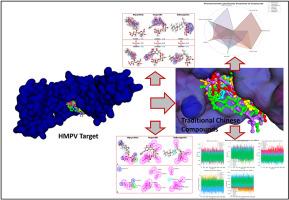
Human metapneumovirus (HMPV) remains a major respiratory pathogen without approved antivirals, highlighting the urgent need for novel therapeutics. This study implemented an integrative computational pipeline combining virtual screening, molecular docking, 2 μs molecular dynamics (MD) simulations, density functional theory (DFT), pharmacophore modeling, and ADMET profiling to identify potent HMPV inhibitors from Traditional Chinese Medicine. Among 180 screened phytoconstituents, glycyrrhizin (–9.3 kcal mol−1), hesperidin (–9.1 kcal mol−1), and saikosaponins (–9.0 kcal mol−1) exhibited strong binding affinities toward the HMPV matrix protein (PDB ID: 5WB0). Extended MD simulations confirmed complex stability with RMSD 0.17–0.22 nm, average of 3–5 persistent H-bonds, and DCCM correlation coefficient = 0.86 for glycyrrhizin. MM-PBSA binding free energies (ΔG_bind) of –46.2 ± 2.5, –44.7 ± 2.8, and –43.9 ± 2.2 kJ mol−1 for glycyrrhizin, hesperidin, and oseltamivir respectively, validated strong and stable interactions. DFT results indicated favorable electronic reactivity (HOMO–LUMO gap = 3.86 eV; electrophilicity = 2.74 eV), enhancing ligand-target complementarity. ADMET analysis predicted low systemic toxicity (LD50= 380–530 mg kg−1) but revealed moderate CYP3A4/CYP2C9 inhibition, suggesting the need for metabolic stability evaluation. Compared with reported fusion inhibitors such as EGCG and rutin, this matrix-targeted strategy introduces a distinct therapeutic mechanism. Overall, these findings establish a robust computational foundation for developing and experimentally validating potent natural inhibitors against HMPV.
期刊介绍:
The Journal of Molecular Graphics and Modelling is devoted to the publication of papers on the uses of computers in theoretical investigations of molecular structure, function, interaction, and design. The scope of the journal includes all aspects of molecular modeling and computational chemistry, including, for instance, the study of molecular shape and properties, molecular simulations, protein and polymer engineering, drug design, materials design, structure-activity and structure-property relationships, database mining, and compound library design.
As a primary research journal, JMGM seeks to bring new knowledge to the attention of our readers. As such, submissions to the journal need to not only report results, but must draw conclusions and explore implications of the work presented. Authors are strongly encouraged to bear this in mind when preparing manuscripts. Routine applications of standard modelling approaches, providing only very limited new scientific insight, will not meet our criteria for publication. Reproducibility of reported calculations is an important issue. Wherever possible, we urge authors to enhance their papers with Supplementary Data, for example, in QSAR studies machine-readable versions of molecular datasets or in the development of new force-field parameters versions of the topology and force field parameter files. Routine applications of existing methods that do not lead to genuinely new insight will not be considered.