{"title":"使用亲脂盐掺入无毒离子选择膜的钾离子分析电导传感器。","authors":"Thiyagarajan Natarajan, Tom Wade, Anjana Ramesh Peringath, Diandian Zhang, Sohini Kar-Narayan","doi":"10.1557/s43578-025-01738-w","DOIUrl":null,"url":null,"abstract":"<p><p>Conductometric ion-selective electrodes (ISEs) offer a promising alternative to conventional potentiometric ISEs due to their suitability for miniaturization, real-time monitoring, and reduced calibration requirements. Here, a non-toxic potassium-selective ionophore, 2-dodecyl-2-methyl-1,3-propanediyl bis[N-[5'-nitro(benzo-15-crown-5)-4'-yl]carbamate] (K-III/BME-44), was incorporated into a polyvinyl chloride (PVC)-based ion-selective membrane (ISM), along with the lipophilic salt potassium tetrakis(4-chlorophenyl)borate (KTpClPB). The membrane was deposited onto gold interdigitated electrodes to facilitate impedance-based measurements. Sensor performance was evaluated, demonstrating that the sensitivity, selectivity, and dynamic range of the ISE can be modulated by adjusting the concentration of KTpClPB. The optimized K-III-based ISEs exhibited a threefold higher response compared to the commonly used, but toxic, valinomycin-based counterpart under equivalent conditions. Selectivity coefficients, determined using both the Separate Solution Method (SSM) and the Fixed Interference Method (FIM), confirmed excellent potassium selectivity comparable to established potentiometric ISEs. These results highlight the potential of K-III-based conductometric ISEs for safe and accurate potassium detection in complex bioanalytical environments.</p><p><strong>Graphical abstract: </strong></p><p><strong>Supplementary information: </strong>The online version contains supplementary material available at 10.1557/s43578-025-01738-w.</p>","PeriodicalId":16306,"journal":{"name":"Journal of Materials Research","volume":"40 23","pages":"3297-3307"},"PeriodicalIF":2.9000,"publicationDate":"2025-01-01","publicationTypes":"Journal Article","fieldsOfStudy":null,"isOpenAccess":false,"openAccessPdf":"https://www.ncbi.nlm.nih.gov/pmc/articles/PMC12717214/pdf/","citationCount":"0","resultStr":"{\"title\":\"Conductometric sensor for potassium ion profiling using lipophilic salt-incorporated non-toxic ion-selective membrane.\",\"authors\":\"Thiyagarajan Natarajan, Tom Wade, Anjana Ramesh Peringath, Diandian Zhang, Sohini Kar-Narayan\",\"doi\":\"10.1557/s43578-025-01738-w\",\"DOIUrl\":null,\"url\":null,\"abstract\":\"<p><p>Conductometric ion-selective electrodes (ISEs) offer a promising alternative to conventional potentiometric ISEs due to their suitability for miniaturization, real-time monitoring, and reduced calibration requirements. Here, a non-toxic potassium-selective ionophore, 2-dodecyl-2-methyl-1,3-propanediyl bis[N-[5'-nitro(benzo-15-crown-5)-4'-yl]carbamate] (K-III/BME-44), was incorporated into a polyvinyl chloride (PVC)-based ion-selective membrane (ISM), along with the lipophilic salt potassium tetrakis(4-chlorophenyl)borate (KTpClPB). The membrane was deposited onto gold interdigitated electrodes to facilitate impedance-based measurements. Sensor performance was evaluated, demonstrating that the sensitivity, selectivity, and dynamic range of the ISE can be modulated by adjusting the concentration of KTpClPB. The optimized K-III-based ISEs exhibited a threefold higher response compared to the commonly used, but toxic, valinomycin-based counterpart under equivalent conditions. Selectivity coefficients, determined using both the Separate Solution Method (SSM) and the Fixed Interference Method (FIM), confirmed excellent potassium selectivity comparable to established potentiometric ISEs. These results highlight the potential of K-III-based conductometric ISEs for safe and accurate potassium detection in complex bioanalytical environments.</p><p><strong>Graphical abstract: </strong></p><p><strong>Supplementary information: </strong>The online version contains supplementary material available at 10.1557/s43578-025-01738-w.</p>\",\"PeriodicalId\":16306,\"journal\":{\"name\":\"Journal of Materials Research\",\"volume\":\"40 23\",\"pages\":\"3297-3307\"},\"PeriodicalIF\":2.9000,\"publicationDate\":\"2025-01-01\",\"publicationTypes\":\"Journal Article\",\"fieldsOfStudy\":null,\"isOpenAccess\":false,\"openAccessPdf\":\"https://www.ncbi.nlm.nih.gov/pmc/articles/PMC12717214/pdf/\",\"citationCount\":\"0\",\"resultStr\":null,\"platform\":\"Semanticscholar\",\"paperid\":null,\"PeriodicalName\":\"Journal of Materials Research\",\"FirstCategoryId\":\"88\",\"ListUrlMain\":\"https://doi.org/10.1557/s43578-025-01738-w\",\"RegionNum\":4,\"RegionCategory\":\"材料科学\",\"ArticlePicture\":[],\"TitleCN\":null,\"AbstractTextCN\":null,\"PMCID\":null,\"EPubDate\":\"2025/11/18 0:00:00\",\"PubModel\":\"Epub\",\"JCR\":\"Q3\",\"JCRName\":\"MATERIALS SCIENCE, MULTIDISCIPLINARY\",\"Score\":null,\"Total\":0}","platform":"Semanticscholar","paperid":null,"PeriodicalName":"Journal of Materials Research","FirstCategoryId":"88","ListUrlMain":"https://doi.org/10.1557/s43578-025-01738-w","RegionNum":4,"RegionCategory":"材料科学","ArticlePicture":[],"TitleCN":null,"AbstractTextCN":null,"PMCID":null,"EPubDate":"2025/11/18 0:00:00","PubModel":"Epub","JCR":"Q3","JCRName":"MATERIALS SCIENCE, MULTIDISCIPLINARY","Score":null,"Total":0}
Conductometric sensor for potassium ion profiling using lipophilic salt-incorporated non-toxic ion-selective membrane.
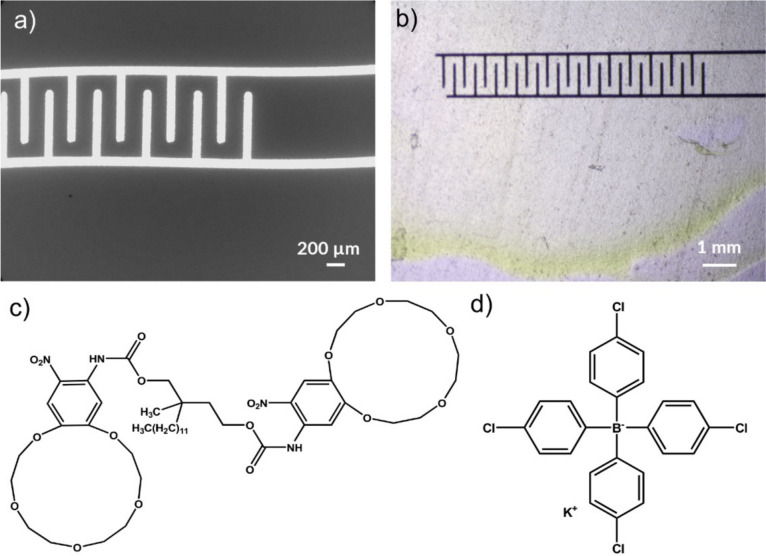
Conductometric ion-selective electrodes (ISEs) offer a promising alternative to conventional potentiometric ISEs due to their suitability for miniaturization, real-time monitoring, and reduced calibration requirements. Here, a non-toxic potassium-selective ionophore, 2-dodecyl-2-methyl-1,3-propanediyl bis[N-[5'-nitro(benzo-15-crown-5)-4'-yl]carbamate] (K-III/BME-44), was incorporated into a polyvinyl chloride (PVC)-based ion-selective membrane (ISM), along with the lipophilic salt potassium tetrakis(4-chlorophenyl)borate (KTpClPB). The membrane was deposited onto gold interdigitated electrodes to facilitate impedance-based measurements. Sensor performance was evaluated, demonstrating that the sensitivity, selectivity, and dynamic range of the ISE can be modulated by adjusting the concentration of KTpClPB. The optimized K-III-based ISEs exhibited a threefold higher response compared to the commonly used, but toxic, valinomycin-based counterpart under equivalent conditions. Selectivity coefficients, determined using both the Separate Solution Method (SSM) and the Fixed Interference Method (FIM), confirmed excellent potassium selectivity comparable to established potentiometric ISEs. These results highlight the potential of K-III-based conductometric ISEs for safe and accurate potassium detection in complex bioanalytical environments.
Graphical abstract:
Supplementary information: The online version contains supplementary material available at 10.1557/s43578-025-01738-w.
期刊介绍:
Journal of Materials Research (JMR) publishes the latest advances about the creation of new materials and materials with novel functionalities, fundamental understanding of processes that control the response of materials, and development of materials with significant performance improvements relative to state of the art materials. JMR welcomes papers that highlight novel processing techniques, the application and development of new analytical tools, and interpretation of fundamental materials science to achieve enhanced materials properties and uses. Materials research papers in the following topical areas are welcome.
• Novel materials discovery
• Electronic, photonic and magnetic materials
• Energy Conversion and storage materials
• New thermal and structural materials
• Soft materials
• Biomaterials and related topics
• Nanoscale science and technology
• Advances in materials characterization methods and techniques
• Computational materials science, modeling and theory



 求助内容:
求助内容: 应助结果提醒方式:

 京公网安备 11010802042870号


