Alice Sinclair, Susan Fitzer, Samantha Greeves, Kirsty Penkman, Chalermrat Sangmanee, Nicola Allison
{"title":"海水温度诱导的珊瑚白化对块状珊瑚骨架文石结构和材料性质的影响。","authors":"Alice Sinclair, Susan Fitzer, Samantha Greeves, Kirsty Penkman, Chalermrat Sangmanee, Nicola Allison","doi":"10.1007/s00338-025-02735-5","DOIUrl":null,"url":null,"abstract":"<p><p>The coral skeletons that contribute to tropical reef structures are biominerals, composed of inorganic aragonite and organic biomolecules. The biomolecules influence the aragonite structure and material properties of the skeleton. We collected massive <i>Porites lutea</i> skeletons from Phuket, Thailand, in 1991, approximately one month into a temperature-induced bleaching event. Some specimens had expelled their Symbiodiniaceae in response to the increased water temperatures (bleached), while other corals appeared unaffected (unbleached). We investigate the effect of Symbiodiniaceae loss on the amino acid composition, aragonite structure, and Vickers hardness of the coral skeletons. We observe no significant difference in the amino acid content or composition of the outermost 1 mm of skeleton (representing 0.5 to 2 months growth) between bleached and unbleached specimens. The full width half maximum of the Raman spectrum ʋ<sub>1</sub> band, an indicator of disorder around the CO<sub>3</sub> group in the aragonite lattice, varies significantly between some corals in the outermost 200 µm of skeleton, but these differences are not attributable to the bleaching status of the coral colonies. Similarly, Vickers hardness varies significantly between some colonies, but this is not related to coral bleaching. This is a positive finding, suggesting that bleaching, from which corals recover, does not adversely affect the coral skeletal structure.</p><p><strong>Supplementary information: </strong>The online version contains supplementary material available at 10.1007/s00338-025-02735-5.</p>","PeriodicalId":10821,"journal":{"name":"Coral Reefs","volume":"44 5","pages":"1617-1629"},"PeriodicalIF":2.9000,"publicationDate":"2025-01-01","publicationTypes":"Journal Article","fieldsOfStudy":null,"isOpenAccess":false,"openAccessPdf":"https://www.ncbi.nlm.nih.gov/pmc/articles/PMC12542618/pdf/","citationCount":"0","resultStr":"{\"title\":\"The effects of seawater temperature-induced coral bleaching on the aragonite structure and material properties of massive <i>Porites lutea</i> coral skeletons.\",\"authors\":\"Alice Sinclair, Susan Fitzer, Samantha Greeves, Kirsty Penkman, Chalermrat Sangmanee, Nicola Allison\",\"doi\":\"10.1007/s00338-025-02735-5\",\"DOIUrl\":null,\"url\":null,\"abstract\":\"<p><p>The coral skeletons that contribute to tropical reef structures are biominerals, composed of inorganic aragonite and organic biomolecules. The biomolecules influence the aragonite structure and material properties of the skeleton. We collected massive <i>Porites lutea</i> skeletons from Phuket, Thailand, in 1991, approximately one month into a temperature-induced bleaching event. Some specimens had expelled their Symbiodiniaceae in response to the increased water temperatures (bleached), while other corals appeared unaffected (unbleached). We investigate the effect of Symbiodiniaceae loss on the amino acid composition, aragonite structure, and Vickers hardness of the coral skeletons. We observe no significant difference in the amino acid content or composition of the outermost 1 mm of skeleton (representing 0.5 to 2 months growth) between bleached and unbleached specimens. The full width half maximum of the Raman spectrum ʋ<sub>1</sub> band, an indicator of disorder around the CO<sub>3</sub> group in the aragonite lattice, varies significantly between some corals in the outermost 200 µm of skeleton, but these differences are not attributable to the bleaching status of the coral colonies. Similarly, Vickers hardness varies significantly between some colonies, but this is not related to coral bleaching. This is a positive finding, suggesting that bleaching, from which corals recover, does not adversely affect the coral skeletal structure.</p><p><strong>Supplementary information: </strong>The online version contains supplementary material available at 10.1007/s00338-025-02735-5.</p>\",\"PeriodicalId\":10821,\"journal\":{\"name\":\"Coral Reefs\",\"volume\":\"44 5\",\"pages\":\"1617-1629\"},\"PeriodicalIF\":2.9000,\"publicationDate\":\"2025-01-01\",\"publicationTypes\":\"Journal Article\",\"fieldsOfStudy\":null,\"isOpenAccess\":false,\"openAccessPdf\":\"https://www.ncbi.nlm.nih.gov/pmc/articles/PMC12542618/pdf/\",\"citationCount\":\"0\",\"resultStr\":null,\"platform\":\"Semanticscholar\",\"paperid\":null,\"PeriodicalName\":\"Coral Reefs\",\"FirstCategoryId\":\"99\",\"ListUrlMain\":\"https://doi.org/10.1007/s00338-025-02735-5\",\"RegionNum\":2,\"RegionCategory\":\"生物学\",\"ArticlePicture\":[],\"TitleCN\":null,\"AbstractTextCN\":null,\"PMCID\":null,\"EPubDate\":\"2025/8/29 0:00:00\",\"PubModel\":\"Epub\",\"JCR\":\"Q1\",\"JCRName\":\"MARINE & FRESHWATER BIOLOGY\",\"Score\":null,\"Total\":0}","platform":"Semanticscholar","paperid":null,"PeriodicalName":"Coral Reefs","FirstCategoryId":"99","ListUrlMain":"https://doi.org/10.1007/s00338-025-02735-5","RegionNum":2,"RegionCategory":"生物学","ArticlePicture":[],"TitleCN":null,"AbstractTextCN":null,"PMCID":null,"EPubDate":"2025/8/29 0:00:00","PubModel":"Epub","JCR":"Q1","JCRName":"MARINE & FRESHWATER BIOLOGY","Score":null,"Total":0}
The effects of seawater temperature-induced coral bleaching on the aragonite structure and material properties of massive Porites lutea coral skeletons.
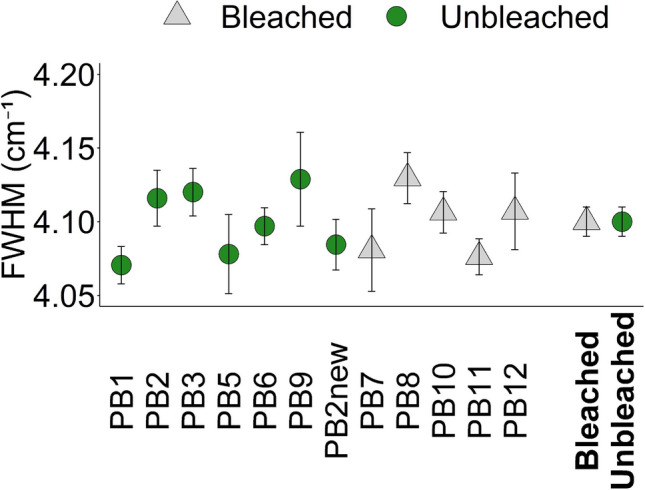
The coral skeletons that contribute to tropical reef structures are biominerals, composed of inorganic aragonite and organic biomolecules. The biomolecules influence the aragonite structure and material properties of the skeleton. We collected massive Porites lutea skeletons from Phuket, Thailand, in 1991, approximately one month into a temperature-induced bleaching event. Some specimens had expelled their Symbiodiniaceae in response to the increased water temperatures (bleached), while other corals appeared unaffected (unbleached). We investigate the effect of Symbiodiniaceae loss on the amino acid composition, aragonite structure, and Vickers hardness of the coral skeletons. We observe no significant difference in the amino acid content or composition of the outermost 1 mm of skeleton (representing 0.5 to 2 months growth) between bleached and unbleached specimens. The full width half maximum of the Raman spectrum ʋ1 band, an indicator of disorder around the CO3 group in the aragonite lattice, varies significantly between some corals in the outermost 200 µm of skeleton, but these differences are not attributable to the bleaching status of the coral colonies. Similarly, Vickers hardness varies significantly between some colonies, but this is not related to coral bleaching. This is a positive finding, suggesting that bleaching, from which corals recover, does not adversely affect the coral skeletal structure.
Supplementary information: The online version contains supplementary material available at 10.1007/s00338-025-02735-5.
期刊介绍:
Coral Reefs, the Journal of the International Coral Reef Society, presents multidisciplinary literature across the broad fields of reef studies, publishing analytical and theoretical papers on both modern and ancient reefs. These encourage the search for theories about reef structure and dynamics, and the use of experimentation, modeling, quantification and the applied sciences.
Coverage includes such subject areas as population dynamics; community ecology of reef organisms; energy and nutrient flows; biogeochemical cycles; physiology of calcification; reef responses to natural and anthropogenic influences; stress markers in reef organisms; behavioural ecology; sedimentology; diagenesis; reef structure and morphology; evolutionary ecology of the reef biota; palaeoceanography of coral reefs and coral islands; reef management and its underlying disciplines; molecular biology and genetics of coral; aetiology of disease in reef-related organisms; reef responses to global change, and more.



 求助内容:
求助内容: 应助结果提醒方式:

 京公网安备 11010802042870号


