Julius Martinkus,Laurent Terradot,Dukas Jurėnas,Eric Cascales
{"title":"人类CD38 adp -核糖素环化酶折叠在抗菌和抗真核多态毒素中的广泛部署。","authors":"Julius Martinkus,Laurent Terradot,Dukas Jurėnas,Eric Cascales","doi":"10.1016/j.jbc.2025.110775","DOIUrl":null,"url":null,"abstract":"Bacterial polymorphic toxins are modular weapons that mediate inter-microbial competition and host interactions by delivering diverse cytotoxic domains through specialized secretion systems. Here, we identify and characterize a novel toxin domain in Pantoea ananatis that displays remarkable structural and functional conservation with the human enzyme CD38. This bacterial toxin, fused to a type VI secretion system (T6SS) PAAR domain, harbors a C-terminal ADP-ribosyl cyclase (ARC) domain that hydrolyzes NAD+ and NADP+in vitro and in vivo, leading to growth inhibition in both bacterial and eukaryotic cells. The 1.6-Å resolution structure of ARC reveals that it adopts a globular fold nearly identical to the human CD38 ADP ribosyl cyclase, with key catalytic residues conserved. Comparative genomics reveals that CD38-like ARC domains are widespread in bacteria, fused to diverse delivery modules including T6SS, T7SS, and CDI systems. Functional assays demonstrate that these domains act as NAD-depleting toxins, with cross-immunity observed between non-cognate toxin-immunity pairs. Taken together, our findings identify a bacterial NAD+ hydrolase fold with strong similarity to human CD38 and define a novel class of metabolic toxins, expanding the functional scope of polymorphic effectors and illustrating how enzymes can be co-opted for microbial warfare.","PeriodicalId":15140,"journal":{"name":"Journal of Biological Chemistry","volume":"5 1","pages":"110775"},"PeriodicalIF":4.0000,"publicationDate":"2025-09-27","publicationTypes":"Journal Article","fieldsOfStudy":null,"isOpenAccess":false,"openAccessPdf":"","citationCount":"0","resultStr":"{\"title\":\"Widespread deployment of the human CD38 ADP-ribosyl cyclase fold in antibacterial and anti-eukaryotic polymorphic toxins.\",\"authors\":\"Julius Martinkus,Laurent Terradot,Dukas Jurėnas,Eric Cascales\",\"doi\":\"10.1016/j.jbc.2025.110775\",\"DOIUrl\":null,\"url\":null,\"abstract\":\"Bacterial polymorphic toxins are modular weapons that mediate inter-microbial competition and host interactions by delivering diverse cytotoxic domains through specialized secretion systems. Here, we identify and characterize a novel toxin domain in Pantoea ananatis that displays remarkable structural and functional conservation with the human enzyme CD38. This bacterial toxin, fused to a type VI secretion system (T6SS) PAAR domain, harbors a C-terminal ADP-ribosyl cyclase (ARC) domain that hydrolyzes NAD+ and NADP+in vitro and in vivo, leading to growth inhibition in both bacterial and eukaryotic cells. The 1.6-Å resolution structure of ARC reveals that it adopts a globular fold nearly identical to the human CD38 ADP ribosyl cyclase, with key catalytic residues conserved. Comparative genomics reveals that CD38-like ARC domains are widespread in bacteria, fused to diverse delivery modules including T6SS, T7SS, and CDI systems. Functional assays demonstrate that these domains act as NAD-depleting toxins, with cross-immunity observed between non-cognate toxin-immunity pairs. Taken together, our findings identify a bacterial NAD+ hydrolase fold with strong similarity to human CD38 and define a novel class of metabolic toxins, expanding the functional scope of polymorphic effectors and illustrating how enzymes can be co-opted for microbial warfare.\",\"PeriodicalId\":15140,\"journal\":{\"name\":\"Journal of Biological Chemistry\",\"volume\":\"5 1\",\"pages\":\"110775\"},\"PeriodicalIF\":4.0000,\"publicationDate\":\"2025-09-27\",\"publicationTypes\":\"Journal Article\",\"fieldsOfStudy\":null,\"isOpenAccess\":false,\"openAccessPdf\":\"\",\"citationCount\":\"0\",\"resultStr\":null,\"platform\":\"Semanticscholar\",\"paperid\":null,\"PeriodicalName\":\"Journal of Biological Chemistry\",\"FirstCategoryId\":\"99\",\"ListUrlMain\":\"https://doi.org/10.1016/j.jbc.2025.110775\",\"RegionNum\":2,\"RegionCategory\":\"生物学\",\"ArticlePicture\":[],\"TitleCN\":null,\"AbstractTextCN\":null,\"PMCID\":null,\"EPubDate\":\"\",\"PubModel\":\"\",\"JCR\":\"Q2\",\"JCRName\":\"BIOCHEMISTRY & MOLECULAR BIOLOGY\",\"Score\":null,\"Total\":0}","platform":"Semanticscholar","paperid":null,"PeriodicalName":"Journal of Biological Chemistry","FirstCategoryId":"99","ListUrlMain":"https://doi.org/10.1016/j.jbc.2025.110775","RegionNum":2,"RegionCategory":"生物学","ArticlePicture":[],"TitleCN":null,"AbstractTextCN":null,"PMCID":null,"EPubDate":"","PubModel":"","JCR":"Q2","JCRName":"BIOCHEMISTRY & MOLECULAR BIOLOGY","Score":null,"Total":0}
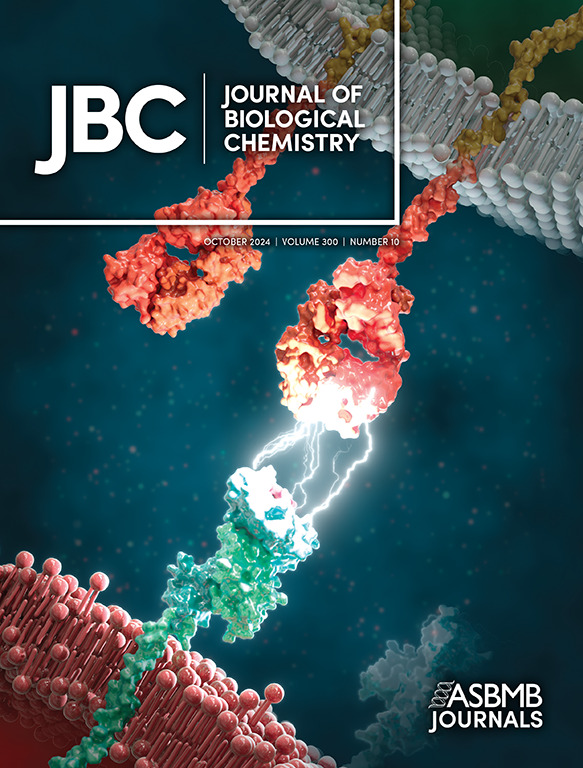
Widespread deployment of the human CD38 ADP-ribosyl cyclase fold in antibacterial and anti-eukaryotic polymorphic toxins.
Bacterial polymorphic toxins are modular weapons that mediate inter-microbial competition and host interactions by delivering diverse cytotoxic domains through specialized secretion systems. Here, we identify and characterize a novel toxin domain in Pantoea ananatis that displays remarkable structural and functional conservation with the human enzyme CD38. This bacterial toxin, fused to a type VI secretion system (T6SS) PAAR domain, harbors a C-terminal ADP-ribosyl cyclase (ARC) domain that hydrolyzes NAD+ and NADP+in vitro and in vivo, leading to growth inhibition in both bacterial and eukaryotic cells. The 1.6-Å resolution structure of ARC reveals that it adopts a globular fold nearly identical to the human CD38 ADP ribosyl cyclase, with key catalytic residues conserved. Comparative genomics reveals that CD38-like ARC domains are widespread in bacteria, fused to diverse delivery modules including T6SS, T7SS, and CDI systems. Functional assays demonstrate that these domains act as NAD-depleting toxins, with cross-immunity observed between non-cognate toxin-immunity pairs. Taken together, our findings identify a bacterial NAD+ hydrolase fold with strong similarity to human CD38 and define a novel class of metabolic toxins, expanding the functional scope of polymorphic effectors and illustrating how enzymes can be co-opted for microbial warfare.
期刊介绍:
The Journal of Biological Chemistry welcomes high-quality science that seeks to elucidate the molecular and cellular basis of biological processes. Papers published in JBC can therefore fall under the umbrellas of not only biological chemistry, chemical biology, or biochemistry, but also allied disciplines such as biophysics, systems biology, RNA biology, immunology, microbiology, neurobiology, epigenetics, computational biology, ’omics, and many more. The outcome of our focus on papers that contribute novel and important mechanistic insights, rather than on a particular topic area, is that JBC is truly a melting pot for scientists across disciplines. In addition, JBC welcomes papers that describe methods that will help scientists push their biochemical inquiries forward and resources that will be of use to the research community.