Lin Wang, Hui-Min Wang, Fan Tang, Yan-Ting Zhang, Rong-Rong Shi, Sheng-Hui Wang, Si-Chao Liang, Liao-Ming Gao, Zhi-Ting Chen, Bao-Feng Li, Bei Chen
{"title":"不同宫颈规划靶体积设计对鼻咽癌疗效和毒性的影响:一项单中心回顾性研究。","authors":"Lin Wang, Hui-Min Wang, Fan Tang, Yan-Ting Zhang, Rong-Rong Shi, Sheng-Hui Wang, Si-Chao Liang, Liao-Ming Gao, Zhi-Ting Chen, Bao-Feng Li, Bei Chen","doi":"10.1186/s12885-025-13865-y","DOIUrl":null,"url":null,"abstract":"<p><strong>Background: </strong>In nasopharyngeal carcinoma (NPC) patients, two radiation target delineation patterns are used for the cervical lymph node area.</p><p><strong>Purpose: </strong>This study compares the efficacy and toxicity of two radiation target volume delineation patterns for planning target volumes (PTVs) in NPC patients.</p><p><strong>Methods: </strong>This retrospective analysis included 387 non-metastatic NPC patients treated with concurrent chemoradiotherapy from January 2017 to December 2020. Patients were divided into two groups: the 2-PTV group with two dose gradients (50-54 Gy and 66-70 Gy) and the 3-PTV group with an additional 60-63 Gy dose.</p><p><strong>Results: </strong>After a median follow-up of 51.2 months, the 3-year regional relapse-free survival (RRFS) showed no significant differences between the 3-PTV and 2-PTV groups (96.6% [95% confidence interval (CI): 96.5%-96.8%] and 96.3% [95% CI: 96.2%-96.3%]). In the N3 subgroup, the 3-year RRFS was also comparable between the 3-PTV and 2-PTV groups (96.2% [95% CI: 76%-99%] vs. 95% [95% CI: 69%-99%], p = 0.727). Importantly, the 2-PTV group demonstrated significantly lower rates of grade 3/4 dermatitis (5.1% vs. 16.5%; HR 0.88, 95% CI: 0.82-0.94, p = 0.002) and xerostomia (49.6% vs. 67%; HR 0.78, 95% CI: 0.72-0.84, p = 0.002).</p><p><strong>Conclusions: </strong>The 2-PTV regimen achieved equivalent survival outcomes while significantly reducing treatment-related toxicities compared to the 3-PTV approach. These results suggest that the 2-PTV strategy may offer a more favorable therapeutic profile for NPC patients, particularly in minimizing severe dermatitis and xerostomia.</p>","PeriodicalId":9131,"journal":{"name":"BMC Cancer","volume":"25 1","pages":"485"},"PeriodicalIF":3.4000,"publicationDate":"2025-03-17","publicationTypes":"Journal Article","fieldsOfStudy":null,"isOpenAccess":false,"openAccessPdf":"https://www.ncbi.nlm.nih.gov/pmc/articles/PMC11912676/pdf/","citationCount":"0","resultStr":"{\"title\":\"The impact of different cervical planning target volume designs on efficacy and toxicity in nasopharyngeal carcinoma: a single-center retrospective study.\",\"authors\":\"Lin Wang, Hui-Min Wang, Fan Tang, Yan-Ting Zhang, Rong-Rong Shi, Sheng-Hui Wang, Si-Chao Liang, Liao-Ming Gao, Zhi-Ting Chen, Bao-Feng Li, Bei Chen\",\"doi\":\"10.1186/s12885-025-13865-y\",\"DOIUrl\":null,\"url\":null,\"abstract\":\"<p><strong>Background: </strong>In nasopharyngeal carcinoma (NPC) patients, two radiation target delineation patterns are used for the cervical lymph node area.</p><p><strong>Purpose: </strong>This study compares the efficacy and toxicity of two radiation target volume delineation patterns for planning target volumes (PTVs) in NPC patients.</p><p><strong>Methods: </strong>This retrospective analysis included 387 non-metastatic NPC patients treated with concurrent chemoradiotherapy from January 2017 to December 2020. Patients were divided into two groups: the 2-PTV group with two dose gradients (50-54 Gy and 66-70 Gy) and the 3-PTV group with an additional 60-63 Gy dose.</p><p><strong>Results: </strong>After a median follow-up of 51.2 months, the 3-year regional relapse-free survival (RRFS) showed no significant differences between the 3-PTV and 2-PTV groups (96.6% [95% confidence interval (CI): 96.5%-96.8%] and 96.3% [95% CI: 96.2%-96.3%]). In the N3 subgroup, the 3-year RRFS was also comparable between the 3-PTV and 2-PTV groups (96.2% [95% CI: 76%-99%] vs. 95% [95% CI: 69%-99%], p = 0.727). Importantly, the 2-PTV group demonstrated significantly lower rates of grade 3/4 dermatitis (5.1% vs. 16.5%; HR 0.88, 95% CI: 0.82-0.94, p = 0.002) and xerostomia (49.6% vs. 67%; HR 0.78, 95% CI: 0.72-0.84, p = 0.002).</p><p><strong>Conclusions: </strong>The 2-PTV regimen achieved equivalent survival outcomes while significantly reducing treatment-related toxicities compared to the 3-PTV approach. These results suggest that the 2-PTV strategy may offer a more favorable therapeutic profile for NPC patients, particularly in minimizing severe dermatitis and xerostomia.</p>\",\"PeriodicalId\":9131,\"journal\":{\"name\":\"BMC Cancer\",\"volume\":\"25 1\",\"pages\":\"485\"},\"PeriodicalIF\":3.4000,\"publicationDate\":\"2025-03-17\",\"publicationTypes\":\"Journal Article\",\"fieldsOfStudy\":null,\"isOpenAccess\":false,\"openAccessPdf\":\"https://www.ncbi.nlm.nih.gov/pmc/articles/PMC11912676/pdf/\",\"citationCount\":\"0\",\"resultStr\":null,\"platform\":\"Semanticscholar\",\"paperid\":null,\"PeriodicalName\":\"BMC Cancer\",\"FirstCategoryId\":\"3\",\"ListUrlMain\":\"https://doi.org/10.1186/s12885-025-13865-y\",\"RegionNum\":2,\"RegionCategory\":\"医学\",\"ArticlePicture\":[],\"TitleCN\":null,\"AbstractTextCN\":null,\"PMCID\":null,\"EPubDate\":\"\",\"PubModel\":\"\",\"JCR\":\"Q2\",\"JCRName\":\"ONCOLOGY\",\"Score\":null,\"Total\":0}","platform":"Semanticscholar","paperid":null,"PeriodicalName":"BMC Cancer","FirstCategoryId":"3","ListUrlMain":"https://doi.org/10.1186/s12885-025-13865-y","RegionNum":2,"RegionCategory":"医学","ArticlePicture":[],"TitleCN":null,"AbstractTextCN":null,"PMCID":null,"EPubDate":"","PubModel":"","JCR":"Q2","JCRName":"ONCOLOGY","Score":null,"Total":0}
引用次数: 0
摘要
背景:在鼻咽癌(NPC)患者中,两种放射靶划定模式用于颈部淋巴结区域。目的:本研究比较两种放射靶体积划定模式在鼻咽癌患者规划靶体积(PTVs)中的疗效和毒性。方法:回顾性分析2017年1月至2020年12月期间接受同步放化疗的387例非转移性鼻咽癌患者。患者分为两组:2-PTV组有两个剂量梯度(50-54 Gy和66-70 Gy), 3-PTV组增加60-63 Gy剂量。结果:中位随访51.2个月后,3-PTV组和2-PTV组的3年区域无复发生存率(RRFS)差异无统计学意义(96.6%[95%置信区间(CI): 96.5%-96.8%]和96.3% [95% CI: 96.2%-96.3%])。在N3亚组中,3-PTV组和2-PTV组的3年RRFS也具有可比性(96.2% [95% CI: 76%-99%] vs. 95% [95% CI: 69%-99%], p = 0.727)。重要的是,2-PTV组的3/4级皮炎发生率显著降低(5.1% vs. 16.5%;HR 0.88, 95% CI: 0.82-0.94, p = 0.002)和口干(49.6% vs. 67%;HR 0.78, 95% CI: 0.72-0.84, p = 0.002)。结论:与3-PTV方法相比,2-PTV方案获得了相同的生存结果,同时显著降低了治疗相关的毒性。这些结果表明,2-PTV策略可能为鼻咽癌患者提供更有利的治疗方案,特别是在减少严重皮炎和口干症方面。
The impact of different cervical planning target volume designs on efficacy and toxicity in nasopharyngeal carcinoma: a single-center retrospective study.
Background: In nasopharyngeal carcinoma (NPC) patients, two radiation target delineation patterns are used for the cervical lymph node area.
Purpose: This study compares the efficacy and toxicity of two radiation target volume delineation patterns for planning target volumes (PTVs) in NPC patients.
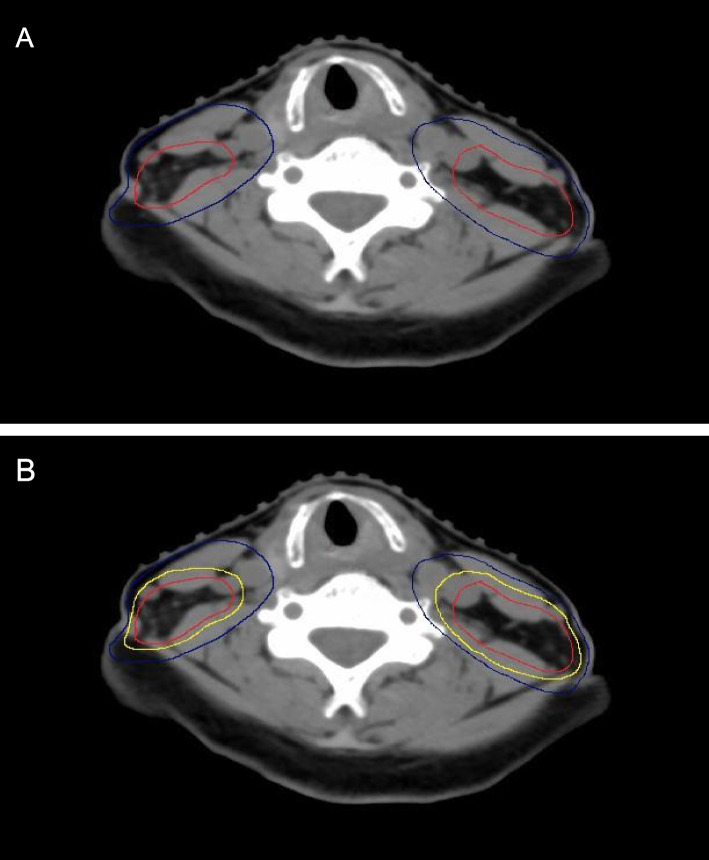
Methods: This retrospective analysis included 387 non-metastatic NPC patients treated with concurrent chemoradiotherapy from January 2017 to December 2020. Patients were divided into two groups: the 2-PTV group with two dose gradients (50-54 Gy and 66-70 Gy) and the 3-PTV group with an additional 60-63 Gy dose.
Results: After a median follow-up of 51.2 months, the 3-year regional relapse-free survival (RRFS) showed no significant differences between the 3-PTV and 2-PTV groups (96.6% [95% confidence interval (CI): 96.5%-96.8%] and 96.3% [95% CI: 96.2%-96.3%]). In the N3 subgroup, the 3-year RRFS was also comparable between the 3-PTV and 2-PTV groups (96.2% [95% CI: 76%-99%] vs. 95% [95% CI: 69%-99%], p = 0.727). Importantly, the 2-PTV group demonstrated significantly lower rates of grade 3/4 dermatitis (5.1% vs. 16.5%; HR 0.88, 95% CI: 0.82-0.94, p = 0.002) and xerostomia (49.6% vs. 67%; HR 0.78, 95% CI: 0.72-0.84, p = 0.002).
Conclusions: The 2-PTV regimen achieved equivalent survival outcomes while significantly reducing treatment-related toxicities compared to the 3-PTV approach. These results suggest that the 2-PTV strategy may offer a more favorable therapeutic profile for NPC patients, particularly in minimizing severe dermatitis and xerostomia.
期刊介绍:
BMC Cancer is an open access, peer-reviewed journal that considers articles on all aspects of cancer research, including the pathophysiology, prevention, diagnosis and treatment of cancers. The journal welcomes submissions concerning molecular and cellular biology, genetics, epidemiology, and clinical trials.



 求助内容:
求助内容: 应助结果提醒方式:

 京公网安备 11010802042870号


