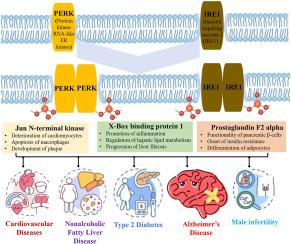
内质网应激的药理学景观:揭示代谢疾病的治疗途径。

IF 4.7 3区 医学 Q1 PHARMACOLOGY & PHARMACY
European journal of pharmacology Pub Date : 2025-07-05 Epub Date: 2025-03-13 DOI:10.1016/j.ejphar.2025.177509
Ghallab Alotaibi, Abdullah Alkhammash
{"title":"内质网应激的药理学景观:揭示代谢疾病的治疗途径。","authors":"Ghallab Alotaibi,&nbsp;Abdullah Alkhammash","doi":"10.1016/j.ejphar.2025.177509","DOIUrl":null,"url":null,"abstract":"<div><div>The endoplasmic reticulum (ER) plays a fundamental role in maintaining cellular homeostasis by ensuring proper protein folding, lipid metabolism, and calcium regulation. However, disruptions to ER function, known as ER stress, activate the unfolded protein response (UPR) to restore balance. Chronic or unresolved ER stress contributes to metabolic dysfunctions, including insulin resistance, non-alcoholic fatty liver disease (NAFLD), and neurodegenerative disorders such as Parkinson's disease and Alzheimer's disease. Recent studies have also highlighted the importance of mitochondria-ER contact sites (MERCs) and ER-associated inflammation in disease progression. This review explores the current pharmacological landscape targeting ER stress, focusing on therapeutic strategies for rare metabolic and neurodegenerative diseases. It examines small molecules such as tauroursodeoxycholic acid (TUDCA) and 4-phenylbutyric acid (4-PBA), repurposed drugs like 17-AAG (17-N-allylamino-17demethoxygeldanamycin (tanespimycin)) and berberine, and phytochemicals such as resveratrol and hesperidin. Additionally, it discusses emerging therapeutic areas, including soluble epoxide hydrolase (sEH) inhibitors for metabolic disorders and MERCs modulation for neurological diseases. The review emphasizes challenges in translating these therapies to clinical applications, such as toxicity, off-target effects, limited bioavailability, and the lack of large-scale randomized controlled trials (RCTs). It also highlights the potential of personalized medicine approaches and pharmacogenomics in optimizing ER stress-targeting therapies.</div></div>","PeriodicalId":12004,"journal":{"name":"European journal of pharmacology","volume":"998 ","pages":"Article 177509"},"PeriodicalIF":4.7000,"publicationDate":"2025-07-05","publicationTypes":"Journal Article","fieldsOfStudy":null,"isOpenAccess":false,"openAccessPdf":"","citationCount":"0","resultStr":"{\"title\":\"Pharmacological landscape of endoplasmic reticulum stress: Uncovering therapeutic avenues for metabolic diseases\",\"authors\":\"Ghallab Alotaibi,&nbsp;Abdullah Alkhammash\",\"doi\":\"10.1016/j.ejphar.2025.177509\",\"DOIUrl\":null,\"url\":null,\"abstract\":\"<div><div>The endoplasmic reticulum (ER) plays a fundamental role in maintaining cellular homeostasis by ensuring proper protein folding, lipid metabolism, and calcium regulation. However, disruptions to ER function, known as ER stress, activate the unfolded protein response (UPR) to restore balance. Chronic or unresolved ER stress contributes to metabolic dysfunctions, including insulin resistance, non-alcoholic fatty liver disease (NAFLD), and neurodegenerative disorders such as Parkinson's disease and Alzheimer's disease. Recent studies have also highlighted the importance of mitochondria-ER contact sites (MERCs) and ER-associated inflammation in disease progression. This review explores the current pharmacological landscape targeting ER stress, focusing on therapeutic strategies for rare metabolic and neurodegenerative diseases. It examines small molecules such as tauroursodeoxycholic acid (TUDCA) and 4-phenylbutyric acid (4-PBA), repurposed drugs like 17-AAG (17-N-allylamino-17demethoxygeldanamycin (tanespimycin)) and berberine, and phytochemicals such as resveratrol and hesperidin. Additionally, it discusses emerging therapeutic areas, including soluble epoxide hydrolase (sEH) inhibitors for metabolic disorders and MERCs modulation for neurological diseases. The review emphasizes challenges in translating these therapies to clinical applications, such as toxicity, off-target effects, limited bioavailability, and the lack of large-scale randomized controlled trials (RCTs). It also highlights the potential of personalized medicine approaches and pharmacogenomics in optimizing ER stress-targeting therapies.</div></div>\",\"PeriodicalId\":12004,\"journal\":{\"name\":\"European journal of pharmacology\",\"volume\":\"998 \",\"pages\":\"Article 177509\"},\"PeriodicalIF\":4.7000,\"publicationDate\":\"2025-07-05\",\"publicationTypes\":\"Journal Article\",\"fieldsOfStudy\":null,\"isOpenAccess\":false,\"openAccessPdf\":\"\",\"citationCount\":\"0\",\"resultStr\":null,\"platform\":\"Semanticscholar\",\"paperid\":null,\"PeriodicalName\":\"European journal of pharmacology\",\"FirstCategoryId\":\"3\",\"ListUrlMain\":\"https://www.sciencedirect.com/science/article/pii/S0014299925002638\",\"RegionNum\":3,\"RegionCategory\":\"医学\",\"ArticlePicture\":[],\"TitleCN\":null,\"AbstractTextCN\":null,\"PMCID\":null,\"EPubDate\":\"2025/3/13 0:00:00\",\"PubModel\":\"Epub\",\"JCR\":\"Q1\",\"JCRName\":\"PHARMACOLOGY & PHARMACY\",\"Score\":null,\"Total\":0}","platform":"Semanticscholar","paperid":null,"PeriodicalName":"European journal of pharmacology","FirstCategoryId":"3","ListUrlMain":"https://www.sciencedirect.com/science/article/pii/S0014299925002638","RegionNum":3,"RegionCategory":"医学","ArticlePicture":[],"TitleCN":null,"AbstractTextCN":null,"PMCID":null,"EPubDate":"2025/3/13 0:00:00","PubModel":"Epub","JCR":"Q1","JCRName":"PHARMACOLOGY & PHARMACY","Score":null,"Total":0}
引用次数: 0

摘要

内质网(ER)通过确保适当的蛋白质折叠、脂质代谢和钙调节,在维持细胞稳态中起着重要作用。然而,内质网功能的破坏,即内质网应激,激活未折叠蛋白反应(UPR)以恢复平衡。慢性或未解决的内质网应激会导致代谢功能障碍,包括胰岛素抵抗、非酒精性脂肪性肝病(NAFLD)和神经退行性疾病,如帕金森病和阿尔茨海默病。最近的研究也强调了线粒体-内质网接触位点(MERCs)和内质网相关炎症在疾病进展中的重要性。这篇综述探讨了目前针对内质网应激的药理学景观,重点是罕见代谢和神经退行性疾病的治疗策略。它检查小分子如牛磺酸去氧胆酸(TUDCA)和4-苯基丁酸(4-PBA),再用途药物如17-AAG (17- n -烯丙基氨基-17 -去甲氧基格尔德那霉素(tanespimycin))和小檗碱,以及植物化学物质如白藜芦醇和橙皮苷。此外,它还讨论了新兴的治疗领域,包括代谢紊乱的可溶性环氧化物水解酶(sEH)抑制剂和神经系统疾病的MERCs调节。这篇综述强调了将这些疗法转化为临床应用的挑战,如毒性、脱靶效应、有限的生物利用度以及缺乏大规模随机对照试验(rct)。它还强调了个性化医学方法和药物基因组学在优化内质网应激靶向治疗方面的潜力。
本文章由计算机程序翻译,如有差异,请以英文原文为准。

Pharmacological landscape of endoplasmic reticulum stress: Uncovering therapeutic avenues for metabolic diseases

Pharmacological landscape of endoplasmic reticulum stress: Uncovering therapeutic avenues for metabolic diseases
The endoplasmic reticulum (ER) plays a fundamental role in maintaining cellular homeostasis by ensuring proper protein folding, lipid metabolism, and calcium regulation. However, disruptions to ER function, known as ER stress, activate the unfolded protein response (UPR) to restore balance. Chronic or unresolved ER stress contributes to metabolic dysfunctions, including insulin resistance, non-alcoholic fatty liver disease (NAFLD), and neurodegenerative disorders such as Parkinson's disease and Alzheimer's disease. Recent studies have also highlighted the importance of mitochondria-ER contact sites (MERCs) and ER-associated inflammation in disease progression. This review explores the current pharmacological landscape targeting ER stress, focusing on therapeutic strategies for rare metabolic and neurodegenerative diseases. It examines small molecules such as tauroursodeoxycholic acid (TUDCA) and 4-phenylbutyric acid (4-PBA), repurposed drugs like 17-AAG (17-N-allylamino-17demethoxygeldanamycin (tanespimycin)) and berberine, and phytochemicals such as resveratrol and hesperidin. Additionally, it discusses emerging therapeutic areas, including soluble epoxide hydrolase (sEH) inhibitors for metabolic disorders and MERCs modulation for neurological diseases. The review emphasizes challenges in translating these therapies to clinical applications, such as toxicity, off-target effects, limited bioavailability, and the lack of large-scale randomized controlled trials (RCTs). It also highlights the potential of personalized medicine approaches and pharmacogenomics in optimizing ER stress-targeting therapies.
求助全文
通过发布文献求助,成功后即可免费获取论文全文。 去求助
来源期刊
CiteScore
9.00
自引率
0.00%
发文量
572
审稿时长
34 days
期刊介绍: The European Journal of Pharmacology publishes research papers covering all aspects of experimental pharmacology with focus on the mechanism of action of structurally identified compounds affecting biological systems. The scope includes: Behavioural pharmacology Neuropharmacology and analgesia Cardiovascular pharmacology Pulmonary, gastrointestinal and urogenital pharmacology Endocrine pharmacology Immunopharmacology and inflammation Molecular and cellular pharmacology Regenerative pharmacology Biologicals and biotherapeutics Translational pharmacology Nutriceutical pharmacology.

×
引用
GB/T 7714-2015
复制
MLA
复制
APA
复制
导出至
BibTeX EndNote RefMan NoteFirst NoteExpress
×
提示
您的信息不完整,为了账户安全,请先补充。
现在去补充
×
提示
您因"违规操作"
具体请查看互助需知
我知道了
×
提示
确定
请完成安全验证×
copy
已复制链接
快去分享给好友吧!
我知道了
右上角分享
点击右上角分享
0
联系我们:info@booksci.cn Book学术提供免费学术资源搜索服务,方便国内外学者检索中英文文献。致力于提供最便捷和优质的服务体验。 Copyright © 2023 布克学术 All rights reserved.
京ICP备2023020795号-1
ghs 京公网安备 11010802042870号
Book学术文献互助
Book学术文献互助群
群 号:604180095
Book学术官方微信
小红书