Kevin Wendo, Catherine Behets, Olivier Barbier, Benoit Herman, Thomas Schubert, Benoit Raucent, Raphael Olszewski
{"title":"基于医院的熔融沉积建模3D打印机制作医学解剖模型的尺寸精度评估。","authors":"Kevin Wendo, Catherine Behets, Olivier Barbier, Benoit Herman, Thomas Schubert, Benoit Raucent, Raphael Olszewski","doi":"10.3390/jimaging11020039","DOIUrl":null,"url":null,"abstract":"<p><p>As 3D printing technology expands rapidly in medical disciplines, the accuracy evaluation of 3D-printed medical models is required. However, no established guidelines to assess the dimensional error of anatomical models exist. This study aims to evaluate the dimensional accuracy of medical models 3D-printed using a hospital-based Fused Deposition Modeling (FDM) 3D printer. Two dissected cadaveric right hands were marked with Titanium Kirshner wires to identify landmarks on the heads and bases of all metacarpals and proximal and middle phalanges. Both hands were scanned using a Cone Beam Computed Tomography scanner. Image post-processing and segmentation were performed on 3D Slicer software. Hand models were 3D-printed using a professional hospital-based FDM 3D printer. Manual measurements of all landmarks marked on both pairs of cadaveric and 3D-printed hands were taken by two independent observers using a digital caliper. The Mean Absolute Difference (MAD) and Mean Dimensional Error (MDE) were calculated. Our results showed an acceptable level of dimensional accuracy. The overall study's MAD was 0.32 mm (±0.34), and its MDE was 1.03% (±0.83). These values fall within the recommended range of errors. A high level of dimensional accuracy of the 3D-printed anatomical models was achieved, suggesting their reliability and suitability for medical applications.</p>","PeriodicalId":37035,"journal":{"name":"Journal of Imaging","volume":"11 2","pages":""},"PeriodicalIF":2.7000,"publicationDate":"2025-01-30","publicationTypes":"Journal Article","fieldsOfStudy":null,"isOpenAccess":false,"openAccessPdf":"https://www.ncbi.nlm.nih.gov/pmc/articles/PMC11856956/pdf/","citationCount":"0","resultStr":"{\"title\":\"Dimensional Accuracy Assessment of Medical Anatomical Models Produced by Hospital-Based Fused Deposition Modeling 3D Printer.\",\"authors\":\"Kevin Wendo, Catherine Behets, Olivier Barbier, Benoit Herman, Thomas Schubert, Benoit Raucent, Raphael Olszewski\",\"doi\":\"10.3390/jimaging11020039\",\"DOIUrl\":null,\"url\":null,\"abstract\":\"<p><p>As 3D printing technology expands rapidly in medical disciplines, the accuracy evaluation of 3D-printed medical models is required. However, no established guidelines to assess the dimensional error of anatomical models exist. This study aims to evaluate the dimensional accuracy of medical models 3D-printed using a hospital-based Fused Deposition Modeling (FDM) 3D printer. Two dissected cadaveric right hands were marked with Titanium Kirshner wires to identify landmarks on the heads and bases of all metacarpals and proximal and middle phalanges. Both hands were scanned using a Cone Beam Computed Tomography scanner. Image post-processing and segmentation were performed on 3D Slicer software. Hand models were 3D-printed using a professional hospital-based FDM 3D printer. Manual measurements of all landmarks marked on both pairs of cadaveric and 3D-printed hands were taken by two independent observers using a digital caliper. The Mean Absolute Difference (MAD) and Mean Dimensional Error (MDE) were calculated. Our results showed an acceptable level of dimensional accuracy. The overall study's MAD was 0.32 mm (±0.34), and its MDE was 1.03% (±0.83). These values fall within the recommended range of errors. A high level of dimensional accuracy of the 3D-printed anatomical models was achieved, suggesting their reliability and suitability for medical applications.</p>\",\"PeriodicalId\":37035,\"journal\":{\"name\":\"Journal of Imaging\",\"volume\":\"11 2\",\"pages\":\"\"},\"PeriodicalIF\":2.7000,\"publicationDate\":\"2025-01-30\",\"publicationTypes\":\"Journal Article\",\"fieldsOfStudy\":null,\"isOpenAccess\":false,\"openAccessPdf\":\"https://www.ncbi.nlm.nih.gov/pmc/articles/PMC11856956/pdf/\",\"citationCount\":\"0\",\"resultStr\":null,\"platform\":\"Semanticscholar\",\"paperid\":null,\"PeriodicalName\":\"Journal of Imaging\",\"FirstCategoryId\":\"1085\",\"ListUrlMain\":\"https://doi.org/10.3390/jimaging11020039\",\"RegionNum\":0,\"RegionCategory\":null,\"ArticlePicture\":[],\"TitleCN\":null,\"AbstractTextCN\":null,\"PMCID\":null,\"EPubDate\":\"\",\"PubModel\":\"\",\"JCR\":\"Q3\",\"JCRName\":\"IMAGING SCIENCE & PHOTOGRAPHIC TECHNOLOGY\",\"Score\":null,\"Total\":0}","platform":"Semanticscholar","paperid":null,"PeriodicalName":"Journal of Imaging","FirstCategoryId":"1085","ListUrlMain":"https://doi.org/10.3390/jimaging11020039","RegionNum":0,"RegionCategory":null,"ArticlePicture":[],"TitleCN":null,"AbstractTextCN":null,"PMCID":null,"EPubDate":"","PubModel":"","JCR":"Q3","JCRName":"IMAGING SCIENCE & PHOTOGRAPHIC TECHNOLOGY","Score":null,"Total":0}
Dimensional Accuracy Assessment of Medical Anatomical Models Produced by Hospital-Based Fused Deposition Modeling 3D Printer.
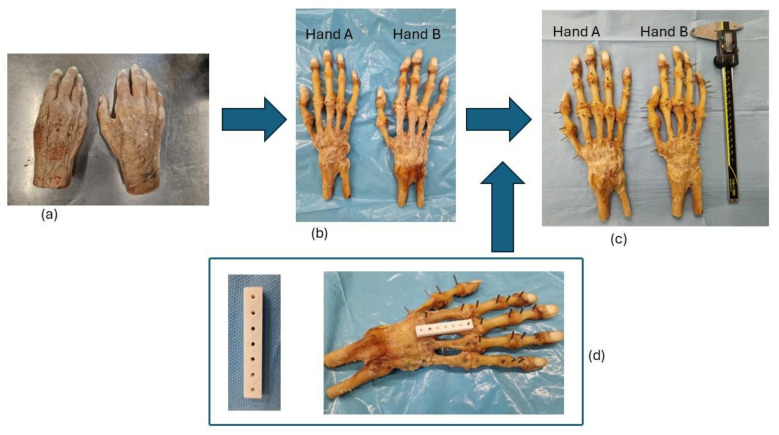
As 3D printing technology expands rapidly in medical disciplines, the accuracy evaluation of 3D-printed medical models is required. However, no established guidelines to assess the dimensional error of anatomical models exist. This study aims to evaluate the dimensional accuracy of medical models 3D-printed using a hospital-based Fused Deposition Modeling (FDM) 3D printer. Two dissected cadaveric right hands were marked with Titanium Kirshner wires to identify landmarks on the heads and bases of all metacarpals and proximal and middle phalanges. Both hands were scanned using a Cone Beam Computed Tomography scanner. Image post-processing and segmentation were performed on 3D Slicer software. Hand models were 3D-printed using a professional hospital-based FDM 3D printer. Manual measurements of all landmarks marked on both pairs of cadaveric and 3D-printed hands were taken by two independent observers using a digital caliper. The Mean Absolute Difference (MAD) and Mean Dimensional Error (MDE) were calculated. Our results showed an acceptable level of dimensional accuracy. The overall study's MAD was 0.32 mm (±0.34), and its MDE was 1.03% (±0.83). These values fall within the recommended range of errors. A high level of dimensional accuracy of the 3D-printed anatomical models was achieved, suggesting their reliability and suitability for medical applications.




 求助内容:
求助内容: 应助结果提醒方式:

 京公网安备 11010802042870号


