Sheng Hu , Fang Shen , Ning Jia , Caiyun Zhang , Xinxin Wu , Wencheng Jiang , Bin Li , Qilong Chen
{"title":"基于精确网络药理学的升脂化瘀方靶向PI3K/Akt信号通路的糖尿病创面愈合新单体配方","authors":"Sheng Hu , Fang Shen , Ning Jia , Caiyun Zhang , Xinxin Wu , Wencheng Jiang , Bin Li , Qilong Chen","doi":"10.1016/j.jep.2025.119509","DOIUrl":null,"url":null,"abstract":"<div><h3>Ethnopharmacological relevance</h3><div>Shengji-Huayu (SJHY) formula has been used clinically for diabetic ulcer (DU) treatment. The transcriptional profiles analysis revealed the PI3K/Akt signaling pathway plays a critical role for diabetic wound healing. However, the effects and underlying mechanisms of SJHY are often challenging in diabetic wound treatment.</div></div><div><h3>Aim of the study</h3><div>To explore the novel monomers recipe and mechanism of SJHY treated diabetic wound via the <em>in vivo</em> and <em>in vitro</em> experiments.</div></div><div><h3>Materials and methods</h3><div>The diabetic wound mice model was established to evaluate the therapeutic efficacy of SJHY treated diabetic ulcer. The transcriptional profile was implemented to identify the differentially expressed genes (DEGs) of SJHY treated diabetic wound mice. The constructed PPI network and KEGG-target network were used to identify the core pathway and related targets. The HPLC-MS method was used to identify the ingredients of SJHY formula. The molecular docking and <em>in vitro</em> experiment was used to screen which monomers regulated core pathway in diabetic wound. Finally, a novel monomers recipe was performed for diabetic wound healing.</div></div><div><h3>Results</h3><div>The <em>in vivo</em> experiment demonstrated SJHY formula significantly promoted diabetic wound healing. Transcriptomic and network analysis revealed the existence of PI3K/Akt signaling pathway was high correlated with SJHY treated diabetic wound. The HPLC-MS and molecular docking revealed that Calycosin (Cal) and Dehydromiltirone (DHT) were strongly targeting Itga6 and Thbs1. The mRNA and protein levels suggested that Itga6 and Thbs1 acted as important upstream regulators of PI3K/Akt signaling pathway in diabetic wound, and the <em>in vitro</em> experiments revealed Cal, DHT and their recipe were significantly increased the levels of Itga6, Thbs1, PI3K and Akt in MGO induced <em>HaCaT</em> cells.</div></div><div><h3>Conclusions</h3><div>SJHY formula has therapeutic efficiency for diabetic wound healing, and Cal and DHT may be a part of the important monomers that alleviate inflammation via activating the PI3K/Akt signaling pathway by regulated Itga6 and Thbs1. Our study demonstrated Cal and DHT formed a novel monomers recipe, which may be one of the critical strategies of SJHY formula promote diabetic wound healing.</div></div>","PeriodicalId":15761,"journal":{"name":"Journal of ethnopharmacology","volume":"344 ","pages":"Article 119509"},"PeriodicalIF":5.4000,"publicationDate":"2025-03-26","publicationTypes":"Journal Article","fieldsOfStudy":null,"isOpenAccess":false,"openAccessPdf":"","citationCount":"0","resultStr":"{\"title\":\"Novel monomers recipe derived from Shengji-Huayu formula targeting PI3K/Akt signaling pathway for diabetic wound healing based on accurate network pharmacology\",\"authors\":\"Sheng Hu , Fang Shen , Ning Jia , Caiyun Zhang , Xinxin Wu , Wencheng Jiang , Bin Li , Qilong Chen\",\"doi\":\"10.1016/j.jep.2025.119509\",\"DOIUrl\":null,\"url\":null,\"abstract\":\"<div><h3>Ethnopharmacological relevance</h3><div>Shengji-Huayu (SJHY) formula has been used clinically for diabetic ulcer (DU) treatment. The transcriptional profiles analysis revealed the PI3K/Akt signaling pathway plays a critical role for diabetic wound healing. However, the effects and underlying mechanisms of SJHY are often challenging in diabetic wound treatment.</div></div><div><h3>Aim of the study</h3><div>To explore the novel monomers recipe and mechanism of SJHY treated diabetic wound via the <em>in vivo</em> and <em>in vitro</em> experiments.</div></div><div><h3>Materials and methods</h3><div>The diabetic wound mice model was established to evaluate the therapeutic efficacy of SJHY treated diabetic ulcer. The transcriptional profile was implemented to identify the differentially expressed genes (DEGs) of SJHY treated diabetic wound mice. The constructed PPI network and KEGG-target network were used to identify the core pathway and related targets. The HPLC-MS method was used to identify the ingredients of SJHY formula. The molecular docking and <em>in vitro</em> experiment was used to screen which monomers regulated core pathway in diabetic wound. Finally, a novel monomers recipe was performed for diabetic wound healing.</div></div><div><h3>Results</h3><div>The <em>in vivo</em> experiment demonstrated SJHY formula significantly promoted diabetic wound healing. Transcriptomic and network analysis revealed the existence of PI3K/Akt signaling pathway was high correlated with SJHY treated diabetic wound. The HPLC-MS and molecular docking revealed that Calycosin (Cal) and Dehydromiltirone (DHT) were strongly targeting Itga6 and Thbs1. The mRNA and protein levels suggested that Itga6 and Thbs1 acted as important upstream regulators of PI3K/Akt signaling pathway in diabetic wound, and the <em>in vitro</em> experiments revealed Cal, DHT and their recipe were significantly increased the levels of Itga6, Thbs1, PI3K and Akt in MGO induced <em>HaCaT</em> cells.</div></div><div><h3>Conclusions</h3><div>SJHY formula has therapeutic efficiency for diabetic wound healing, and Cal and DHT may be a part of the important monomers that alleviate inflammation via activating the PI3K/Akt signaling pathway by regulated Itga6 and Thbs1. Our study demonstrated Cal and DHT formed a novel monomers recipe, which may be one of the critical strategies of SJHY formula promote diabetic wound healing.</div></div>\",\"PeriodicalId\":15761,\"journal\":{\"name\":\"Journal of ethnopharmacology\",\"volume\":\"344 \",\"pages\":\"Article 119509\"},\"PeriodicalIF\":5.4000,\"publicationDate\":\"2025-03-26\",\"publicationTypes\":\"Journal Article\",\"fieldsOfStudy\":null,\"isOpenAccess\":false,\"openAccessPdf\":\"\",\"citationCount\":\"0\",\"resultStr\":null,\"platform\":\"Semanticscholar\",\"paperid\":null,\"PeriodicalName\":\"Journal of ethnopharmacology\",\"FirstCategoryId\":\"3\",\"ListUrlMain\":\"https://www.sciencedirect.com/science/article/pii/S037887412500193X\",\"RegionNum\":2,\"RegionCategory\":\"医学\",\"ArticlePicture\":[],\"TitleCN\":null,\"AbstractTextCN\":null,\"PMCID\":null,\"EPubDate\":\"2025/2/17 0:00:00\",\"PubModel\":\"Epub\",\"JCR\":\"Q1\",\"JCRName\":\"CHEMISTRY, MEDICINAL\",\"Score\":null,\"Total\":0}","platform":"Semanticscholar","paperid":null,"PeriodicalName":"Journal of ethnopharmacology","FirstCategoryId":"3","ListUrlMain":"https://www.sciencedirect.com/science/article/pii/S037887412500193X","RegionNum":2,"RegionCategory":"医学","ArticlePicture":[],"TitleCN":null,"AbstractTextCN":null,"PMCID":null,"EPubDate":"2025/2/17 0:00:00","PubModel":"Epub","JCR":"Q1","JCRName":"CHEMISTRY, MEDICINAL","Score":null,"Total":0}
Novel monomers recipe derived from Shengji-Huayu formula targeting PI3K/Akt signaling pathway for diabetic wound healing based on accurate network pharmacology
Ethnopharmacological relevance
Shengji-Huayu (SJHY) formula has been used clinically for diabetic ulcer (DU) treatment. The transcriptional profiles analysis revealed the PI3K/Akt signaling pathway plays a critical role for diabetic wound healing. However, the effects and underlying mechanisms of SJHY are often challenging in diabetic wound treatment.
Aim of the study
To explore the novel monomers recipe and mechanism of SJHY treated diabetic wound via the in vivo and in vitro experiments.
Materials and methods
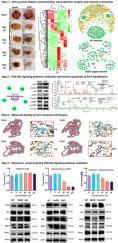
The diabetic wound mice model was established to evaluate the therapeutic efficacy of SJHY treated diabetic ulcer. The transcriptional profile was implemented to identify the differentially expressed genes (DEGs) of SJHY treated diabetic wound mice. The constructed PPI network and KEGG-target network were used to identify the core pathway and related targets. The HPLC-MS method was used to identify the ingredients of SJHY formula. The molecular docking and in vitro experiment was used to screen which monomers regulated core pathway in diabetic wound. Finally, a novel monomers recipe was performed for diabetic wound healing.
Results
The in vivo experiment demonstrated SJHY formula significantly promoted diabetic wound healing. Transcriptomic and network analysis revealed the existence of PI3K/Akt signaling pathway was high correlated with SJHY treated diabetic wound. The HPLC-MS and molecular docking revealed that Calycosin (Cal) and Dehydromiltirone (DHT) were strongly targeting Itga6 and Thbs1. The mRNA and protein levels suggested that Itga6 and Thbs1 acted as important upstream regulators of PI3K/Akt signaling pathway in diabetic wound, and the in vitro experiments revealed Cal, DHT and their recipe were significantly increased the levels of Itga6, Thbs1, PI3K and Akt in MGO induced HaCaT cells.
Conclusions
SJHY formula has therapeutic efficiency for diabetic wound healing, and Cal and DHT may be a part of the important monomers that alleviate inflammation via activating the PI3K/Akt signaling pathway by regulated Itga6 and Thbs1. Our study demonstrated Cal and DHT formed a novel monomers recipe, which may be one of the critical strategies of SJHY formula promote diabetic wound healing.
期刊介绍:
The Journal of Ethnopharmacology is dedicated to the exchange of information and understandings about people''s use of plants, fungi, animals, microorganisms and minerals and their biological and pharmacological effects based on the principles established through international conventions. Early people confronted with illness and disease, discovered a wealth of useful therapeutic agents in the plant and animal kingdoms. The empirical knowledge of these medicinal substances and their toxic potential was passed on by oral tradition and sometimes recorded in herbals and other texts on materia medica. Many valuable drugs of today (e.g., atropine, ephedrine, tubocurarine, digoxin, reserpine) came into use through the study of indigenous remedies. Chemists continue to use plant-derived drugs (e.g., morphine, taxol, physostigmine, quinidine, emetine) as prototypes in their attempts to develop more effective and less toxic medicinals.