Bailee N. Barrett, Pedram AziziHariri, Vijay T. John, Donghui Zhang
{"title":"通过可电离单体位置和溶液pH调节序列型离子型肽嵌段共聚物的胶束重组","authors":"Bailee N. Barrett, Pedram AziziHariri, Vijay T. John, Donghui Zhang","doi":"10.1021/acs.macromol.4c02829","DOIUrl":null,"url":null,"abstract":"The micellar aggregation of singly charged sequence-defined ionic peptoid block copolymers can be finely tuned by adjusting the position of the ionizable monomer along the chain and varying the solution pH. The pH-induced structural reorganization of these micelles was found to depend on the position of the ionizable monomer along the chain, influencing the balance of the hydrophobic interactions, excluded volume effect, and electrostatic forces (i.e., charge repulsion, solvation of the ionic monomers, counterion association) that govern the micellar structure. As the solution pH increases, positioning the ionizable monomer closer to the junction of the hydrophobic and hydrophilic blocks causes a larger reduction in the micellar size and aggregation number across two distinct regimes. In contrast, placing the ionizable monomer at the terminus of the hydrophilic block results in a smaller reduction in the micellar size and aggregation number over three regimes. This study provides new insights into leveraging the strategic positioning of ionizable monomers to design stimuli-responsive nanoassemblies capable of programmable structural reorganization.","PeriodicalId":51,"journal":{"name":"Macromolecules","volume":"41 1","pages":""},"PeriodicalIF":5.2000,"publicationDate":"2025-02-09","publicationTypes":"Journal Article","fieldsOfStudy":null,"isOpenAccess":false,"openAccessPdf":"","citationCount":"0","resultStr":"{\"title\":\"Modulating the Aqueous Micellar Reorganization of Sequence-Defined Ionic Peptoid Block Copolymers by Ionizable Monomer Position and Solution pH\",\"authors\":\"Bailee N. Barrett, Pedram AziziHariri, Vijay T. John, Donghui Zhang\",\"doi\":\"10.1021/acs.macromol.4c02829\",\"DOIUrl\":null,\"url\":null,\"abstract\":\"The micellar aggregation of singly charged sequence-defined ionic peptoid block copolymers can be finely tuned by adjusting the position of the ionizable monomer along the chain and varying the solution pH. The pH-induced structural reorganization of these micelles was found to depend on the position of the ionizable monomer along the chain, influencing the balance of the hydrophobic interactions, excluded volume effect, and electrostatic forces (i.e., charge repulsion, solvation of the ionic monomers, counterion association) that govern the micellar structure. As the solution pH increases, positioning the ionizable monomer closer to the junction of the hydrophobic and hydrophilic blocks causes a larger reduction in the micellar size and aggregation number across two distinct regimes. In contrast, placing the ionizable monomer at the terminus of the hydrophilic block results in a smaller reduction in the micellar size and aggregation number over three regimes. This study provides new insights into leveraging the strategic positioning of ionizable monomers to design stimuli-responsive nanoassemblies capable of programmable structural reorganization.\",\"PeriodicalId\":51,\"journal\":{\"name\":\"Macromolecules\",\"volume\":\"41 1\",\"pages\":\"\"},\"PeriodicalIF\":5.2000,\"publicationDate\":\"2025-02-09\",\"publicationTypes\":\"Journal Article\",\"fieldsOfStudy\":null,\"isOpenAccess\":false,\"openAccessPdf\":\"\",\"citationCount\":\"0\",\"resultStr\":null,\"platform\":\"Semanticscholar\",\"paperid\":null,\"PeriodicalName\":\"Macromolecules\",\"FirstCategoryId\":\"92\",\"ListUrlMain\":\"https://doi.org/10.1021/acs.macromol.4c02829\",\"RegionNum\":1,\"RegionCategory\":\"化学\",\"ArticlePicture\":[],\"TitleCN\":null,\"AbstractTextCN\":null,\"PMCID\":null,\"EPubDate\":\"\",\"PubModel\":\"\",\"JCR\":\"Q1\",\"JCRName\":\"POLYMER SCIENCE\",\"Score\":null,\"Total\":0}","platform":"Semanticscholar","paperid":null,"PeriodicalName":"Macromolecules","FirstCategoryId":"92","ListUrlMain":"https://doi.org/10.1021/acs.macromol.4c02829","RegionNum":1,"RegionCategory":"化学","ArticlePicture":[],"TitleCN":null,"AbstractTextCN":null,"PMCID":null,"EPubDate":"","PubModel":"","JCR":"Q1","JCRName":"POLYMER SCIENCE","Score":null,"Total":0}
Modulating the Aqueous Micellar Reorganization of Sequence-Defined Ionic Peptoid Block Copolymers by Ionizable Monomer Position and Solution pH
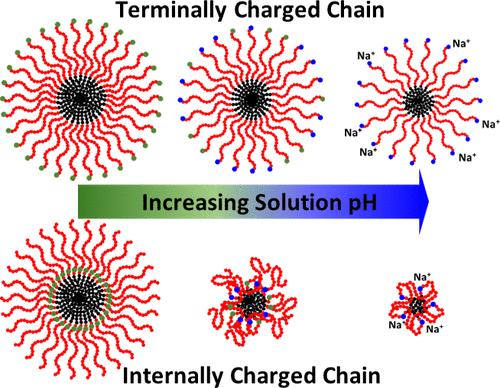
The micellar aggregation of singly charged sequence-defined ionic peptoid block copolymers can be finely tuned by adjusting the position of the ionizable monomer along the chain and varying the solution pH. The pH-induced structural reorganization of these micelles was found to depend on the position of the ionizable monomer along the chain, influencing the balance of the hydrophobic interactions, excluded volume effect, and electrostatic forces (i.e., charge repulsion, solvation of the ionic monomers, counterion association) that govern the micellar structure. As the solution pH increases, positioning the ionizable monomer closer to the junction of the hydrophobic and hydrophilic blocks causes a larger reduction in the micellar size and aggregation number across two distinct regimes. In contrast, placing the ionizable monomer at the terminus of the hydrophilic block results in a smaller reduction in the micellar size and aggregation number over three regimes. This study provides new insights into leveraging the strategic positioning of ionizable monomers to design stimuli-responsive nanoassemblies capable of programmable structural reorganization.
期刊介绍:
Macromolecules publishes original, fundamental, and impactful research on all aspects of polymer science. Topics of interest include synthesis (e.g., controlled polymerizations, polymerization catalysis, post polymerization modification, new monomer structures and polymer architectures, and polymerization mechanisms/kinetics analysis); phase behavior, thermodynamics, dynamic, and ordering/disordering phenomena (e.g., self-assembly, gelation, crystallization, solution/melt/solid-state characteristics); structure and properties (e.g., mechanical and rheological properties, surface/interfacial characteristics, electronic and transport properties); new state of the art characterization (e.g., spectroscopy, scattering, microscopy, rheology), simulation (e.g., Monte Carlo, molecular dynamics, multi-scale/coarse-grained modeling), and theoretical methods. Renewable/sustainable polymers, polymer networks, responsive polymers, electro-, magneto- and opto-active macromolecules, inorganic polymers, charge-transporting polymers (ion-containing, semiconducting, and conducting), nanostructured polymers, and polymer composites are also of interest. Typical papers published in Macromolecules showcase important and innovative concepts, experimental methods/observations, and theoretical/computational approaches that demonstrate a fundamental advance in the understanding of polymers.