Haishao Yu, Shuangzhu Lin, Lin Li, Jiayi Li, Qiandui Chen, Yuheng Wu, Yangfan Qi, Wanqi Wang, Xingzhi Chang, Jie Zhang
{"title":"病例报告:新型ADA2变异引起非典型腺苷脱氨酶2缺乏。","authors":"Haishao Yu, Shuangzhu Lin, Lin Li, Jiayi Li, Qiandui Chen, Yuheng Wu, Yangfan Qi, Wanqi Wang, Xingzhi Chang, Jie Zhang","doi":"10.3389/fgene.2024.1478581","DOIUrl":null,"url":null,"abstract":"<p><strong>Case presentation: </strong>A girl aged 2 years and 5 months presented to the hospital with chief complaints of intermittent fever and weakness of the left limb for more than 1 month. The child had transient urticaria appearing on her face for 5 days. The inflammatory biomarkers were significantly increased. Brain MRI showed multiple ischemic lesions in the brain's small vessels. The patient exhibited significant systemic inflammation and multiple vasculitis. Whole-exome sequencing showed c.1358A>G p. (Tyr453Cys) and c.1082-7T>A compound heterozygous variants in the adenosine deaminase 2 (<i>ADA2</i>) gene, of which the c.1082-7T>A variant has not been reported yet in previous literature. Peripheral blood mRNA reverse transcription-Sanger sequencing confirmed that this variant affected mRNA splicing, resulting in a frameshift with premature stop codon c.1083_1103del p. (Leu362Glnfs*45). Peripheral blood test suggested a significant decrease in ADA2 activity. Eventually, the patient was diagnosed with deficiency of adenosine deaminase 2 (DADA2). Her condition improved after treatment with etanercept. She had no more fevers, and no hemiplegia attacks were observed during the 3 years of follow-up.</p><p><strong>Conclusion: </strong>Fever and hemiplegia were the main manifestations in this patient, without typical rashes. DADA2 was finally confirmed by enzymology and genetic testing, and we believe this is the first reported case of the c.1082-7T>A intronic variant in DADA2, and the RNA studies conducted in this case have been pivotal in assessing its pathogenicity.</p>","PeriodicalId":12750,"journal":{"name":"Frontiers in Genetics","volume":"15 ","pages":"1478581"},"PeriodicalIF":2.8000,"publicationDate":"2025-01-15","publicationTypes":"Journal Article","fieldsOfStudy":null,"isOpenAccess":false,"openAccessPdf":"https://www.ncbi.nlm.nih.gov/pmc/articles/PMC11774911/pdf/","citationCount":"0","resultStr":"{\"title\":\"Case Report: Novel <i>ADA2</i> variants cause atypical adenosine deaminase 2 deficiency.\",\"authors\":\"Haishao Yu, Shuangzhu Lin, Lin Li, Jiayi Li, Qiandui Chen, Yuheng Wu, Yangfan Qi, Wanqi Wang, Xingzhi Chang, Jie Zhang\",\"doi\":\"10.3389/fgene.2024.1478581\",\"DOIUrl\":null,\"url\":null,\"abstract\":\"<p><strong>Case presentation: </strong>A girl aged 2 years and 5 months presented to the hospital with chief complaints of intermittent fever and weakness of the left limb for more than 1 month. The child had transient urticaria appearing on her face for 5 days. The inflammatory biomarkers were significantly increased. Brain MRI showed multiple ischemic lesions in the brain's small vessels. The patient exhibited significant systemic inflammation and multiple vasculitis. Whole-exome sequencing showed c.1358A>G p. (Tyr453Cys) and c.1082-7T>A compound heterozygous variants in the adenosine deaminase 2 (<i>ADA2</i>) gene, of which the c.1082-7T>A variant has not been reported yet in previous literature. Peripheral blood mRNA reverse transcription-Sanger sequencing confirmed that this variant affected mRNA splicing, resulting in a frameshift with premature stop codon c.1083_1103del p. (Leu362Glnfs*45). Peripheral blood test suggested a significant decrease in ADA2 activity. Eventually, the patient was diagnosed with deficiency of adenosine deaminase 2 (DADA2). Her condition improved after treatment with etanercept. She had no more fevers, and no hemiplegia attacks were observed during the 3 years of follow-up.</p><p><strong>Conclusion: </strong>Fever and hemiplegia were the main manifestations in this patient, without typical rashes. DADA2 was finally confirmed by enzymology and genetic testing, and we believe this is the first reported case of the c.1082-7T>A intronic variant in DADA2, and the RNA studies conducted in this case have been pivotal in assessing its pathogenicity.</p>\",\"PeriodicalId\":12750,\"journal\":{\"name\":\"Frontiers in Genetics\",\"volume\":\"15 \",\"pages\":\"1478581\"},\"PeriodicalIF\":2.8000,\"publicationDate\":\"2025-01-15\",\"publicationTypes\":\"Journal Article\",\"fieldsOfStudy\":null,\"isOpenAccess\":false,\"openAccessPdf\":\"https://www.ncbi.nlm.nih.gov/pmc/articles/PMC11774911/pdf/\",\"citationCount\":\"0\",\"resultStr\":null,\"platform\":\"Semanticscholar\",\"paperid\":null,\"PeriodicalName\":\"Frontiers in Genetics\",\"FirstCategoryId\":\"99\",\"ListUrlMain\":\"https://doi.org/10.3389/fgene.2024.1478581\",\"RegionNum\":3,\"RegionCategory\":\"生物学\",\"ArticlePicture\":[],\"TitleCN\":null,\"AbstractTextCN\":null,\"PMCID\":null,\"EPubDate\":\"2024/1/1 0:00:00\",\"PubModel\":\"eCollection\",\"JCR\":\"Q2\",\"JCRName\":\"GENETICS & HEREDITY\",\"Score\":null,\"Total\":0}","platform":"Semanticscholar","paperid":null,"PeriodicalName":"Frontiers in Genetics","FirstCategoryId":"99","ListUrlMain":"https://doi.org/10.3389/fgene.2024.1478581","RegionNum":3,"RegionCategory":"生物学","ArticlePicture":[],"TitleCN":null,"AbstractTextCN":null,"PMCID":null,"EPubDate":"2024/1/1 0:00:00","PubModel":"eCollection","JCR":"Q2","JCRName":"GENETICS & HEREDITY","Score":null,"Total":0}
引用次数: 0
摘要
病例介绍:一名女童,年龄2岁零5个月,主诉为间歇性发热,左肢体无力1个多月。该儿童面部出现短暂性荨麻疹,持续5天。炎症生物标志物显著升高。脑MRI显示脑小血管多发缺血性病变。患者表现出明显的全身炎症和多发性血管炎。全外显子组测序显示,腺苷脱氨酶2 (ADA2)基因存在c.1358A>G . p. (Tyr453Cys)和c.1082-7T>A复合杂合变异体,其中c.1082-7T>A变异体在既往文献中未见报道。外周血mRNA逆转录- sanger测序证实,该变异影响mRNA剪接,导致带有过早终止密码子c.1083_1103del p的移码(Leu362Glnfs*45)。外周血检查显示ADA2活性明显降低。最终,患者被诊断为腺苷脱氨酶2 (DADA2)缺乏。经依那西普治疗后病情好转。在3年的随访中,她不再发烧,也没有观察到偏瘫发作。结论:该患者以发热、偏瘫为主要表现,无典型皮疹。最终通过酶学和基因检测证实了DADA2,我们认为这是DADA2 c.1082-7T>A内含子变异的第一例报道,在该病例中进行的RNA研究对评估其致病性具有关键意义。
Case Report: Novel ADA2 variants cause atypical adenosine deaminase 2 deficiency.
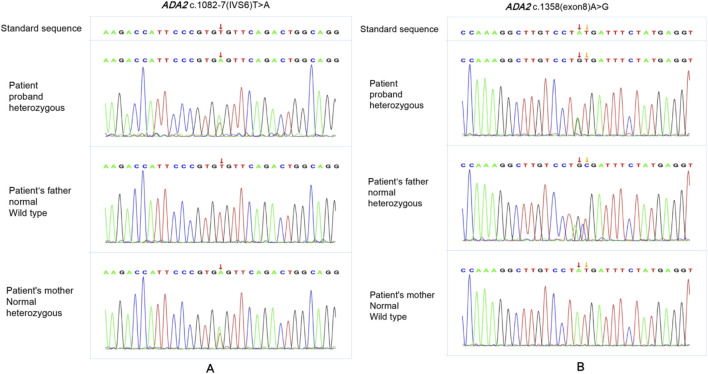
Case presentation: A girl aged 2 years and 5 months presented to the hospital with chief complaints of intermittent fever and weakness of the left limb for more than 1 month. The child had transient urticaria appearing on her face for 5 days. The inflammatory biomarkers were significantly increased. Brain MRI showed multiple ischemic lesions in the brain's small vessels. The patient exhibited significant systemic inflammation and multiple vasculitis. Whole-exome sequencing showed c.1358A>G p. (Tyr453Cys) and c.1082-7T>A compound heterozygous variants in the adenosine deaminase 2 (ADA2) gene, of which the c.1082-7T>A variant has not been reported yet in previous literature. Peripheral blood mRNA reverse transcription-Sanger sequencing confirmed that this variant affected mRNA splicing, resulting in a frameshift with premature stop codon c.1083_1103del p. (Leu362Glnfs*45). Peripheral blood test suggested a significant decrease in ADA2 activity. Eventually, the patient was diagnosed with deficiency of adenosine deaminase 2 (DADA2). Her condition improved after treatment with etanercept. She had no more fevers, and no hemiplegia attacks were observed during the 3 years of follow-up.
Conclusion: Fever and hemiplegia were the main manifestations in this patient, without typical rashes. DADA2 was finally confirmed by enzymology and genetic testing, and we believe this is the first reported case of the c.1082-7T>A intronic variant in DADA2, and the RNA studies conducted in this case have been pivotal in assessing its pathogenicity.
Frontiers in GeneticsBiochemistry, Genetics and Molecular Biology-Molecular Medicine
CiteScore
5.50
自引率
8.10%
发文量
3491
审稿时长
14 weeks
期刊介绍:
Frontiers in Genetics publishes rigorously peer-reviewed research on genes and genomes relating to all the domains of life, from humans to plants to livestock and other model organisms. Led by an outstanding Editorial Board of the world’s leading experts, this multidisciplinary, open-access journal is at the forefront of communicating cutting-edge research to researchers, academics, clinicians, policy makers and the public.
The study of inheritance and the impact of the genome on various biological processes is well documented. However, the majority of discoveries are still to come. A new era is seeing major developments in the function and variability of the genome, the use of genetic and genomic tools and the analysis of the genetic basis of various biological phenomena.




 求助内容:
求助内容: 应助结果提醒方式:

 京公网安备 11010802042870号


