{"title":"纳米磁学中自旋-晶格耦合突破尺寸依赖极限","authors":"Mengmeng Li, Xiuyu Wang","doi":"10.1021/jacs.4c12978","DOIUrl":null,"url":null,"abstract":"Further miniaturization of magnetic nanomaterials is intrinsically accompanied by a reduction in spin ordered domains, resulting in size-dependent magnetic behaviors. Consequently, a longstanding roadblock in the advancement of nanodevices based on magnetic nanomaterials is the absence of a method to beat the size-dependent limit in nanomagnetism. Here, we discover and exploit a spin–lattice coupling effect in three-dimensional freestanding magnetic nanoparticles to beat the size-dependent limit for the first time. The so-called spin–lattice coupling involves varying spin configuration and exchange constant of spin interactions induced by lattice deformations. We correlate spin–lattice coupling to g-shift and employ two-dimensional magnetic resonance imaging to visualize <i>g</i>-factor. As lattice constants decrease (even ∼1%), positive offset of g-shift increases significantly, signaling stronger spin–lattice coupling, which induces a transition from paramagnetism to surperparamagnetism, thereby effectively beating the size-dependent limit.","PeriodicalId":49,"journal":{"name":"Journal of the American Chemical Society","volume":"28 1","pages":""},"PeriodicalIF":15.6000,"publicationDate":"2025-01-06","publicationTypes":"Journal Article","fieldsOfStudy":null,"isOpenAccess":false,"openAccessPdf":"","citationCount":"0","resultStr":"{\"title\":\"Beating the Size-Dependent Limit with Spin–Lattice Coupling in Nanomagnetism\",\"authors\":\"Mengmeng Li, Xiuyu Wang\",\"doi\":\"10.1021/jacs.4c12978\",\"DOIUrl\":null,\"url\":null,\"abstract\":\"Further miniaturization of magnetic nanomaterials is intrinsically accompanied by a reduction in spin ordered domains, resulting in size-dependent magnetic behaviors. Consequently, a longstanding roadblock in the advancement of nanodevices based on magnetic nanomaterials is the absence of a method to beat the size-dependent limit in nanomagnetism. Here, we discover and exploit a spin–lattice coupling effect in three-dimensional freestanding magnetic nanoparticles to beat the size-dependent limit for the first time. The so-called spin–lattice coupling involves varying spin configuration and exchange constant of spin interactions induced by lattice deformations. We correlate spin–lattice coupling to g-shift and employ two-dimensional magnetic resonance imaging to visualize <i>g</i>-factor. As lattice constants decrease (even ∼1%), positive offset of g-shift increases significantly, signaling stronger spin–lattice coupling, which induces a transition from paramagnetism to surperparamagnetism, thereby effectively beating the size-dependent limit.\",\"PeriodicalId\":49,\"journal\":{\"name\":\"Journal of the American Chemical Society\",\"volume\":\"28 1\",\"pages\":\"\"},\"PeriodicalIF\":15.6000,\"publicationDate\":\"2025-01-06\",\"publicationTypes\":\"Journal Article\",\"fieldsOfStudy\":null,\"isOpenAccess\":false,\"openAccessPdf\":\"\",\"citationCount\":\"0\",\"resultStr\":null,\"platform\":\"Semanticscholar\",\"paperid\":null,\"PeriodicalName\":\"Journal of the American Chemical Society\",\"FirstCategoryId\":\"92\",\"ListUrlMain\":\"https://doi.org/10.1021/jacs.4c12978\",\"RegionNum\":1,\"RegionCategory\":\"化学\",\"ArticlePicture\":[],\"TitleCN\":null,\"AbstractTextCN\":null,\"PMCID\":null,\"EPubDate\":\"\",\"PubModel\":\"\",\"JCR\":\"Q1\",\"JCRName\":\"CHEMISTRY, MULTIDISCIPLINARY\",\"Score\":null,\"Total\":0}","platform":"Semanticscholar","paperid":null,"PeriodicalName":"Journal of the American Chemical Society","FirstCategoryId":"92","ListUrlMain":"https://doi.org/10.1021/jacs.4c12978","RegionNum":1,"RegionCategory":"化学","ArticlePicture":[],"TitleCN":null,"AbstractTextCN":null,"PMCID":null,"EPubDate":"","PubModel":"","JCR":"Q1","JCRName":"CHEMISTRY, MULTIDISCIPLINARY","Score":null,"Total":0}
Beating the Size-Dependent Limit with Spin–Lattice Coupling in Nanomagnetism
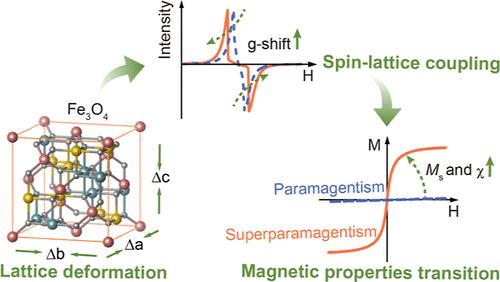
Further miniaturization of magnetic nanomaterials is intrinsically accompanied by a reduction in spin ordered domains, resulting in size-dependent magnetic behaviors. Consequently, a longstanding roadblock in the advancement of nanodevices based on magnetic nanomaterials is the absence of a method to beat the size-dependent limit in nanomagnetism. Here, we discover and exploit a spin–lattice coupling effect in three-dimensional freestanding magnetic nanoparticles to beat the size-dependent limit for the first time. The so-called spin–lattice coupling involves varying spin configuration and exchange constant of spin interactions induced by lattice deformations. We correlate spin–lattice coupling to g-shift and employ two-dimensional magnetic resonance imaging to visualize g-factor. As lattice constants decrease (even ∼1%), positive offset of g-shift increases significantly, signaling stronger spin–lattice coupling, which induces a transition from paramagnetism to surperparamagnetism, thereby effectively beating the size-dependent limit.
期刊介绍:
The flagship journal of the American Chemical Society, known as the Journal of the American Chemical Society (JACS), has been a prestigious publication since its establishment in 1879. It holds a preeminent position in the field of chemistry and related interdisciplinary sciences. JACS is committed to disseminating cutting-edge research papers, covering a wide range of topics, and encompasses approximately 19,000 pages of Articles, Communications, and Perspectives annually. With a weekly publication frequency, JACS plays a vital role in advancing the field of chemistry by providing essential research.