Uddipta Kar, Elisha Cho-Hao Lu, Akhilesh Kr. Singh, P. V. Sreenivasa Reddy, Youngjoon Han, Xinwei Li, Cheng-Tung Cheng, Song Yang, Chun-Yen Lin, I-Chun Cheng, Chia-Hung Hsu, David Hsieh, Wei-Cheng Lee, Guang-Yu Guo, Wei-Li Lee
{"title":"铁磁性 Weyl MetalSrRuO3 非孪晶薄膜中的非线性和非互易传输效应","authors":"Uddipta Kar, Elisha Cho-Hao Lu, Akhilesh Kr. Singh, P. V. Sreenivasa Reddy, Youngjoon Han, Xinwei Li, Cheng-Tung Cheng, Song Yang, Chun-Yen Lin, I-Chun Cheng, Chia-Hung Hsu, David Hsieh, Wei-Cheng Lee, Guang-Yu Guo, Wei-Li Lee","doi":"10.1103/physrevx.14.011022","DOIUrl":null,"url":null,"abstract":"The identification of distinct charge transport features, deriving from nontrivial bulk band and surface states, has been a challenging subject in the field of topological systems. In topological Dirac and Weyl semimetals, nontrivial conical bands with Fermi-arc surface states give rise to negative longitudinal magnetoresistance due to chiral anomaly effect and unusual thickness dependent quantum oscillation from Weyl-orbit effect, which were demonstrated recently in experiments. In this work, we report the experimental observations of large nonlinear and nonreciprocal transport effects for both longitudinal and transverse channels in an untwinned Weyl metal of <math display=\"inline\" xmlns=\"http://www.w3.org/1998/Math/MathML\"><mrow><msub><mrow><mi>SrRuO</mi></mrow><mrow><mn>3</mn></mrow></msub></mrow></math> thin film grown on a <math display=\"inline\" xmlns=\"http://www.w3.org/1998/Math/MathML\"><mrow><msub><mrow><mi>SrTiO</mi></mrow><mrow><mn>3</mn></mrow></msub></mrow></math> substrate. From rigorous measurements with bias current applied along various directions with respect to the crystalline principal axes, the magnitude of nonlinear Hall signals from the transverse channel exhibits a simple <math display=\"inline\" xmlns=\"http://www.w3.org/1998/Math/MathML\"><mrow><mi>sin</mi><mi>α</mi></mrow></math> dependence at low temperatures, where <math display=\"inline\" xmlns=\"http://www.w3.org/1998/Math/MathML\"><mi>α</mi></math> is the angle between bias current direction and orthorhombic <math display=\"inline\" xmlns=\"http://www.w3.org/1998/Math/MathML\"><mrow><mo stretchy=\"false\">[</mo><mn>001</mn><msub><mrow><mo stretchy=\"false\">]</mo></mrow><mrow><mi mathvariant=\"normal\">o</mi></mrow></msub></mrow></math>, reaching a maximum when current is along orthorhombic <math display=\"inline\" xmlns=\"http://www.w3.org/1998/Math/MathML\"><mrow><mo stretchy=\"false\">[</mo><mn>1</mn><mover accent=\"true\"><mrow><mn>1</mn></mrow><mrow><mo stretchy=\"false\">¯</mo></mrow></mover><mn>0</mn><msub><mrow><mo stretchy=\"false\">]</mo></mrow><mrow><mi mathvariant=\"normal\">o</mi></mrow></msub></mrow></math>. On the contrary, the magnitude of nonlinear and nonreciprocal signals in the longitudinal channel attains a maximum for bias current along <math display=\"inline\" xmlns=\"http://www.w3.org/1998/Math/MathML\"><mrow><mo stretchy=\"false\">[</mo><mn>001</mn><msub><mrow><mo stretchy=\"false\">]</mo></mrow><mrow><mi mathvariant=\"normal\">o</mi></mrow></msub></mrow></math>, and it vanishes for bias current along <math display=\"inline\" xmlns=\"http://www.w3.org/1998/Math/MathML\"><mrow><mo stretchy=\"false\">[</mo><mn>1</mn><mover accent=\"true\"><mrow><mn>1</mn></mrow><mrow><mo stretchy=\"false\">¯</mo></mrow></mover><mn>0</mn><msub><mrow><mo stretchy=\"false\">]</mo></mrow><mrow><mi mathvariant=\"normal\">o</mi></mrow></msub></mrow></math>. The observed <math display=\"inline\" xmlns=\"http://www.w3.org/1998/Math/MathML\"><mi>α</mi></math>-dependent nonlinear and nonreciprocal signals in longitudinal and transverse channels reveal a magnetic Weyl phase with an effective Berry curvature dipole along <math display=\"inline\" xmlns=\"http://www.w3.org/1998/Math/MathML\"><mrow><mo stretchy=\"false\">[</mo><mn>1</mn><mover accent=\"true\"><mrow><mn>1</mn></mrow><mrow><mo stretchy=\"false\">¯</mo></mrow></mover><mn>0</mn><msub><mrow><mo stretchy=\"false\">]</mo></mrow><mrow><mi mathvariant=\"normal\">o</mi></mrow></msub></mrow></math> from surface states, accompanied by 1D chiral edge modes along <math display=\"inline\" xmlns=\"http://www.w3.org/1998/Math/MathML\"><mrow><mo stretchy=\"false\">[</mo><mn>001</mn><msub><mrow><mo stretchy=\"false\">]</mo></mrow><mrow><mi mathvariant=\"normal\">o</mi></mrow></msub></mrow></math>.","PeriodicalId":20161,"journal":{"name":"Physical Review X","volume":"10 1","pages":""},"PeriodicalIF":15.7000,"publicationDate":"2024-02-20","publicationTypes":"Journal Article","fieldsOfStudy":null,"isOpenAccess":false,"openAccessPdf":"","citationCount":"0","resultStr":"{\"title\":\"Nonlinear and Nonreciprocal Transport Effects in Untwinned Thin Films of Ferromagnetic Weyl MetalSrRuO3\",\"authors\":\"Uddipta Kar, Elisha Cho-Hao Lu, Akhilesh Kr. Singh, P. V. Sreenivasa Reddy, Youngjoon Han, Xinwei Li, Cheng-Tung Cheng, Song Yang, Chun-Yen Lin, I-Chun Cheng, Chia-Hung Hsu, David Hsieh, Wei-Cheng Lee, Guang-Yu Guo, Wei-Li Lee\",\"doi\":\"10.1103/physrevx.14.011022\",\"DOIUrl\":null,\"url\":null,\"abstract\":\"The identification of distinct charge transport features, deriving from nontrivial bulk band and surface states, has been a challenging subject in the field of topological systems. In topological Dirac and Weyl semimetals, nontrivial conical bands with Fermi-arc surface states give rise to negative longitudinal magnetoresistance due to chiral anomaly effect and unusual thickness dependent quantum oscillation from Weyl-orbit effect, which were demonstrated recently in experiments. In this work, we report the experimental observations of large nonlinear and nonreciprocal transport effects for both longitudinal and transverse channels in an untwinned Weyl metal of <math display=\\\"inline\\\" xmlns=\\\"http://www.w3.org/1998/Math/MathML\\\"><mrow><msub><mrow><mi>SrRuO</mi></mrow><mrow><mn>3</mn></mrow></msub></mrow></math> thin film grown on a <math display=\\\"inline\\\" xmlns=\\\"http://www.w3.org/1998/Math/MathML\\\"><mrow><msub><mrow><mi>SrTiO</mi></mrow><mrow><mn>3</mn></mrow></msub></mrow></math> substrate. From rigorous measurements with bias current applied along various directions with respect to the crystalline principal axes, the magnitude of nonlinear Hall signals from the transverse channel exhibits a simple <math display=\\\"inline\\\" xmlns=\\\"http://www.w3.org/1998/Math/MathML\\\"><mrow><mi>sin</mi><mi>α</mi></mrow></math> dependence at low temperatures, where <math display=\\\"inline\\\" xmlns=\\\"http://www.w3.org/1998/Math/MathML\\\"><mi>α</mi></math> is the angle between bias current direction and orthorhombic <math display=\\\"inline\\\" xmlns=\\\"http://www.w3.org/1998/Math/MathML\\\"><mrow><mo stretchy=\\\"false\\\">[</mo><mn>001</mn><msub><mrow><mo stretchy=\\\"false\\\">]</mo></mrow><mrow><mi mathvariant=\\\"normal\\\">o</mi></mrow></msub></mrow></math>, reaching a maximum when current is along orthorhombic <math display=\\\"inline\\\" xmlns=\\\"http://www.w3.org/1998/Math/MathML\\\"><mrow><mo stretchy=\\\"false\\\">[</mo><mn>1</mn><mover accent=\\\"true\\\"><mrow><mn>1</mn></mrow><mrow><mo stretchy=\\\"false\\\">¯</mo></mrow></mover><mn>0</mn><msub><mrow><mo stretchy=\\\"false\\\">]</mo></mrow><mrow><mi mathvariant=\\\"normal\\\">o</mi></mrow></msub></mrow></math>. On the contrary, the magnitude of nonlinear and nonreciprocal signals in the longitudinal channel attains a maximum for bias current along <math display=\\\"inline\\\" xmlns=\\\"http://www.w3.org/1998/Math/MathML\\\"><mrow><mo stretchy=\\\"false\\\">[</mo><mn>001</mn><msub><mrow><mo stretchy=\\\"false\\\">]</mo></mrow><mrow><mi mathvariant=\\\"normal\\\">o</mi></mrow></msub></mrow></math>, and it vanishes for bias current along <math display=\\\"inline\\\" xmlns=\\\"http://www.w3.org/1998/Math/MathML\\\"><mrow><mo stretchy=\\\"false\\\">[</mo><mn>1</mn><mover accent=\\\"true\\\"><mrow><mn>1</mn></mrow><mrow><mo stretchy=\\\"false\\\">¯</mo></mrow></mover><mn>0</mn><msub><mrow><mo stretchy=\\\"false\\\">]</mo></mrow><mrow><mi mathvariant=\\\"normal\\\">o</mi></mrow></msub></mrow></math>. The observed <math display=\\\"inline\\\" xmlns=\\\"http://www.w3.org/1998/Math/MathML\\\"><mi>α</mi></math>-dependent nonlinear and nonreciprocal signals in longitudinal and transverse channels reveal a magnetic Weyl phase with an effective Berry curvature dipole along <math display=\\\"inline\\\" xmlns=\\\"http://www.w3.org/1998/Math/MathML\\\"><mrow><mo stretchy=\\\"false\\\">[</mo><mn>1</mn><mover accent=\\\"true\\\"><mrow><mn>1</mn></mrow><mrow><mo stretchy=\\\"false\\\">¯</mo></mrow></mover><mn>0</mn><msub><mrow><mo stretchy=\\\"false\\\">]</mo></mrow><mrow><mi mathvariant=\\\"normal\\\">o</mi></mrow></msub></mrow></math> from surface states, accompanied by 1D chiral edge modes along <math display=\\\"inline\\\" xmlns=\\\"http://www.w3.org/1998/Math/MathML\\\"><mrow><mo stretchy=\\\"false\\\">[</mo><mn>001</mn><msub><mrow><mo stretchy=\\\"false\\\">]</mo></mrow><mrow><mi mathvariant=\\\"normal\\\">o</mi></mrow></msub></mrow></math>.\",\"PeriodicalId\":20161,\"journal\":{\"name\":\"Physical Review X\",\"volume\":\"10 1\",\"pages\":\"\"},\"PeriodicalIF\":15.7000,\"publicationDate\":\"2024-02-20\",\"publicationTypes\":\"Journal Article\",\"fieldsOfStudy\":null,\"isOpenAccess\":false,\"openAccessPdf\":\"\",\"citationCount\":\"0\",\"resultStr\":null,\"platform\":\"Semanticscholar\",\"paperid\":null,\"PeriodicalName\":\"Physical Review X\",\"FirstCategoryId\":\"101\",\"ListUrlMain\":\"https://doi.org/10.1103/physrevx.14.011022\",\"RegionNum\":1,\"RegionCategory\":\"物理与天体物理\",\"ArticlePicture\":[],\"TitleCN\":null,\"AbstractTextCN\":null,\"PMCID\":null,\"EPubDate\":\"\",\"PubModel\":\"\",\"JCR\":\"Q1\",\"JCRName\":\"PHYSICS, MULTIDISCIPLINARY\",\"Score\":null,\"Total\":0}","platform":"Semanticscholar","paperid":null,"PeriodicalName":"Physical Review X","FirstCategoryId":"101","ListUrlMain":"https://doi.org/10.1103/physrevx.14.011022","RegionNum":1,"RegionCategory":"物理与天体物理","ArticlePicture":[],"TitleCN":null,"AbstractTextCN":null,"PMCID":null,"EPubDate":"","PubModel":"","JCR":"Q1","JCRName":"PHYSICS, MULTIDISCIPLINARY","Score":null,"Total":0}
Nonlinear and Nonreciprocal Transport Effects in Untwinned Thin Films of Ferromagnetic Weyl MetalSrRuO3
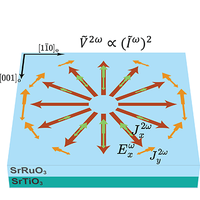
The identification of distinct charge transport features, deriving from nontrivial bulk band and surface states, has been a challenging subject in the field of topological systems. In topological Dirac and Weyl semimetals, nontrivial conical bands with Fermi-arc surface states give rise to negative longitudinal magnetoresistance due to chiral anomaly effect and unusual thickness dependent quantum oscillation from Weyl-orbit effect, which were demonstrated recently in experiments. In this work, we report the experimental observations of large nonlinear and nonreciprocal transport effects for both longitudinal and transverse channels in an untwinned Weyl metal of thin film grown on a substrate. From rigorous measurements with bias current applied along various directions with respect to the crystalline principal axes, the magnitude of nonlinear Hall signals from the transverse channel exhibits a simple dependence at low temperatures, where is the angle between bias current direction and orthorhombic , reaching a maximum when current is along orthorhombic . On the contrary, the magnitude of nonlinear and nonreciprocal signals in the longitudinal channel attains a maximum for bias current along , and it vanishes for bias current along . The observed -dependent nonlinear and nonreciprocal signals in longitudinal and transverse channels reveal a magnetic Weyl phase with an effective Berry curvature dipole along from surface states, accompanied by 1D chiral edge modes along .
期刊介绍:
Physical Review X (PRX) stands as an exclusively online, fully open-access journal, emphasizing innovation, quality, and enduring impact in the scientific content it disseminates. Devoted to showcasing a curated selection of papers from pure, applied, and interdisciplinary physics, PRX aims to feature work with the potential to shape current and future research while leaving a lasting and profound impact in their respective fields. Encompassing the entire spectrum of physics subject areas, PRX places a special focus on groundbreaking interdisciplinary research with broad-reaching influence.


 求助内容:
求助内容: 应助结果提醒方式:

 京公网安备 11010802042870号


