Wafaa Achache, Jean Louis Mege, Mustapha Fellag, Michel Drancourt
{"title":"The <i>Enterococcus</i> secretome inhibits the growth of <i>Mycobacterium tuberculosis</i> complex mycobacteria.","authors":"Wafaa Achache, Jean Louis Mege, Mustapha Fellag, Michel Drancourt","doi":"10.1099/acmi.0.000471.v3","DOIUrl":null,"url":null,"abstract":"<p><p><i>Enterococcus mundtii</i> , a commensal intestinal bacterium, was demonstrated to inhibit the growth of some <i>Mycobacterium tuberculosis</i> complex (MTC) species that cause tuberculosis in humans and mammals. To further explore this preliminary observation, we cross-investigated five <i>E. mundtii</i> strains and seven MTC strains representative of four MTC species using a standardized quantitative agar well diffusion assay. All five <i>E. mundtii</i> strains, calibrated at 10 MacFarland, inhibited the growth of all <i>M. tuberculosis</i> strains with various susceptibility profiles, but no inhibition was observed with lower inoculums. Further, eight <i>E. mundtii</i> freeze-dried cell-free culture supernatants (CFCS) inhibited the growth of <i>M. tuberculosis</i> , <i>Mycobacterium africanum, Mycobacterium bovis</i> and <i>Mycobacterium canettii</i>, the most susceptible MTC species (inhibition diameter 25±1 mm), proportionally to CFCS protein concentrations. The data reported here indicate that the <i>E. mundtii</i> secretome inhibited growth of all MTC species of medical interest, which broadens previously reported data. In the gut, the <i>E. mundtii</i> secretome may modulate the expression of tuberculosis, exhibiting an anti-tuberculosis effect, with some protective roles in human and animal health.</p>","PeriodicalId":6956,"journal":{"name":"Access Microbiology","volume":"5 6","pages":""},"PeriodicalIF":0.0000,"publicationDate":"2023-06-23","publicationTypes":"Journal Article","fieldsOfStudy":null,"isOpenAccess":false,"openAccessPdf":"https://www.ncbi.nlm.nih.gov/pmc/articles/PMC10323786/pdf/","citationCount":"0","resultStr":null,"platform":"Semanticscholar","paperid":null,"PeriodicalName":"Access Microbiology","FirstCategoryId":"1085","ListUrlMain":"https://doi.org/10.1099/acmi.0.000471.v3","RegionNum":0,"RegionCategory":null,"ArticlePicture":[],"TitleCN":null,"AbstractTextCN":null,"PMCID":null,"EPubDate":"2023/1/1 0:00:00","PubModel":"eCollection","JCR":"","JCRName":"","Score":null,"Total":0}
引用次数: 0
Abstract
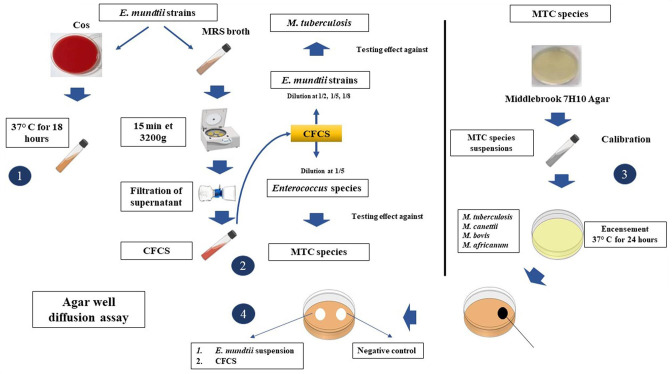
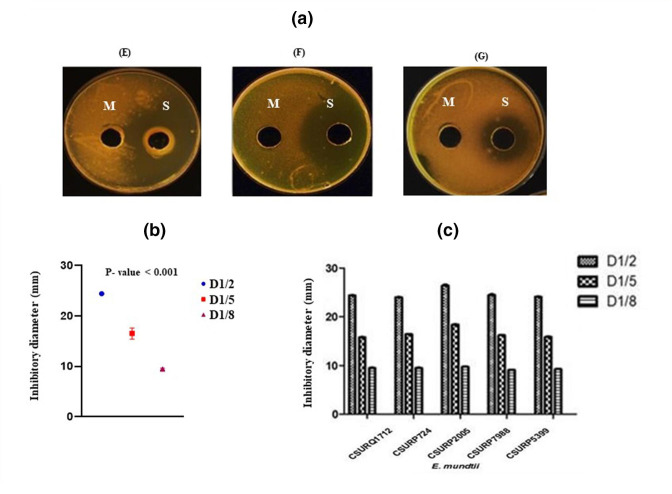
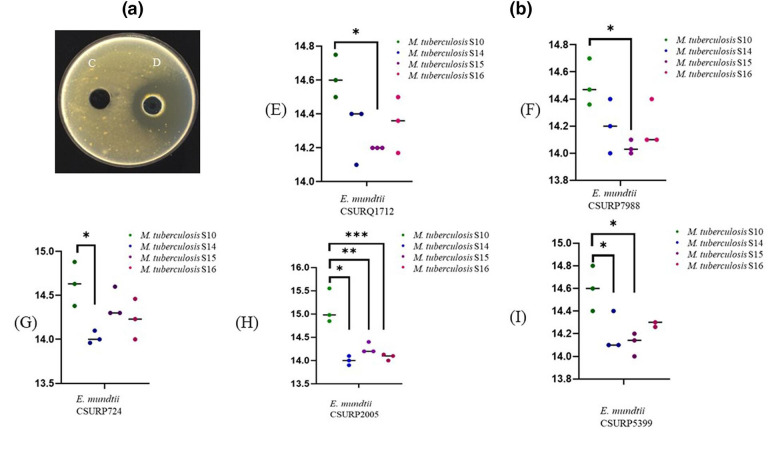
Enterococcus mundtii , a commensal intestinal bacterium, was demonstrated to inhibit the growth of some Mycobacterium tuberculosis complex (MTC) species that cause tuberculosis in humans and mammals. To further explore this preliminary observation, we cross-investigated five E. mundtii strains and seven MTC strains representative of four MTC species using a standardized quantitative agar well diffusion assay. All five E. mundtii strains, calibrated at 10 MacFarland, inhibited the growth of all M. tuberculosis strains with various susceptibility profiles, but no inhibition was observed with lower inoculums. Further, eight E. mundtii freeze-dried cell-free culture supernatants (CFCS) inhibited the growth of M. tuberculosis , Mycobacterium africanum, Mycobacterium bovis and Mycobacterium canettii, the most susceptible MTC species (inhibition diameter 25±1 mm), proportionally to CFCS protein concentrations. The data reported here indicate that the E. mundtii secretome inhibited growth of all MTC species of medical interest, which broadens previously reported data. In the gut, the E. mundtii secretome may modulate the expression of tuberculosis, exhibiting an anti-tuberculosis effect, with some protective roles in human and animal health.


 求助内容:
 应助结果提醒方式:


 京公网安备 11010802042870号


