{"title":"Comparing Supervised Learning and Rigorous Approach for Predicting Protein Stability upon Point Mutations in Difficult Targets","authors":"Jason Kurniawan, and , Takashi Ishida*, ","doi":"10.1021/acs.jcim.3c00750","DOIUrl":null,"url":null,"abstract":"<p >Accurate prediction of protein stability upon a point mutation has important applications in drug discovery and personalized medicine. It remains a challenging issue in computational biology. Existing computational prediction methods, which range from mechanistic to supervised learning approaches, have experienced limited progress over the last few decades. This stagnation is largely due to their heavy reliance on both the quantity and quality of the training data. This is evident in recent state-of-the-art methods that continue to yield substantial errors on two challenging blind test sets: frataxin and p53, with average root-mean-square errors exceeding 3 and 1.5 kcal/mol, respectively, which is still above the theoretical 1 kcal/mol prediction barrier. Rigorous approaches, on the other hand, offer greater potential for accuracy without relying on training data but are computationally demanding and require both wild-type and mutant structure information. Although they showed high accuracy for conserving mutations, their performance is still limited for charge-changing mutation cases. This might be due to the lack of an available mutant structure, often represented by a simplified capped peptide. The recent advances in protein structure prediction methods now make it possible to obtain structures comparable to experimental ones, including complete mutant structure information. In this work, we compare the performance of supervised learning-based methods and rigorous approaches for predicting protein stability on point mutations in difficult targets: frataxin and p53. The rigorous alchemical method significantly surpasses state-of-the-art techniques in terms of both the root-mean-squared error and Pearson correlation coefficient in these two challenging blind test sets. Additionally, we propose an improved alchemical method that employs the <i>pmx</i> double-system/single-box approach to accurately predict the folding free energy change upon both conserving and charge-changing mutations. The enhanced protocol can accurately predict both types of mutations, thereby outperforming existing state-of-the-art methods in overall performance.</p>","PeriodicalId":44,"journal":{"name":"Journal of Chemical Information and Modeling ","volume":"63 21","pages":"6778–6788"},"PeriodicalIF":6.4000,"publicationDate":"2023-10-28","publicationTypes":"Journal Article","fieldsOfStudy":null,"isOpenAccess":false,"openAccessPdf":"","citationCount":"0","resultStr":null,"platform":"Semanticscholar","paperid":null,"PeriodicalName":"Journal of Chemical Information and Modeling ","FirstCategoryId":"92","ListUrlMain":"https://pubs.acs.org/doi/10.1021/acs.jcim.3c00750","RegionNum":2,"RegionCategory":"化学","ArticlePicture":[],"TitleCN":null,"AbstractTextCN":null,"PMCID":null,"EPubDate":"","PubModel":"","JCR":"Q1","JCRName":"CHEMISTRY, MEDICINAL","Score":null,"Total":0}
引用次数: 0
Abstract
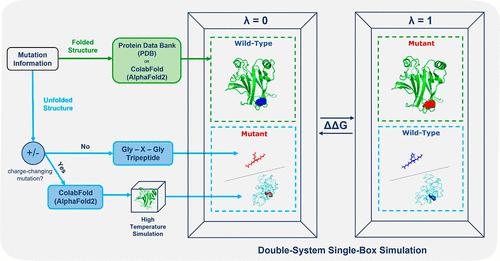
Accurate prediction of protein stability upon a point mutation has important applications in drug discovery and personalized medicine. It remains a challenging issue in computational biology. Existing computational prediction methods, which range from mechanistic to supervised learning approaches, have experienced limited progress over the last few decades. This stagnation is largely due to their heavy reliance on both the quantity and quality of the training data. This is evident in recent state-of-the-art methods that continue to yield substantial errors on two challenging blind test sets: frataxin and p53, with average root-mean-square errors exceeding 3 and 1.5 kcal/mol, respectively, which is still above the theoretical 1 kcal/mol prediction barrier. Rigorous approaches, on the other hand, offer greater potential for accuracy without relying on training data but are computationally demanding and require both wild-type and mutant structure information. Although they showed high accuracy for conserving mutations, their performance is still limited for charge-changing mutation cases. This might be due to the lack of an available mutant structure, often represented by a simplified capped peptide. The recent advances in protein structure prediction methods now make it possible to obtain structures comparable to experimental ones, including complete mutant structure information. In this work, we compare the performance of supervised learning-based methods and rigorous approaches for predicting protein stability on point mutations in difficult targets: frataxin and p53. The rigorous alchemical method significantly surpasses state-of-the-art techniques in terms of both the root-mean-squared error and Pearson correlation coefficient in these two challenging blind test sets. Additionally, we propose an improved alchemical method that employs the pmx double-system/single-box approach to accurately predict the folding free energy change upon both conserving and charge-changing mutations. The enhanced protocol can accurately predict both types of mutations, thereby outperforming existing state-of-the-art methods in overall performance.
期刊介绍:
The Journal of Chemical Information and Modeling publishes papers reporting new methodology and/or important applications in the fields of chemical informatics and molecular modeling. Specific topics include the representation and computer-based searching of chemical databases, molecular modeling, computer-aided molecular design of new materials, catalysts, or ligands, development of new computational methods or efficient algorithms for chemical software, and biopharmaceutical chemistry including analyses of biological activity and other issues related to drug discovery.
Astute chemists, computer scientists, and information specialists look to this monthly’s insightful research studies, programming innovations, and software reviews to keep current with advances in this integral, multidisciplinary field.
As a subscriber you’ll stay abreast of database search systems, use of graph theory in chemical problems, substructure search systems, pattern recognition and clustering, analysis of chemical and physical data, molecular modeling, graphics and natural language interfaces, bibliometric and citation analysis, and synthesis design and reactions databases.

 求助内容:
求助内容: 应助结果提醒方式:

 京公网安备 11010802042870号


