Xiaomei Peng, Chia-Hsiu Yeh, Sheng Fu Wang, Jie Yan, Shifeng Gan, Shi-Jian Su, Xiuwen Zhou, Ye-Xin Zhang, Yun Chi
{"title":"Near-Infrared OLEDs Based on Functional Pyrazinyl Azolate Os(II) Phosphors and Deuteration","authors":"Xiaomei Peng, Chia-Hsiu Yeh, Sheng Fu Wang, Jie Yan, Shifeng Gan, Shi-Jian Su, Xiuwen Zhou, Ye-Xin Zhang, Yun Chi","doi":"10.1002/adom.202201291","DOIUrl":null,"url":null,"abstract":"<p>Near-infrared (NIR) emitting Os(II) complexes [Os(L1)<sub>2</sub>(PPhMe<sub>2</sub>)<sub>2</sub>] (tz1), [Os(L2)<sub>2</sub>(PPhMe<sub>2</sub>)<sub>2</sub>] (tz2), and [Os(L3)<sub>2</sub>(PPhMe<sub>2</sub>)<sub>2</sub>] (tz3), bearing dual (1<i>H</i>-1,2,4-triazol-5-yl)pyrazine chromophoric chelates, are successfully developed. These pyrazine chelates tz<i>n</i> (<i>n</i> = 1, 2, 3) differ by the location and number of 4-(trifluoromethyl)phenyl appendage(s) on pyrazine, and the associated Os(II) complexes exhibit bathochromic shifted emission, higher quantum yield, and increased radiative lifetime in comparison to parent complex [Os(fprtz)<sub>2</sub>(PMe<sub>2</sub>Ph)<sub>2</sub>] (tz0). Moreover, partially deuterated pyrazine chelate L1-d is prepared using post-synthetic deuteration, from which the Os(II) complex tz1 shows a photoluminescence quantum yield (PLQY) of 12.2% in co-doped 4,4′-bis(N-carbazolyl)biphenyl (CBP) thin film at 3 wt%. Further, the partially deuterated tz1-d exhibits a notable increase in PLQY to 17.8% upon co-deposited into CBP thin film, confirming the influence of C-H(D) stretching vibrations on the non-radiative transition processes. Finally, tz1-d is demonstrated to be suitable in the fabrication of efficient NIR organic light-emitting diodes (OLEDs), from which max. external quantum efficiency of 3.77% and max. radiance of 24.1 W sr<sup>-1</sup> m<sup>-2</sup> are recorded for emission with peak maximum at 776 nm. These experiments confirm the suppression of C–H vibration caused quenching by deuteration, which should be broadly applicable to the OLED emitters, especially in the NIR region.</p>","PeriodicalId":116,"journal":{"name":"Advanced Optical Materials","volume":"10 20","pages":""},"PeriodicalIF":7.2000,"publicationDate":"2022-07-17","publicationTypes":"Journal Article","fieldsOfStudy":null,"isOpenAccess":false,"openAccessPdf":"","citationCount":"8","resultStr":null,"platform":"Semanticscholar","paperid":null,"PeriodicalName":"Advanced Optical Materials","FirstCategoryId":"88","ListUrlMain":"https://onlinelibrary.wiley.com/doi/10.1002/adom.202201291","RegionNum":2,"RegionCategory":"材料科学","ArticlePicture":[],"TitleCN":null,"AbstractTextCN":null,"PMCID":null,"EPubDate":"","PubModel":"","JCR":"Q1","JCRName":"MATERIALS SCIENCE, MULTIDISCIPLINARY","Score":null,"Total":0}
引用次数: 8
Abstract
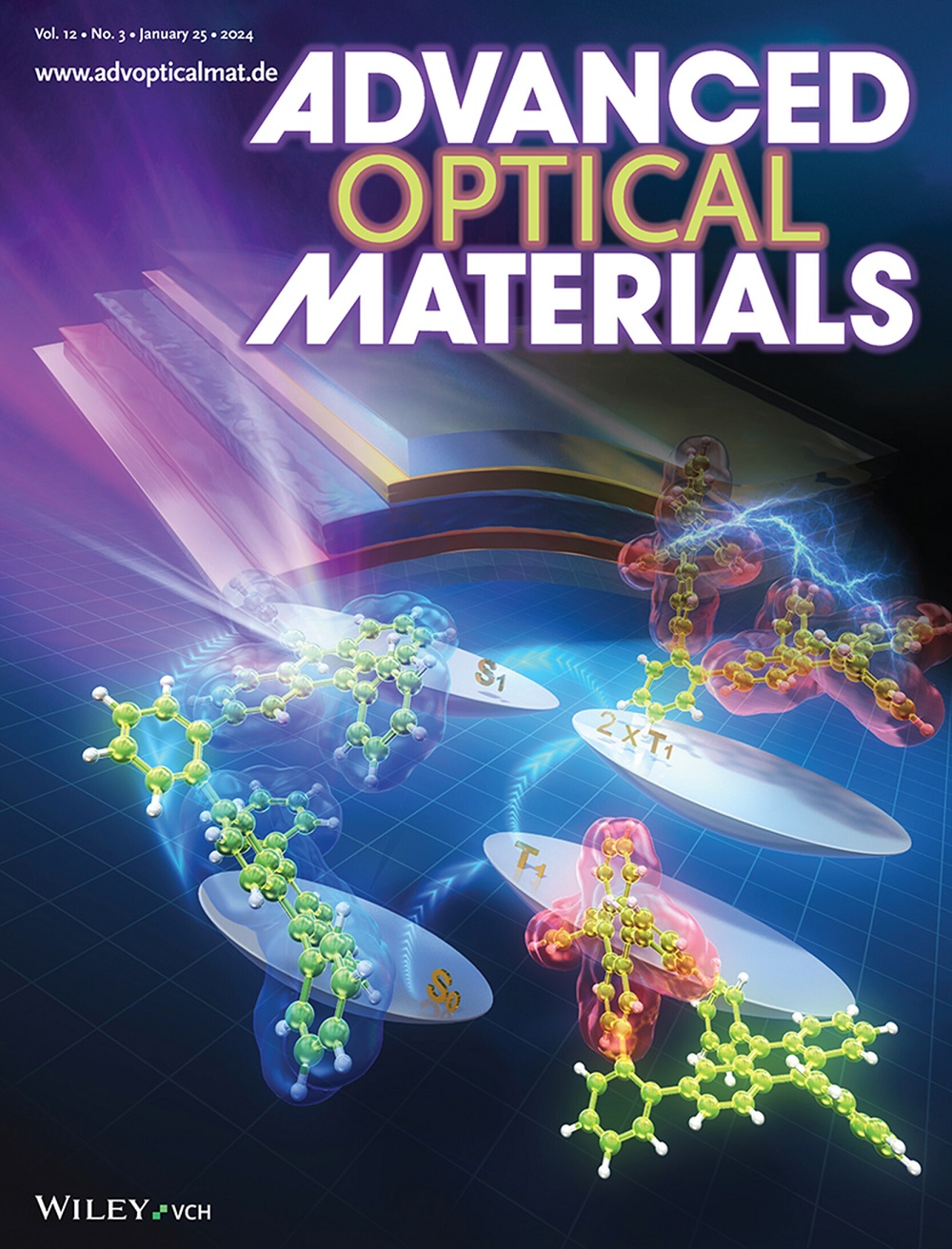
Near-infrared (NIR) emitting Os(II) complexes [Os(L1)2(PPhMe2)2] (tz1), [Os(L2)2(PPhMe2)2] (tz2), and [Os(L3)2(PPhMe2)2] (tz3), bearing dual (1H-1,2,4-triazol-5-yl)pyrazine chromophoric chelates, are successfully developed. These pyrazine chelates tzn (n = 1, 2, 3) differ by the location and number of 4-(trifluoromethyl)phenyl appendage(s) on pyrazine, and the associated Os(II) complexes exhibit bathochromic shifted emission, higher quantum yield, and increased radiative lifetime in comparison to parent complex [Os(fprtz)2(PMe2Ph)2] (tz0). Moreover, partially deuterated pyrazine chelate L1-d is prepared using post-synthetic deuteration, from which the Os(II) complex tz1 shows a photoluminescence quantum yield (PLQY) of 12.2% in co-doped 4,4′-bis(N-carbazolyl)biphenyl (CBP) thin film at 3 wt%. Further, the partially deuterated tz1-d exhibits a notable increase in PLQY to 17.8% upon co-deposited into CBP thin film, confirming the influence of C-H(D) stretching vibrations on the non-radiative transition processes. Finally, tz1-d is demonstrated to be suitable in the fabrication of efficient NIR organic light-emitting diodes (OLEDs), from which max. external quantum efficiency of 3.77% and max. radiance of 24.1 W sr-1 m-2 are recorded for emission with peak maximum at 776 nm. These experiments confirm the suppression of C–H vibration caused quenching by deuteration, which should be broadly applicable to the OLED emitters, especially in the NIR region.
期刊介绍:
Advanced Optical Materials, part of the esteemed Advanced portfolio, is a unique materials science journal concentrating on all facets of light-matter interactions. For over a decade, it has been the preferred optical materials journal for significant discoveries in photonics, plasmonics, metamaterials, and more. The Advanced portfolio from Wiley is a collection of globally respected, high-impact journals that disseminate the best science from established and emerging researchers, aiding them in fulfilling their mission and amplifying the reach of their scientific discoveries.

 求助内容:
 应助结果提醒方式:


 京公网安备 11010802042870号


