High-resolution crystal structure of spin labelled (T21R1) azurin from Pseudomonas aeruginosa: a challenging structural benchmark for in silico spin labelling algorithms
{"title":"High-resolution crystal structure of spin labelled (T21R1) azurin from Pseudomonas aeruginosa: a challenging structural benchmark for in silico spin labelling algorithms","authors":"Nicole Florin, Olav Schiemann, Gregor Hagelueken","doi":"10.1186/1472-6807-14-16","DOIUrl":null,"url":null,"abstract":"<p>EPR-based distance measurements between spin labels in proteins have become a valuable tool in structural biology. The direct translation of the experimental distances into structural information is however often impaired by the intrinsic flexibility of the spin labelled side chains. Different algorithms exist that predict the approximate conformation of the spin label either by using pre-computed rotamer libraries of the labelled side chain (rotamer approach) or by simply determining its accessible volume (accessible volume approach). Surprisingly, comparisons with many experimental distances have shown that both approaches deliver the same distance prediction accuracy of about 3 ?.</p><p>Here, instead of comparing predicted and experimental distances, we test the ability of both approaches to predict the actual conformations of spin labels found in a new high-resolution crystal structure of spin labelled azurin (T21R1). Inside the crystal, the label is found in two very different environments which serve as a challenging test for the <i>in silico</i> approaches.</p><p>Our results illustrate why simple and more sophisticated programs lead to the same prediciton error. Thus, a more precise treatment of the complete environment of the label and also its interactions with the environment will be needed to increase the accuracy of <i>in silico</i> spin labelling algorithms.</p>","PeriodicalId":51240,"journal":{"name":"BMC Structural Biology","volume":"14 1","pages":""},"PeriodicalIF":0.0000,"publicationDate":"2014-05-29","publicationTypes":"Journal Article","fieldsOfStudy":null,"isOpenAccess":false,"openAccessPdf":"https://sci-hub-pdf.com/10.1186/1472-6807-14-16","citationCount":"12","resultStr":null,"platform":"Semanticscholar","paperid":null,"PeriodicalName":"BMC Structural Biology","FirstCategoryId":"1085","ListUrlMain":"https://link.springer.com/article/10.1186/1472-6807-14-16","RegionNum":0,"RegionCategory":null,"ArticlePicture":[],"TitleCN":null,"AbstractTextCN":null,"PMCID":null,"EPubDate":"","PubModel":"","JCR":"Q3","JCRName":"Biochemistry, Genetics and Molecular Biology","Score":null,"Total":0}
引用次数: 12
Abstract
EPR-based distance measurements between spin labels in proteins have become a valuable tool in structural biology. The direct translation of the experimental distances into structural information is however often impaired by the intrinsic flexibility of the spin labelled side chains. Different algorithms exist that predict the approximate conformation of the spin label either by using pre-computed rotamer libraries of the labelled side chain (rotamer approach) or by simply determining its accessible volume (accessible volume approach). Surprisingly, comparisons with many experimental distances have shown that both approaches deliver the same distance prediction accuracy of about 3 ?.
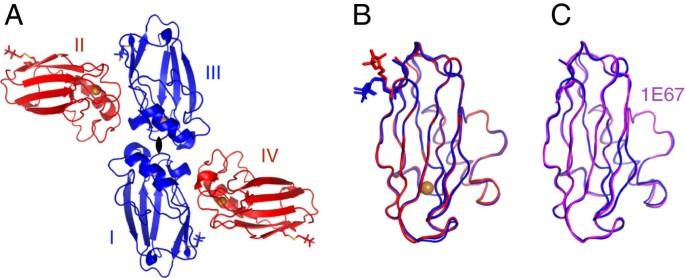
Here, instead of comparing predicted and experimental distances, we test the ability of both approaches to predict the actual conformations of spin labels found in a new high-resolution crystal structure of spin labelled azurin (T21R1). Inside the crystal, the label is found in two very different environments which serve as a challenging test for the in silico approaches.
Our results illustrate why simple and more sophisticated programs lead to the same prediciton error. Thus, a more precise treatment of the complete environment of the label and also its interactions with the environment will be needed to increase the accuracy of in silico spin labelling algorithms.
期刊介绍:
BMC Structural Biology is an open access, peer-reviewed journal that considers articles on investigations into the structure of biological macromolecules, including solving structures, structural and functional analyses, and computational modeling.


 求助内容:
 应助结果提醒方式:


 京公网安备 11010802042870号


