Luis Sanchez-Pulido, Laurent Perez, Steffen Kuhn, Isabelle Vernos, Miguel A. Andrade-Navarro
{"title":"The C-terminal domain of TPX2 is made of alpha-helical tandem repeats","authors":"Luis Sanchez-Pulido, Laurent Perez, Steffen Kuhn, Isabelle Vernos, Miguel A. Andrade-Navarro","doi":"10.1186/s12900-016-0070-8","DOIUrl":null,"url":null,"abstract":"<p>TPX2 (Targeting Protein for Xklp2) is essential for spindle assembly, activation of the mitotic kinase Aurora A and for triggering microtubule nucleation. Homologs of TPX2 in Chordata and plants were previously identified. Currently, proteins of the TPX2 family have little structural information and only small parts are covered by defined protein domains.</p><p>We have used computational sequence analyses and structural predictions of proteins of the TPX2 family, supported with Circular Dichroism (CD) measurements.</p><p>Here, we report our finding that the C-terminal domain of TPX2, which is responsible of its microtubule nucleation capacity and is conserved in all members of the family, is actually formed by tandem repeats, covering well above 2/3 of the protein. We propose that this region forms a flexible solenoid involved in protein-protein interactions. Structural prediction and molecular modeling, combined with Circular Dichroism (CD) measurements reveal a predominant alpha-helical content. Furthermore, we identify full length homologs in fungi and shorter homologs with a different domain organization in diptera (including a paralogous expansion in <i>Drosophila</i>).</p><p>Our results, represent the first computational and biophysical analysis of the TPX2 proteins family and help understand the structure and evolution of this conserved protein family to direct future structural studies.</p>","PeriodicalId":51240,"journal":{"name":"BMC Structural Biology","volume":"16 1","pages":""},"PeriodicalIF":0.0000,"publicationDate":"2016-10-26","publicationTypes":"Journal Article","fieldsOfStudy":null,"isOpenAccess":false,"openAccessPdf":"https://sci-hub-pdf.com/10.1186/s12900-016-0070-8","citationCount":"7","resultStr":null,"platform":"Semanticscholar","paperid":null,"PeriodicalName":"BMC Structural Biology","FirstCategoryId":"1085","ListUrlMain":"https://link.springer.com/article/10.1186/s12900-016-0070-8","RegionNum":0,"RegionCategory":null,"ArticlePicture":[],"TitleCN":null,"AbstractTextCN":null,"PMCID":null,"EPubDate":"","PubModel":"","JCR":"Q3","JCRName":"Biochemistry, Genetics and Molecular Biology","Score":null,"Total":0}
引用次数: 7
Abstract
TPX2 (Targeting Protein for Xklp2) is essential for spindle assembly, activation of the mitotic kinase Aurora A and for triggering microtubule nucleation. Homologs of TPX2 in Chordata and plants were previously identified. Currently, proteins of the TPX2 family have little structural information and only small parts are covered by defined protein domains.
We have used computational sequence analyses and structural predictions of proteins of the TPX2 family, supported with Circular Dichroism (CD) measurements.
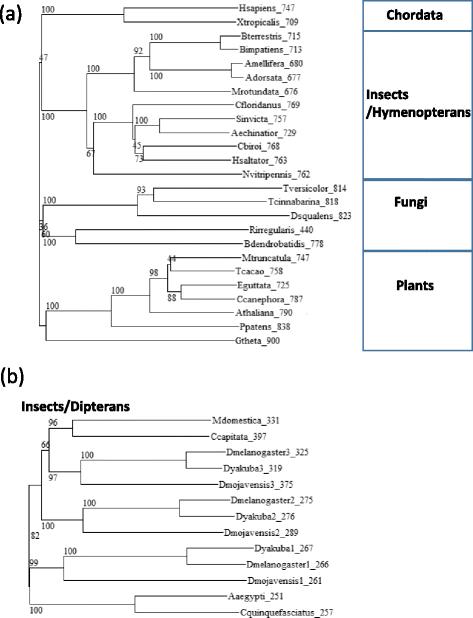
Here, we report our finding that the C-terminal domain of TPX2, which is responsible of its microtubule nucleation capacity and is conserved in all members of the family, is actually formed by tandem repeats, covering well above 2/3 of the protein. We propose that this region forms a flexible solenoid involved in protein-protein interactions. Structural prediction and molecular modeling, combined with Circular Dichroism (CD) measurements reveal a predominant alpha-helical content. Furthermore, we identify full length homologs in fungi and shorter homologs with a different domain organization in diptera (including a paralogous expansion in Drosophila).
Our results, represent the first computational and biophysical analysis of the TPX2 proteins family and help understand the structure and evolution of this conserved protein family to direct future structural studies.
期刊介绍:
BMC Structural Biology is an open access, peer-reviewed journal that considers articles on investigations into the structure of biological macromolecules, including solving structures, structural and functional analyses, and computational modeling.


 求助内容:
 应助结果提醒方式:


 京公网安备 11010802042870号


