{"title":"Helical ambivalency induced by point mutations","authors":"Nicholus Bhattacharjee, Parbati Biswas","doi":"10.1186/1472-6807-13-9","DOIUrl":null,"url":null,"abstract":"<p>Mutation of amino acid sequences in a protein may have diverse effects on its structure and function. Point mutations of even a single amino acid residue in the helices of the non-redundant database may lead to sequentially identical peptides which adopt different secondary structures in different proteins. However, various physico-chemical factors which govern the formation of these ambivalent helices generated by point mutations of a sequence are not clearly known.</p><p>Sequences generated by point mutations of helices are mapped on to their non-helical counterparts in the SCOP database. The results show that short helices are prone to transform into non-helical conformations upon point mutations. Mutation of amino acid residues by helix breakers preferentially yield non-helical conformations, while mutation with residues of intermediate helix propensity display least preferences for non-helical conformations. Differences in the solvent accessibility of the mutating/mutated residues are found to be a major criteria for these sequences to conform to non-helical conformations. Even with minimal differences in the amino acid distributions of the sequences flanking the helical and non-helical conformations, helix-flanking sequences are found be more solvent accessible.</p><p>All types of mutations from helical to non-helical conformations are investigated. The primary factors attributing such changes in conformation can be: i) type/propensity of the mutating and mutant residues ii) solvent accessibility of the residue at the mutation site iii) context/environment dependence of the flanking sequences. The results from the present study may be used to design <i>de novo</i> proteins via point mutations.</p>","PeriodicalId":51240,"journal":{"name":"BMC Structural Biology","volume":"13 1","pages":""},"PeriodicalIF":0.0000,"publicationDate":"2013-05-15","publicationTypes":"Journal Article","fieldsOfStudy":null,"isOpenAccess":false,"openAccessPdf":"https://sci-hub-pdf.com/10.1186/1472-6807-13-9","citationCount":"5","resultStr":null,"platform":"Semanticscholar","paperid":null,"PeriodicalName":"BMC Structural Biology","FirstCategoryId":"1085","ListUrlMain":"https://link.springer.com/article/10.1186/1472-6807-13-9","RegionNum":0,"RegionCategory":null,"ArticlePicture":[],"TitleCN":null,"AbstractTextCN":null,"PMCID":null,"EPubDate":"","PubModel":"","JCR":"Q3","JCRName":"Biochemistry, Genetics and Molecular Biology","Score":null,"Total":0}
引用次数: 5
Abstract
Mutation of amino acid sequences in a protein may have diverse effects on its structure and function. Point mutations of even a single amino acid residue in the helices of the non-redundant database may lead to sequentially identical peptides which adopt different secondary structures in different proteins. However, various physico-chemical factors which govern the formation of these ambivalent helices generated by point mutations of a sequence are not clearly known.
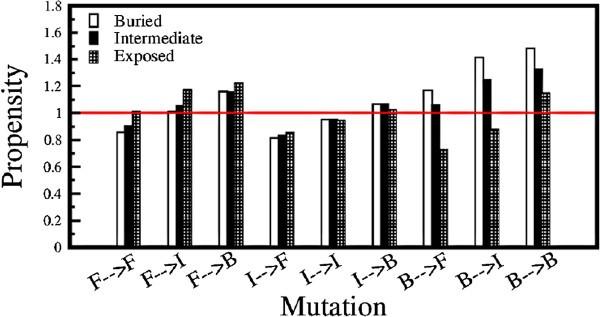
Sequences generated by point mutations of helices are mapped on to their non-helical counterparts in the SCOP database. The results show that short helices are prone to transform into non-helical conformations upon point mutations. Mutation of amino acid residues by helix breakers preferentially yield non-helical conformations, while mutation with residues of intermediate helix propensity display least preferences for non-helical conformations. Differences in the solvent accessibility of the mutating/mutated residues are found to be a major criteria for these sequences to conform to non-helical conformations. Even with minimal differences in the amino acid distributions of the sequences flanking the helical and non-helical conformations, helix-flanking sequences are found be more solvent accessible.
All types of mutations from helical to non-helical conformations are investigated. The primary factors attributing such changes in conformation can be: i) type/propensity of the mutating and mutant residues ii) solvent accessibility of the residue at the mutation site iii) context/environment dependence of the flanking sequences. The results from the present study may be used to design de novo proteins via point mutations.
期刊介绍:
BMC Structural Biology is an open access, peer-reviewed journal that considers articles on investigations into the structure of biological macromolecules, including solving structures, structural and functional analyses, and computational modeling.


 求助内容:
 应助结果提醒方式:


 京公网安备 11010802042870号


