Su-Hyun Kim, Na Young Park, Ki Hoon Kim, Jae-Won Hyun, Ho Jin Kim
{"title":"Rituximab-Induced Hypogammaglobulinemia and Risk of Infection in Neuromyelitis Optica Spectrum Disorders: A 14-Year Real-Life Experience.","authors":"Su-Hyun Kim, Na Young Park, Ki Hoon Kim, Jae-Won Hyun, Ho Jin Kim","doi":"10.1212/NXI.0000000000001179","DOIUrl":null,"url":null,"abstract":"<p><strong>Background and objectives: </strong>To investigate the frequency and predictors of hypogammaglobulinemia during long-term rituximab (RTX) treatment in patients with neuromyelitis optica spectrum disorder (NMOSD) and its association with infections.</p><p><strong>Methods: </strong>We retrospectively reviewed the data of patients with NMOSD who received RTX through the maintenance regimen based on memory B-cell detection for at least 1 year from 2006 to 2021 at an institutional referral center for NMOSD.</p><p><strong>Results: </strong>A total of 169 patients received a median of 10 courses (range 1-27) of RTX reinfusion after induction over a median of 8 (range, 1-15) years. Their mean serum immunoglobulin (Ig)G level began to decline significantly after 2 years of treatment, steadily declined at a rate of 2%-8% per year for the following 8 years, and then plateaued after 10 years. The proportion of patients with hypo-IgG (<6 g/L) increased from 1.2% after 1 year of treatment to 41% after 14 years of treatment. While being treated with RTX, 58 (34%) patients had 114 infections, of whom 14 (8%) patients had 15 severe infections. Multivariable logistic regression analyses identified duration of RTX treatment in years (odds ratio [OR] 1.234, 95% confidence interval [CI] 1.015-1.502), mean annual RTX dose (OR 0.063, 95% CI 0.009-0.434), history of mitoxantrone (OR 3.318, 95% CI 1.109-9.93), hypo-IgG at baseline (OR 40.552, 95% CI 3.024-543.786), and body mass index >25 kg/m<sup>2</sup> (OR 4.798, 95% CI 1.468-15.678) as independent predictors of hypo-IgG. The risk of infection during RTX treatment was independently associated with high Expanded Disability Status Scale scores (OR 1.427, 95% CI 1.2-1.697) and relapses during RTX treatment (OR 1.665, 95% CI 1.112-2.492), but not with hypogammaglobulinemia.</p><p><strong>Discussion: </strong>Over 14 years of long-term RTX treatment, IgG levels gradually decreased, and the frequency of hypo-IgG increased to 41% of the patients. Patients with prolonged memory B-cell depletion after RTX, previous mitoxantrone history, hypo-IgG at baseline, or obesity were at risk of developing RTX-induced hypogammaglobulinemia. Nevertheless, infection rates remained low during treatment, and reduced immunoglobulin levels were not associated with an increased incidence of infections.</p>","PeriodicalId":520720,"journal":{"name":"Neurology(R) neuroimmunology & neuroinflammation","volume":" ","pages":""},"PeriodicalIF":7.5000,"publicationDate":"2022-07-19","publicationTypes":"Journal Article","fieldsOfStudy":null,"isOpenAccess":false,"openAccessPdf":"https://ftp.ncbi.nlm.nih.gov/pub/pmc/oa_pdf/be/74/NEURIMMINFL2022039863.PMC9296048.pdf","citationCount":"9","resultStr":null,"platform":"Semanticscholar","paperid":null,"PeriodicalName":"Neurology(R) neuroimmunology & neuroinflammation","FirstCategoryId":"3","ListUrlMain":"https://doi.org/10.1212/NXI.0000000000001179","RegionNum":0,"RegionCategory":null,"ArticlePicture":[],"TitleCN":null,"AbstractTextCN":null,"PMCID":null,"EPubDate":"2022/9/1 0:00:00","PubModel":"Print","JCR":"","JCRName":"","Score":null,"Total":0}
引用次数: 9
Abstract
Background and objectives: To investigate the frequency and predictors of hypogammaglobulinemia during long-term rituximab (RTX) treatment in patients with neuromyelitis optica spectrum disorder (NMOSD) and its association with infections.
Methods: We retrospectively reviewed the data of patients with NMOSD who received RTX through the maintenance regimen based on memory B-cell detection for at least 1 year from 2006 to 2021 at an institutional referral center for NMOSD.
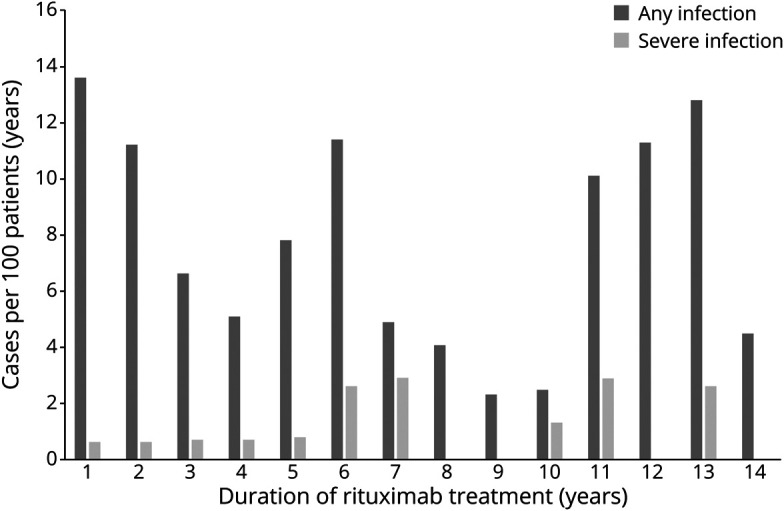
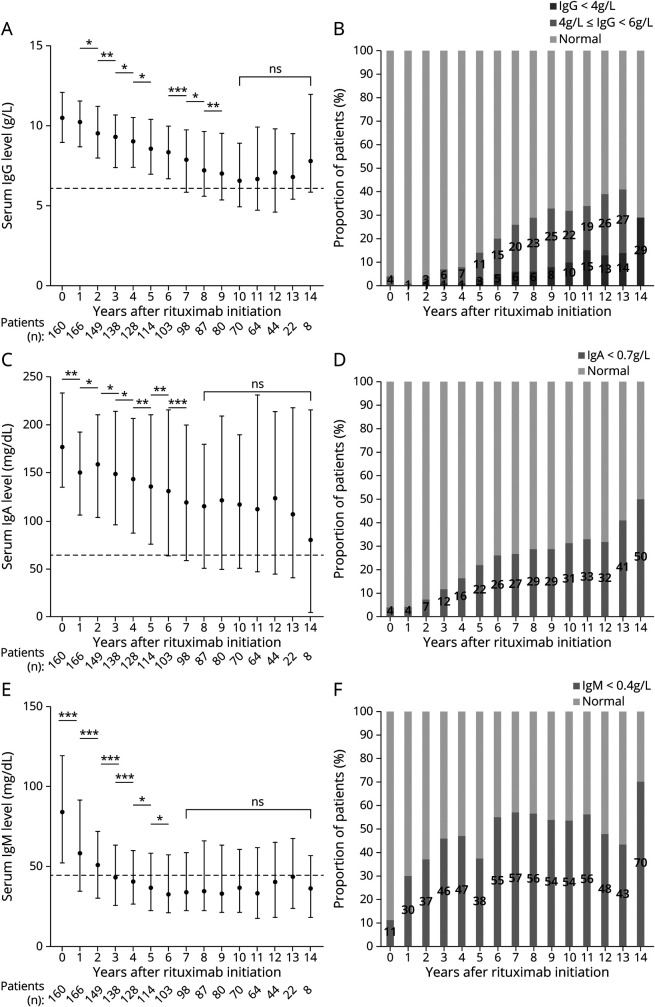
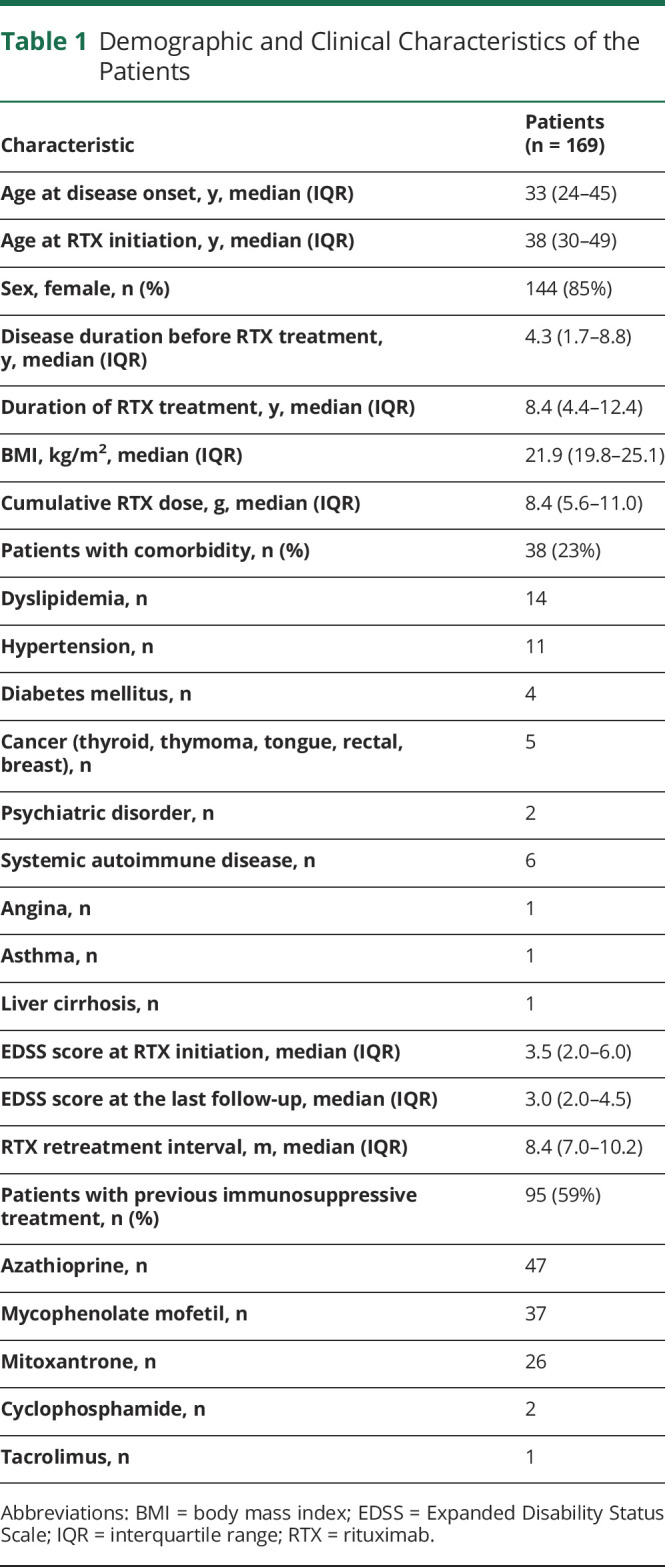
Results: A total of 169 patients received a median of 10 courses (range 1-27) of RTX reinfusion after induction over a median of 8 (range, 1-15) years. Their mean serum immunoglobulin (Ig)G level began to decline significantly after 2 years of treatment, steadily declined at a rate of 2%-8% per year for the following 8 years, and then plateaued after 10 years. The proportion of patients with hypo-IgG (<6 g/L) increased from 1.2% after 1 year of treatment to 41% after 14 years of treatment. While being treated with RTX, 58 (34%) patients had 114 infections, of whom 14 (8%) patients had 15 severe infections. Multivariable logistic regression analyses identified duration of RTX treatment in years (odds ratio [OR] 1.234, 95% confidence interval [CI] 1.015-1.502), mean annual RTX dose (OR 0.063, 95% CI 0.009-0.434), history of mitoxantrone (OR 3.318, 95% CI 1.109-9.93), hypo-IgG at baseline (OR 40.552, 95% CI 3.024-543.786), and body mass index >25 kg/m2 (OR 4.798, 95% CI 1.468-15.678) as independent predictors of hypo-IgG. The risk of infection during RTX treatment was independently associated with high Expanded Disability Status Scale scores (OR 1.427, 95% CI 1.2-1.697) and relapses during RTX treatment (OR 1.665, 95% CI 1.112-2.492), but not with hypogammaglobulinemia.
Discussion: Over 14 years of long-term RTX treatment, IgG levels gradually decreased, and the frequency of hypo-IgG increased to 41% of the patients. Patients with prolonged memory B-cell depletion after RTX, previous mitoxantrone history, hypo-IgG at baseline, or obesity were at risk of developing RTX-induced hypogammaglobulinemia. Nevertheless, infection rates remained low during treatment, and reduced immunoglobulin levels were not associated with an increased incidence of infections.


 求助内容:
 应助结果提醒方式:


 京公网安备 11010802042870号


