Duck Hyoun Jeong, Han Beom Lee, Hyuk Hur, Byung Soh Min, Seung Hyuk Baik, Nam Kyu Kim
{"title":"Optimal timing of surgery after neoadjuvant chemoradiation therapy in locally advanced rectal cancer.","authors":"Duck Hyoun Jeong, Han Beom Lee, Hyuk Hur, Byung Soh Min, Seung Hyuk Baik, Nam Kyu Kim","doi":"10.4174/jkss.2013.84.6.338","DOIUrl":null,"url":null,"abstract":"<p><strong>Purpose: </strong>The optimal time between neoadjuvant chemoradiotherapy (CRT) and surgery for rectal cancer has been debated. This study evaluated the influence of this interval on oncological outcomes.</p><p><strong>Methods: </strong>We compared postoperative complications, pathological downstaging, disease recurrence, and survival in patients with locally advanced rectal cancer who underwent surgical resection <8 weeks (group A, n = 105) to those who had surgery ≥8 weeks (group B, n = 48) after neoadjuvant CRT.</p><p><strong>Results: </strong>Of 153 patients, 117 (76.5%) were male and 36 (23.5%) were female. Mean age was 57.8 years (range, 28 to 79 years). There was no difference in the rate of sphincter preserving surgery between the two groups (group A, 82.7% vs. group B, 77.6%; P = 0.509). The longer interval group had decreased postoperative complications, although statistical significance was not reached (group A, 28.8% vs. group B, 14.3%; P = 0.068). A total of 111 (group A, 75 [71.4%] and group B, 36 [75%]) patients were downstaged and 26 (group A, 17 [16.2%] and group B, 9 [18%]) achieved pathological complete response (pCR). There was no significant difference in the pCR rate (P = 0.817). The longer interval group experienced significant improvement in the nodal (N) downstaging rate (group A, 46.7% vs. group B, 66.7%; P = 0.024). The local recurrence (P = 0.279), distant recurrence (P = 0.427), disease-free survival (P = 0.967), and overall survival (P = 0.825) rates were not significantly different.</p><p><strong>Conclusion: </strong>It is worth delaying surgical resection for 8 weeks or more after completion of CRT as it is safe and is associated with higher nodal downstaging rates.</p>","PeriodicalId":49991,"journal":{"name":"Journal of the Korean Surgical Society","volume":"84 6","pages":"338-45"},"PeriodicalIF":0.0000,"publicationDate":"2013-06-01","publicationTypes":"Journal Article","fieldsOfStudy":null,"isOpenAccess":false,"openAccessPdf":"https://sci-hub-pdf.com/10.4174/jkss.2013.84.6.338","citationCount":"33","resultStr":null,"platform":"Semanticscholar","paperid":null,"PeriodicalName":"Journal of the Korean Surgical Society","FirstCategoryId":"1085","ListUrlMain":"https://doi.org/10.4174/jkss.2013.84.6.338","RegionNum":0,"RegionCategory":null,"ArticlePicture":[],"TitleCN":null,"AbstractTextCN":null,"PMCID":null,"EPubDate":"2013/5/28 0:00:00","PubModel":"Epub","JCR":"","JCRName":"","Score":null,"Total":0}
引用次数: 33
Abstract
Purpose: The optimal time between neoadjuvant chemoradiotherapy (CRT) and surgery for rectal cancer has been debated. This study evaluated the influence of this interval on oncological outcomes.
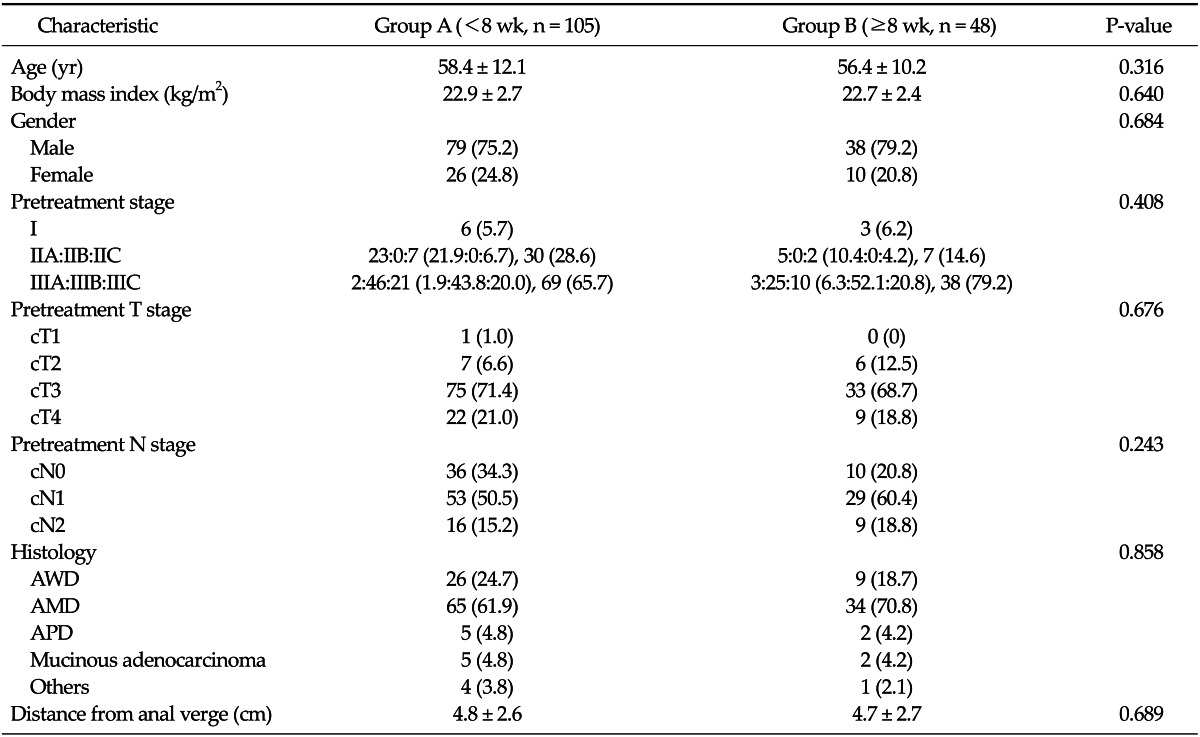
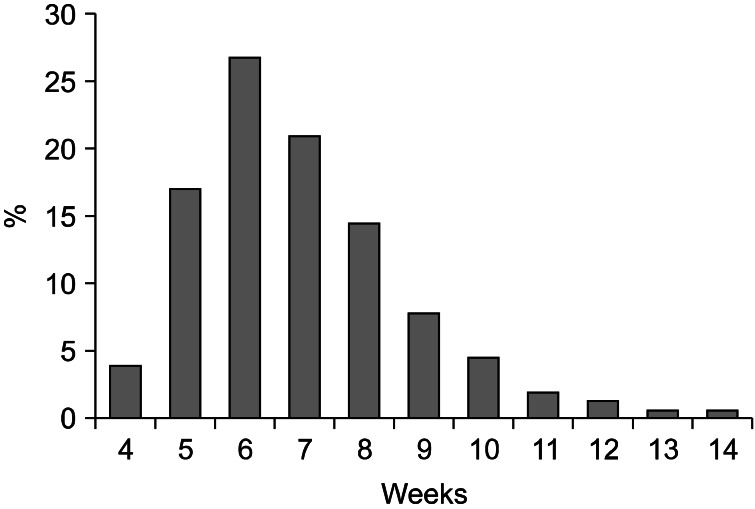
Methods: We compared postoperative complications, pathological downstaging, disease recurrence, and survival in patients with locally advanced rectal cancer who underwent surgical resection <8 weeks (group A, n = 105) to those who had surgery ≥8 weeks (group B, n = 48) after neoadjuvant CRT.
Results: Of 153 patients, 117 (76.5%) were male and 36 (23.5%) were female. Mean age was 57.8 years (range, 28 to 79 years). There was no difference in the rate of sphincter preserving surgery between the two groups (group A, 82.7% vs. group B, 77.6%; P = 0.509). The longer interval group had decreased postoperative complications, although statistical significance was not reached (group A, 28.8% vs. group B, 14.3%; P = 0.068). A total of 111 (group A, 75 [71.4%] and group B, 36 [75%]) patients were downstaged and 26 (group A, 17 [16.2%] and group B, 9 [18%]) achieved pathological complete response (pCR). There was no significant difference in the pCR rate (P = 0.817). The longer interval group experienced significant improvement in the nodal (N) downstaging rate (group A, 46.7% vs. group B, 66.7%; P = 0.024). The local recurrence (P = 0.279), distant recurrence (P = 0.427), disease-free survival (P = 0.967), and overall survival (P = 0.825) rates were not significantly different.
Conclusion: It is worth delaying surgical resection for 8 weeks or more after completion of CRT as it is safe and is associated with higher nodal downstaging rates.


 求助内容:
 应助结果提醒方式:


 京公网安备 11010802042870号


