
Carbohydrate-biased control of energy metabolism: the darker side of the selfish brain.

Frontiers in neuroenergetics Pub Date : 2011-12-20 eCollection Date: 2011-01-01 DOI:10.3389/fnene.2011.00008
Tanya Zilberter
{"title":"Carbohydrate-biased control of energy metabolism: the darker side of the selfish brain.","authors":"Tanya Zilberter","doi":"10.3389/fnene.2011.00008","DOIUrl":null,"url":null,"abstract":"There is evidence that the brain favors consumption of carbohydrates (CHO) rather than fats, this preference resulting in glycolysis-based energy metabolism domination. This metabolic mode, typical for consumers of the “Western diet” (Cordain et al., 2005; Seneff et al., 2011), is characterized by over-generation of reactive oxygen species and advanced glycation products both of which are implicated in many of the neurodegenerative diseases (Tessier, 2010; Vicente Miranda and Outeiro, 2010; Auburger and Kurz, 2011). However, it is not CHO but fat that is often held responsible for metabolic pathologies. This paper, based on analysis of experimental data, offers an opinion that the obesogenic and neurodegenerative effects of dietary fat in the high-fat diets (HFD) cannot be separated from the effects of the CHO compound in them. Since this is not a comprehensive literature review, only essential research results are presented. \n \nIt is general knowledge that the glucose homeostasis possesses very limited buffering capacities, while energy homeostasis in its fat-controlling part enjoys practically unlimited energy stores. Logically, a control system with a limited buffer should thoroughly defend the “consumption” part. Indeed, existing experimental data (briefly reviewed here later) show important properties of the CHO intake control that is different from or not shown for the fat intake control: \n \n \n(1) \n \nA mere oral sensation of CHO elicits physiological anticipation response (cephalic phase) that is either inborn or rapidly conditioned. \n \n \n(2) \n \nOral CHO sensation stimulates reward-specific brain areas. \n \n \n(3) \n \nCHO addiction is essentially similar to typical drug addictions. \n \n \n \nThese peculiarities can explain the physiologically and metabolically opposite effects of obesogenic HFD versus the ketogenic diet (KD), which is also HFD but lower in CHO.","PeriodicalId":88242,"journal":{"name":"Frontiers in neuroenergetics","volume":"3 ","pages":"8"},"PeriodicalIF":0.0000,"publicationDate":"2011-12-20","publicationTypes":"Journal Article","fieldsOfStudy":null,"isOpenAccess":false,"openAccessPdf":"https://sci-hub-pdf.com/10.3389/fnene.2011.00008","citationCount":"12","resultStr":null,"platform":"Semanticscholar","paperid":null,"PeriodicalName":"Frontiers in neuroenergetics","FirstCategoryId":"1085","ListUrlMain":"https://doi.org/10.3389/fnene.2011.00008","RegionNum":0,"RegionCategory":null,"ArticlePicture":[],"TitleCN":null,"AbstractTextCN":null,"PMCID":null,"EPubDate":"2011/1/1 0:00:00","PubModel":"eCollection","JCR":"","JCRName":"","Score":null,"Total":0}
引用次数: 12

Abstract

There is evidence that the brain favors consumption of carbohydrates (CHO) rather than fats, this preference resulting in glycolysis-based energy metabolism domination. This metabolic mode, typical for consumers of the “Western diet” (Cordain et al., 2005; Seneff et al., 2011), is characterized by over-generation of reactive oxygen species and advanced glycation products both of which are implicated in many of the neurodegenerative diseases (Tessier, 2010; Vicente Miranda and Outeiro, 2010; Auburger and Kurz, 2011). However, it is not CHO but fat that is often held responsible for metabolic pathologies. This paper, based on analysis of experimental data, offers an opinion that the obesogenic and neurodegenerative effects of dietary fat in the high-fat diets (HFD) cannot be separated from the effects of the CHO compound in them. Since this is not a comprehensive literature review, only essential research results are presented. It is general knowledge that the glucose homeostasis possesses very limited buffering capacities, while energy homeostasis in its fat-controlling part enjoys practically unlimited energy stores. Logically, a control system with a limited buffer should thoroughly defend the “consumption” part. Indeed, existing experimental data (briefly reviewed here later) show important properties of the CHO intake control that is different from or not shown for the fat intake control: (1) A mere oral sensation of CHO elicits physiological anticipation response (cephalic phase) that is either inborn or rapidly conditioned. (2) Oral CHO sensation stimulates reward-specific brain areas. (3) CHO addiction is essentially similar to typical drug addictions. These peculiarities can explain the physiologically and metabolically opposite effects of obesogenic HFD versus the ketogenic diet (KD), which is also HFD but lower in CHO.
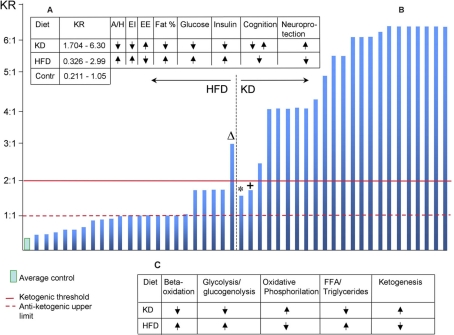
Abstract Image

以碳水化合物为主的能量代谢控制:自私大脑的阴暗面。
本文章由计算机程序翻译,如有差异,请以英文原文为准。
求助全文
约1分钟内获得全文 求助全文
来源期刊
自引率
0.00%
发文量
0
×
引用
GB/T 7714-2015
复制
MLA
复制
APA
复制
导出至
BibTeX EndNote RefMan NoteFirst NoteExpress
×
提示
您的信息不完整,为了账户安全,请先补充。
现在去补充
×
提示
您因"违规操作"
具体请查看互助需知
我知道了
×
提示
确定
请完成安全验证×
copy
已复制链接
快去分享给好友吧!
我知道了
右上角分享
点击右上角分享
0
联系我们:info@booksci.cn Book学术提供免费学术资源搜索服务,方便国内外学者检索中英文文献。致力于提供最便捷和优质的服务体验。 Copyright © 2023 布克学术 All rights reserved.
京ICP备2023020795号-1
ghs 京公网安备 11010802042870号
Book学术文献互助
Book学术文献互助群
群 号:604180095
Book学术官方微信
小红书



