Daniel W Sirkis, Luke W Bonham, Jennifer S Yokoyama
{"title":"The Role of Microglia in Inherited White-Matter Disorders and Connections to Frontotemporal Dementia.","authors":"Daniel W Sirkis, Luke W Bonham, Jennifer S Yokoyama","doi":"10.2147/TACG.S245029","DOIUrl":null,"url":null,"abstract":"<p><p>Microglia play a critical but poorly understood role in promoting white-matter homeostasis. In this review, we leverage advances in human genetics and mouse models of leukodystrophies to delineate our current knowledge and identify outstanding questions regarding the impact of microglia on central nervous system white matter. We first focus on the role of pathogenic mutations in genes, such as <i>TREM2, TYROBP</i>, and <i>CSF1R,</i> that cause leukodystrophies in which the primary deficit is thought to originate in microglia. We next discuss recent advances in disorders such as adrenoleukodystrophy and Krabbe disease, in which microglia play an increasingly recognized role. We conclude by reviewing the roles of <i>GRN</i> and related genes, such as <i>TMEM106B, PSAP</i>, and <i>SORT1,</i> that affect microglial biology and associate with several types of disease, including multiple leukodystrophies as well as forms of frontotemporal dementia (FTD) presenting with white-matter abnormalities. Taken together, mouse and human data support the notion that loss of microglia-facilitated white-matter homeostasis plays an important role in the development of leukodystrophies and suggest novel mechanisms contributing to FTD.</p>","PeriodicalId":506374,"journal":{"name":"The Application of Clinical Genetics","volume":"14 ","pages":"195-207"},"PeriodicalIF":0.0000,"publicationDate":"2021-03-31","publicationTypes":"Journal Article","fieldsOfStudy":null,"isOpenAccess":false,"openAccessPdf":"https://ftp.ncbi.nlm.nih.gov/pub/pmc/oa_pdf/44/5b/tacg-14-195.PMC8020808.pdf","citationCount":"9","resultStr":null,"platform":"Semanticscholar","paperid":null,"PeriodicalName":"The Application of Clinical Genetics","FirstCategoryId":"1085","ListUrlMain":"https://doi.org/10.2147/TACG.S245029","RegionNum":0,"RegionCategory":null,"ArticlePicture":[],"TitleCN":null,"AbstractTextCN":null,"PMCID":null,"EPubDate":"2021/1/1 0:00:00","PubModel":"eCollection","JCR":"","JCRName":"","Score":null,"Total":0}
引用次数: 9
Abstract
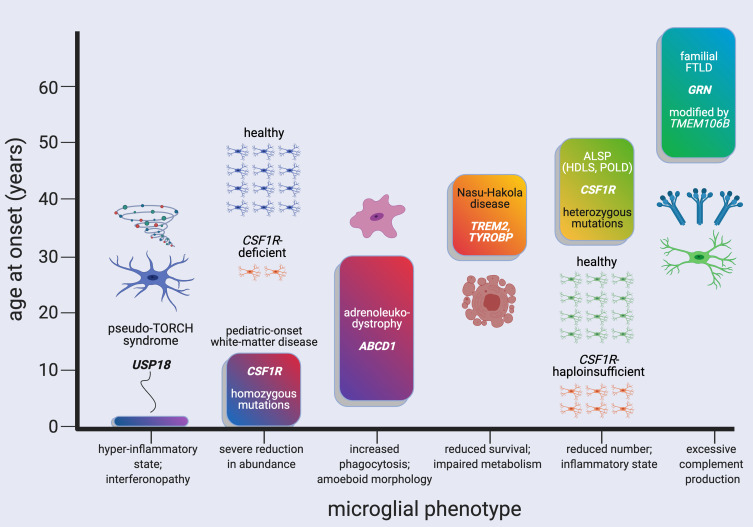
Microglia play a critical but poorly understood role in promoting white-matter homeostasis. In this review, we leverage advances in human genetics and mouse models of leukodystrophies to delineate our current knowledge and identify outstanding questions regarding the impact of microglia on central nervous system white matter. We first focus on the role of pathogenic mutations in genes, such as TREM2, TYROBP, and CSF1R, that cause leukodystrophies in which the primary deficit is thought to originate in microglia. We next discuss recent advances in disorders such as adrenoleukodystrophy and Krabbe disease, in which microglia play an increasingly recognized role. We conclude by reviewing the roles of GRN and related genes, such as TMEM106B, PSAP, and SORT1, that affect microglial biology and associate with several types of disease, including multiple leukodystrophies as well as forms of frontotemporal dementia (FTD) presenting with white-matter abnormalities. Taken together, mouse and human data support the notion that loss of microglia-facilitated white-matter homeostasis plays an important role in the development of leukodystrophies and suggest novel mechanisms contributing to FTD.


 求助内容:
 应助结果提醒方式:


 京公网安备 11010802042870号


