
Bioinspired Metal-Free Carbazole-Guanine Quadruplex Gel for Ambient Room-Temperature Phosphorescence

IF 8.1 1区 化学 Q1 CHEMISTRY, MULTIDISCIPLINARY
Sona Saji,Ariharasudhan R.,Jibin Jibin Sivanarayanan,Mahesh Hariharan
{"title":"Bioinspired Metal-Free Carbazole-Guanine Quadruplex Gel for Ambient Room-Temperature Phosphorescence","authors":"Sona Saji,Ariharasudhan R.,Jibin Jibin Sivanarayanan,Mahesh Hariharan","doi":"10.1039/d6sc05787j","DOIUrl":null,"url":null,"abstract":"Organic room-temperature phosphorescence (RTP) from metal-free supramolecular biomimetic systems remains challenging because of the rapid non-radiative deactivation of triplet excitons under ambient conditions. Herein, we report a structurally modified guanine-carbazole molecule (GC) that spontaneously self-assembles into a metal-free gel (GCG) and exhibits RTP under ambient conditions. Variable-temperature NMR, DOSY NMR, circular dichroism, and high-resolution mass spectrometry measurements collectively confirm the formation of hydrogen-bonded tetrameric G-quartets in solution without the assistance of metal ions. Single-crystal X-ray diffraction of GC reveals cyclic Hoogsteen hydrogen-bonded tetrads that further propagate into ordered helical supramolecular arrays. Gelation induces ordered J-type aggregation and conformational rigidification, and suppresses non-radiative decay pathways. Both dilute and concentrated solutions of GC in THF are non-phosphorescent at room temperature and display only fluorescence. However, upon ageing, the concentrated solution undergoes gelation to form GCG, leading to the emergence of distinct RTP with a phosphorescence lifetime of 170 μs under ambient conditions. These findings demonstrate that G-quadruplex assemblies are a supramolecular scaffold for controlling triplet excited-state dynamics and establish nucleobase-chromophore coupling as a promising strategy for the development of heavy-atom-free phosphorescent soft materials.","PeriodicalId":9909,"journal":{"name":"Chemical Science","volume":"34 1","pages":""},"PeriodicalIF":8.1000,"publicationDate":"2026-11-05","publicationTypes":"Journal Article","fieldsOfStudy":null,"isOpenAccess":false,"openAccessPdf":"","citationCount":"0","resultStr":null,"platform":"Semanticscholar","paperid":null,"PeriodicalName":"Chemical Science","FirstCategoryId":"92","ListUrlMain":"https://doi.org/10.1039/d6sc05787j","RegionNum":1,"RegionCategory":"化学","ArticlePicture":[],"TitleCN":null,"AbstractTextCN":null,"PMCID":null,"EPubDate":"","PubModel":"","JCR":"Q1","JCRName":"CHEMISTRY, MULTIDISCIPLINARY","Score":null,"Total":0}
引用次数: 0

Abstract

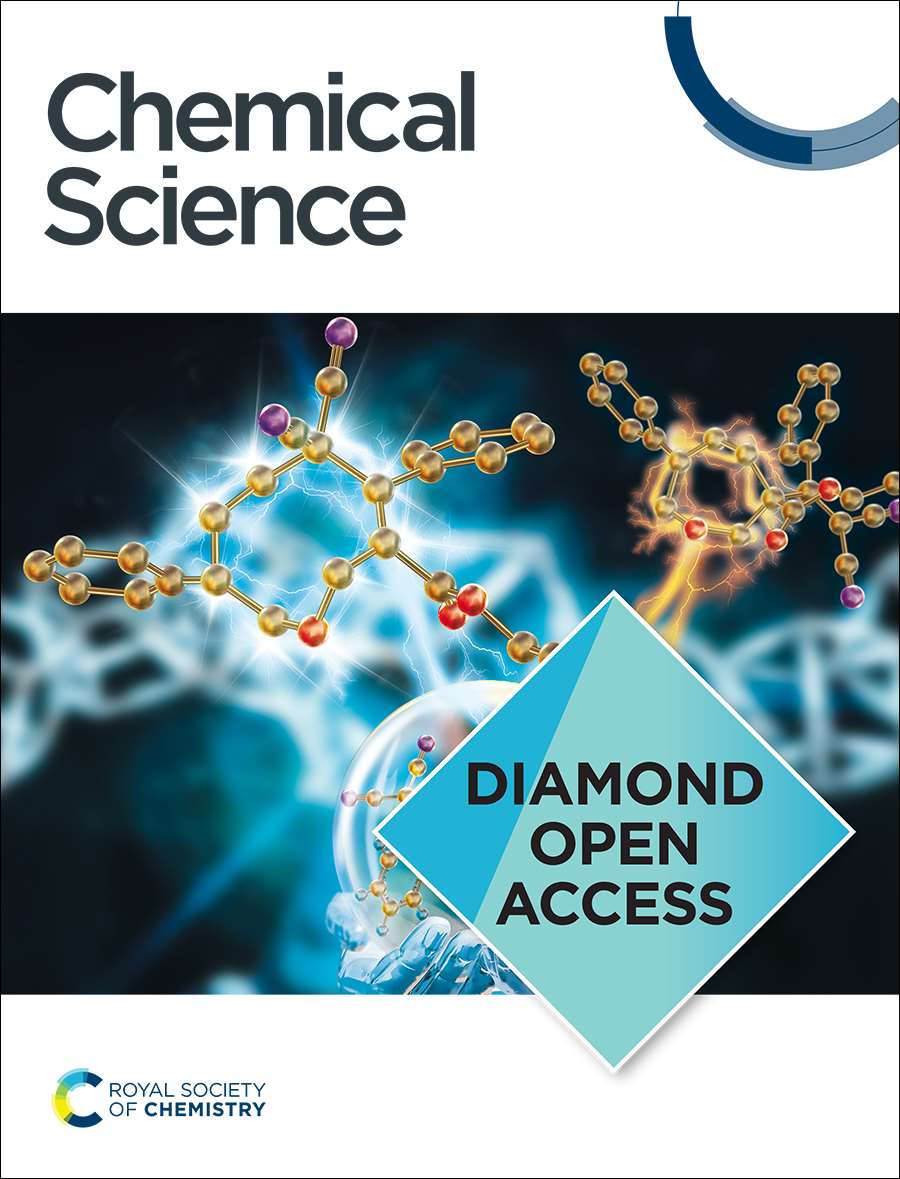
Organic room-temperature phosphorescence (RTP) from metal-free supramolecular biomimetic systems remains challenging because of the rapid non-radiative deactivation of triplet excitons under ambient conditions. Herein, we report a structurally modified guanine-carbazole molecule (GC) that spontaneously self-assembles into a metal-free gel (GCG) and exhibits RTP under ambient conditions. Variable-temperature NMR, DOSY NMR, circular dichroism, and high-resolution mass spectrometry measurements collectively confirm the formation of hydrogen-bonded tetrameric G-quartets in solution without the assistance of metal ions. Single-crystal X-ray diffraction of GC reveals cyclic Hoogsteen hydrogen-bonded tetrads that further propagate into ordered helical supramolecular arrays. Gelation induces ordered J-type aggregation and conformational rigidification, and suppresses non-radiative decay pathways. Both dilute and concentrated solutions of GC in THF are non-phosphorescent at room temperature and display only fluorescence. However, upon ageing, the concentrated solution undergoes gelation to form GCG, leading to the emergence of distinct RTP with a phosphorescence lifetime of 170 μs under ambient conditions. These findings demonstrate that G-quadruplex assemblies are a supramolecular scaffold for controlling triplet excited-state dynamics and establish nucleobase-chromophore coupling as a promising strategy for the development of heavy-atom-free phosphorescent soft materials.
用于室温磷光的仿生无金属咔唑-鸟嘌呤四联凝胶
由于在环境条件下三重态激子的快速非辐射失活,来自无金属超分子仿生系统的有机室温磷光(RTP)仍然具有挑战性。在此,我们报道了一种结构修饰的鸟嘌呤-咔唑分子(GC),它可以自发地自组装成无金属凝胶(GCG),并在环境条件下表现出RTP。变温核磁共振、DOSY核磁共振、圆二色性和高分辨率质谱测量共同证实了在没有金属离子辅助的情况下溶液中氢键四聚体g -四重奏的形成。GC单晶x射线衍射显示循环Hoogsteen氢键四元体进一步繁殖成有序的螺旋超分子阵列。凝胶化诱导有序j型聚集和构象硬化,抑制非辐射衰变途径。气相色谱在THF中的稀溶液和浓溶液在室温下都不发磷光,只显示荧光。然而,随着时间的推移,浓溶液发生凝胶反应形成GCG,形成明显的RTP,其磷光寿命在环境条件下为170 μs。这些发现表明,g -四重体组装体是一种控制三重态激发态动力学的超分子支架,并将核碱基-发色团耦合作为开发无重原子磷光软材料的一种有前途的策略。
本文章由计算机程序翻译,如有差异,请以英文原文为准。
求助全文
约1分钟内获得全文 求助全文
来源期刊
Chemical Science
Chemical Science CHEMISTRY, MULTIDISCIPLINARY-
CiteScore
14.40
自引率
4.80%
发文量
1352
审稿时长
2.1 months
期刊介绍: Chemical Science is a journal that encompasses various disciplines within the chemical sciences. Its scope includes publishing ground-breaking research with significant implications for its respective field, as well as appealing to a wider audience in related areas. To be considered for publication, articles must showcase innovative and original advances in their field of study and be presented in a manner that is understandable to scientists from diverse backgrounds. However, the journal generally does not publish highly specialized research.

×
引用
GB/T 7714-2015
复制
MLA
复制
APA
复制
导出至
BibTeX EndNote RefMan NoteFirst NoteExpress
×
提示
您的信息不完整,为了账户安全,请先补充。
现在去补充
×
提示
您因"违规操作"
具体请查看互助需知
我知道了
×
提示
确定
请完成安全验证×
copy
已复制链接
快去分享给好友吧!
我知道了
右上角分享
点击右上角分享
0
联系我们:info@booksci.cn Book学术提供免费学术资源搜索服务,方便国内外学者检索中英文文献。致力于提供最便捷和优质的服务体验。 Copyright © 2023 布克学术 All rights reserved.
京ICP备2023020795号-1
ghs 京公网安备 11010802042870号
Book学术文献互助
Book学术文献互助群
群 号:604180095
Book学术官方微信
小红书


