Yen Jea Lee, Jihyeon Yoon, Xubo Luo, David Prendergast, William A. Goddard, III, Nitash P. Balsara, Xi Jiang, Ronald N. Zuckermann, Brooks A. Abel
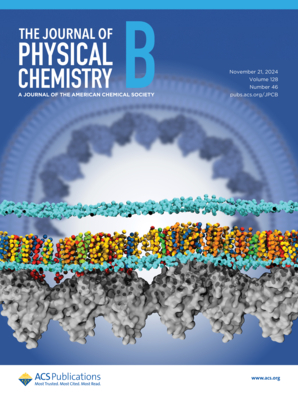
{"title":"Entropy-Driven Stabilization of Highly Charged Peptoid Nanosheets","authors":"Yen Jea Lee, Jihyeon Yoon, Xubo Luo, David Prendergast, William A. Goddard, III, Nitash P. Balsara, Xi Jiang, Ronald N. Zuckermann, Brooks A. Abel","doi":"10.1021/acs.jpcb.6c04368","DOIUrl":null,"url":null,"abstract":"<p>Free-standing\r\ntwo-dimensional (2D) peptoid nanosheets are promising\r\nfor many aqueous applications, yet how the ionic environment governs\r\ntheir structure and thermal stability remains poorly understood. Here\r\nwe design an ultrathin (∼2 nm) crystalline peptoid nanosheet\r\nwith an extremely small ionizable (ethylammonium) polar domain as\r\na structurally well-defined, highly charged model system, whose molecular\r\npacking is directly resolved by cryogenic electron microscopy. Solution-state\r\ndifferential scanning calorimetry reveals that salt-induced stabilization\r\nis dominated by entropy rather than enthalpy. Our Molecular Dynamics\r\n(MD) simulations attribute this to the release of surface-condensed\r\ncounterions upon melting, which is set by both the surface’s\r\ncounterion-condensing capacity and the bulk ion concentration, with\r\nour computed release entropies tracking the measured melting entropies.\r\nWith sodium halide salts, the melting temperatures follow a Hofmeister-like\r\nordering (F<sup>–</sup> > Cl<sup>–</sup> > Br<sup>–</sup>), reflecting F<sup>–</sup> ’s higher\r\npropensity for\r\ncontact ion pairing with the <em>N</em>-terminal ammonium\r\ngroups, as demonstrated by our MD simulations. Bulky organic cations\r\nsuch as tetrabutylammonium add enthalpic stabilization, which we ascribed\r\nto the direct dispersion contacts with hydrophobic surface groups\r\nbetween their alkyl chains of tetrabutylammonium and hydrophobic surface-exposed\r\nside chains, whereas Na<sup>+</sup> does not. By resolving how ion\r\nidentity partitions stabilization between entropic and enthalpic interfacial\r\npathways, this work establishes electrolyte composition as a key design\r\nparameter for tuning free-standing, highly charged 2D soft materials.</p>","PeriodicalId":60,"journal":{"name":"The Journal of Physical Chemistry B","volume":"130 43","pages":"11623–11636"},"PeriodicalIF":3.2000,"publicationDate":"2026-10-29","publicationTypes":"Journal Article","fieldsOfStudy":null,"isOpenAccess":false,"openAccessPdf":"","citationCount":"0","resultStr":null,"platform":"Semanticscholar","paperid":null,"PeriodicalName":"The Journal of Physical Chemistry B","FirstCategoryId":"1","ListUrlMain":"https://pubs.acs.org/doi/10.1021/acs.jpcb.6c04368","RegionNum":2,"RegionCategory":"化学","ArticlePicture":[],"TitleCN":null,"AbstractTextCN":null,"PMCID":null,"EPubDate":"2026/10/19 0:00:00","PubModel":"Epub","JCR":"Q3","JCRName":"CHEMISTRY, PHYSICAL","Score":null,"Total":0}
引用次数: 0
Abstract
Free-standing
two-dimensional (2D) peptoid nanosheets are promising
for many aqueous applications, yet how the ionic environment governs
their structure and thermal stability remains poorly understood. Here
we design an ultrathin (∼2 nm) crystalline peptoid nanosheet
with an extremely small ionizable (ethylammonium) polar domain as
a structurally well-defined, highly charged model system, whose molecular
packing is directly resolved by cryogenic electron microscopy. Solution-state
differential scanning calorimetry reveals that salt-induced stabilization
is dominated by entropy rather than enthalpy. Our Molecular Dynamics
(MD) simulations attribute this to the release of surface-condensed
counterions upon melting, which is set by both the surface’s
counterion-condensing capacity and the bulk ion concentration, with
our computed release entropies tracking the measured melting entropies.
With sodium halide salts, the melting temperatures follow a Hofmeister-like
ordering (F– > Cl– > Br–), reflecting F– ’s higher
propensity for
contact ion pairing with the N-terminal ammonium
groups, as demonstrated by our MD simulations. Bulky organic cations
such as tetrabutylammonium add enthalpic stabilization, which we ascribed
to the direct dispersion contacts with hydrophobic surface groups
between their alkyl chains of tetrabutylammonium and hydrophobic surface-exposed
side chains, whereas Na+ does not. By resolving how ion
identity partitions stabilization between entropic and enthalpic interfacial
pathways, this work establishes electrolyte composition as a key design
parameter for tuning free-standing, highly charged 2D soft materials.
期刊介绍:
An essential criterion for acceptance of research articles in the journal is that they provide new physical insight. Please refer to the New Physical Insights virtual issue on what constitutes new physical insight. Manuscripts that are essentially reporting data or applications of data are, in general, not suitable for publication in JPC B.


 求助内容:
 应助结果提醒方式:


 京公网安备 11010802042870号


