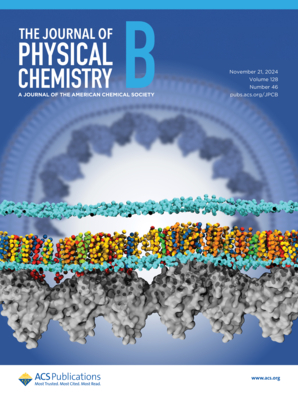
{"title":"Interfacial Solute Organization Governs Mixed-Osmolyte Compatibility under Salt Stress","authors":"Susmita Sarkar, Nandita Mohandas, Rayantan Sadhukhan, Priyanshu Garai, Dibyendu Das, Tharangattu N. Narayanan, Jagannath Mondal","doi":"10.1021/acs.jpcb.6c04733","DOIUrl":null,"url":null,"abstract":"<p>Mixed osmolytes protect charged biomolecular and nanomaterial\r\ninterfaces\r\nunder salt stress, but their combined effects are often nonadditive.\r\nHere we identify interfacial solute organization as a molecular criterion\r\nthat determines whether a mixture is protective or antagonistic via\r\ncombining computer simulations and experiments. All-atom simulations\r\nof negatively charged α-quartz nanoslabs, supported by SHINERS\r\nand ATR-FTIRS experiments on silica surfaces, show that urea weakens\r\nglycine-mediated protection but strengthens TMAO- and betaine-mediated\r\nprotection. The difference arises from nanoscale organization: urea\r\nassociates with glycine at the charged interface, suppressing glycine-driven\r\ncation displacement and reducing intersurface repulsion, whereas urea\r\nremains spatially independent of TMAO and betaine, allowing their\r\nion-modulating effects to combine constructively. The same directional\r\nbehavior is reproduced in Aβ(1–40) dimerization simulations\r\nand Aβ-derived AcKE aggregation kinetic experiments. These results\r\nestablish interfacial solute organization as a transferable rule for\r\ndesigning multicomponent protective environments.</p>","PeriodicalId":60,"journal":{"name":"The Journal of Physical Chemistry B","volume":"130 43","pages":"11383–11394"},"PeriodicalIF":3.2000,"publicationDate":"2026-10-29","publicationTypes":"Journal Article","fieldsOfStudy":null,"isOpenAccess":false,"openAccessPdf":"","citationCount":"0","resultStr":null,"platform":"Semanticscholar","paperid":null,"PeriodicalName":"The Journal of Physical Chemistry B","FirstCategoryId":"1","ListUrlMain":"https://pubs.acs.org/doi/10.1021/acs.jpcb.6c04733","RegionNum":2,"RegionCategory":"化学","ArticlePicture":[],"TitleCN":null,"AbstractTextCN":null,"PMCID":null,"EPubDate":"2026/10/19 0:00:00","PubModel":"Epub","JCR":"Q3","JCRName":"CHEMISTRY, PHYSICAL","Score":null,"Total":0}
引用次数: 0
Abstract
Mixed osmolytes protect charged biomolecular and nanomaterial
interfaces
under salt stress, but their combined effects are often nonadditive.
Here we identify interfacial solute organization as a molecular criterion
that determines whether a mixture is protective or antagonistic via
combining computer simulations and experiments. All-atom simulations
of negatively charged α-quartz nanoslabs, supported by SHINERS
and ATR-FTIRS experiments on silica surfaces, show that urea weakens
glycine-mediated protection but strengthens TMAO- and betaine-mediated
protection. The difference arises from nanoscale organization: urea
associates with glycine at the charged interface, suppressing glycine-driven
cation displacement and reducing intersurface repulsion, whereas urea
remains spatially independent of TMAO and betaine, allowing their
ion-modulating effects to combine constructively. The same directional
behavior is reproduced in Aβ(1–40) dimerization simulations
and Aβ-derived AcKE aggregation kinetic experiments. These results
establish interfacial solute organization as a transferable rule for
designing multicomponent protective environments.
期刊介绍:
An essential criterion for acceptance of research articles in the journal is that they provide new physical insight. Please refer to the New Physical Insights virtual issue on what constitutes new physical insight. Manuscripts that are essentially reporting data or applications of data are, in general, not suitable for publication in JPC B.


 求助内容:
 应助结果提醒方式:


 京公网安备 11010802042870号


