{"title":"Glycosaminoglycans Recruit IAPP Oligomers on Lipid Bilayers","authors":"Suhas Gotla, Meenal Jain, Silvina Matysiak","doi":"10.1021/acs.jpcb.6c03348","DOIUrl":null,"url":null,"abstract":"<p>Glycosaminoglycans (GAGs) are anionic polysaccharides\r\nthat coexist\r\nwith cell membranes in the extracellular matrix and have been shown\r\nto cooperatively enhance the aggregation of islet amyloid polypeptide\r\n(IAPP) at zwitterionic lipid surfaces─a process implicated\r\nin β-cell death in type 2 diabetes. However, the molecular mechanisms\r\nby which GAGs and lipids concertedly promote IAPP aggregation remain\r\npoorly understood. Here, we develop a coarse-grained model for the\r\nGAG chondroitin-4-sulfate (CS) and employ molecular dynamics simulations\r\nto investigate the aggregation of the IAPP<sub>11–29</sub> fragment\r\nin environments containing CS, a 1-palmitoyl-2-oleoyl-<em>sn</em>-glycero-3-phosphocholine (POPC) bilayer, or both. By comparing simultaneous\r\nand sequential assembly pathways, we show that the order of molecular\r\nencounters reshapes the aggregation landscape. CS drives rapid peptide\r\nconsolidation at the bilayer surface through GAG-chain flexion and\r\npeptide crawling on the GAG chain, yielding ternary aggregates in\r\nwhich hydrophobic residues anchor into the bilayer, a globular peptide\r\nbody extends above the membrane plane, while the CS chain forms a\r\ncorona. CS further stabilizes helical intermediates through dipole–charge\r\ninteractions, with helix half-lives four- to five-fold greater than\r\nin the bilayer-only system. When introduced to dispersed, bilayer-bound\r\noligomers, CS recruits them into larger, more orientationally ordered\r\naggregates that may serve as superior seeds for downstream fibrillation.\r\nTogether, these results provide a molecular basis for the experimentally\r\nobserved cooperative enhancement of IAPP aggregation by GAGs and zwitterionic\r\nlipids.</p>","PeriodicalId":60,"journal":{"name":"The Journal of Physical Chemistry B","volume":"130 43","pages":"11452–11462"},"PeriodicalIF":3.2000,"publicationDate":"2026-10-29","publicationTypes":"Journal Article","fieldsOfStudy":null,"isOpenAccess":false,"openAccessPdf":"","citationCount":"0","resultStr":null,"platform":"Semanticscholar","paperid":null,"PeriodicalName":"The Journal of Physical Chemistry B","FirstCategoryId":"1","ListUrlMain":"https://pubs.acs.org/doi/10.1021/acs.jpcb.6c03348","RegionNum":2,"RegionCategory":"化学","ArticlePicture":[],"TitleCN":null,"AbstractTextCN":null,"PMCID":null,"EPubDate":"2026/10/19 0:00:00","PubModel":"Epub","JCR":"Q3","JCRName":"CHEMISTRY, PHYSICAL","Score":null,"Total":0}
引用次数: 0
Abstract
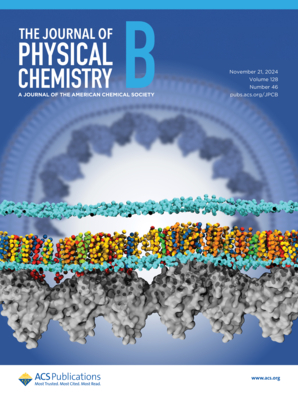
Glycosaminoglycans (GAGs) are anionic polysaccharides
that coexist
with cell membranes in the extracellular matrix and have been shown
to cooperatively enhance the aggregation of islet amyloid polypeptide
(IAPP) at zwitterionic lipid surfaces─a process implicated
in β-cell death in type 2 diabetes. However, the molecular mechanisms
by which GAGs and lipids concertedly promote IAPP aggregation remain
poorly understood. Here, we develop a coarse-grained model for the
GAG chondroitin-4-sulfate (CS) and employ molecular dynamics simulations
to investigate the aggregation of the IAPP11–29 fragment
in environments containing CS, a 1-palmitoyl-2-oleoyl-sn-glycero-3-phosphocholine (POPC) bilayer, or both. By comparing simultaneous
and sequential assembly pathways, we show that the order of molecular
encounters reshapes the aggregation landscape. CS drives rapid peptide
consolidation at the bilayer surface through GAG-chain flexion and
peptide crawling on the GAG chain, yielding ternary aggregates in
which hydrophobic residues anchor into the bilayer, a globular peptide
body extends above the membrane plane, while the CS chain forms a
corona. CS further stabilizes helical intermediates through dipole–charge
interactions, with helix half-lives four- to five-fold greater than
in the bilayer-only system. When introduced to dispersed, bilayer-bound
oligomers, CS recruits them into larger, more orientationally ordered
aggregates that may serve as superior seeds for downstream fibrillation.
Together, these results provide a molecular basis for the experimentally
observed cooperative enhancement of IAPP aggregation by GAGs and zwitterionic
lipids.
期刊介绍:
An essential criterion for acceptance of research articles in the journal is that they provide new physical insight. Please refer to the New Physical Insights virtual issue on what constitutes new physical insight. Manuscripts that are essentially reporting data or applications of data are, in general, not suitable for publication in JPC B.


 求助内容:
 应助结果提醒方式:


 京公网安备 11010802042870号


