
Mapping of pikachurin heparan sulfate modification to a region dispensable for synaptic localization in photoreceptors
IF 4
2区 生物学
Q2 BIOCHEMISTRY & MOLECULAR BIOLOGY
引用次数: 0
Abstract
Rod and cone photoreceptors (PRs) are specialized neurons that detect light, then transmit information to bipolar cells at synapses in the outer plexiform layer of the retina. Pikachurin (PIKA) is a multi-domain heparan sulfate (HS) proteoglycan expressed in PRs. It is secreted into the synaptic cleft, where it binds to presynaptic dystroglycan, postsynaptic orphan receptor GPR179, and postsynaptic adhesion molecule LRRTM4. Knockout of PIKA results in ultrastructural and functional defects at rod synapses. However, the role of HS in PIKA function at synapses is unknown. Using a panel of deletion and truncation mutants expressed in heterologous cells, we determined that a.a. 240-342, a region of unknown function between the last fibronectin III domain and the first EGF-like domain, is necessary and sufficient for PIKA HS modification. Site-directed mutagenesis of S244, identified as a likely candidate based on neighboring sequences, abolished HS modification, indicating that this residue is the sole HS attachment site. Deletion of the 240-342 region or mutation of S244 also abolished co-immunoprecipitation of LRRTM4, consistent with the previously reported HS-dependent binding. To assess requirements for synaptic localization, PIKA mutants were expressed in mouse rods. Deletion of the HS-containing region or the fibronectin III domains did not prevent localization at rod presynapses. In contrast, deletion of the first EGF-like and laminin G domains severely impaired localization, suggesting an important role for these domains in mediating trafficking or synaptic enrichment.皮卡丘林硫酸肝素修饰在光感受器突触定位中不可或缺的区域的映射
视杆和视锥光感受器(pr)是一种特殊的神经元,它们检测光,然后将信息传递给视网膜外丛状层突触的双极细胞。Pikachurin (PIKA)是一种在PRs中表达的多结构域硫酸肝素(HS)蛋白多糖。它被分泌到突触间隙中,在那里它与突触前糖酐、突触后孤儿受体GPR179和突触后粘附分子LRRTM4结合。敲除PIKA会导致杆突触的超微结构和功能缺陷。然而,HS在PIKA突触功能中的作用尚不清楚。利用一组在异源细胞中表达的缺失和截断突变体,我们确定a.a.240 -342,一个位于最后一个纤维连接蛋白III结构域和第一个egf样结构域之间的未知功能区域,对于PIKA HS修饰是必要和充分的。基于邻近序列确定的S244的位点定向突变消除了HS修饰,表明该残基是唯一的HS附着位点。240-342区域的缺失或S244的突变也消除了LRRTM4的共免疫沉淀,这与之前报道的hs依赖性结合一致。为了评估对突触定位的要求,在小鼠棒中表达了PIKA突变体。含有hs的区域或纤维连接蛋白III结构域的删除不会阻止杆前突触的定位。相比之下,第一个egf样结构域和层粘连蛋白G结构域的缺失严重损害了定位,这表明这些结构域在介导运输或突触富集中起着重要作用。
本文章由计算机程序翻译,如有差异,请以英文原文为准。
求助全文
约1分钟内获得全文
求助全文
来源期刊
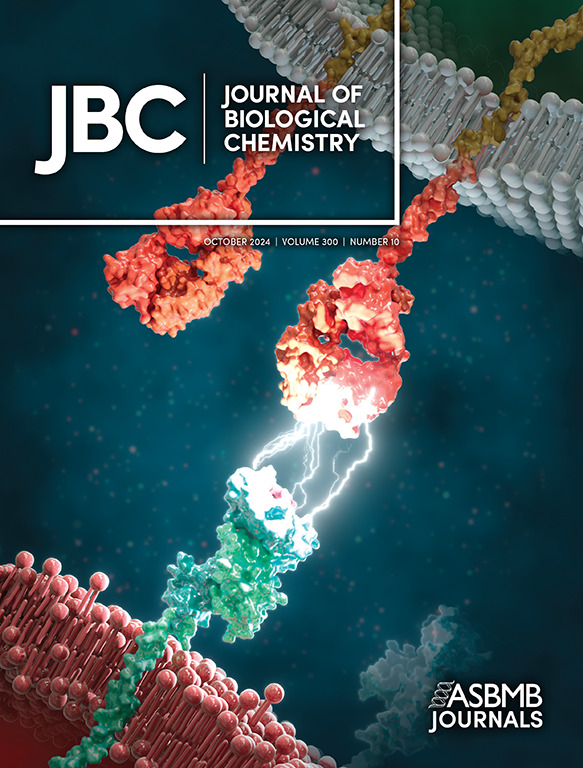
Journal of Biological Chemistry
Biochemistry, Genetics and Molecular Biology-Biochemistry
自引率
4.20%
发文量
1233
期刊介绍:
The Journal of Biological Chemistry welcomes high-quality science that seeks to elucidate the molecular and cellular basis of biological processes. Papers published in JBC can therefore fall under the umbrellas of not only biological chemistry, chemical biology, or biochemistry, but also allied disciplines such as biophysics, systems biology, RNA biology, immunology, microbiology, neurobiology, epigenetics, computational biology, ’omics, and many more. The outcome of our focus on papers that contribute novel and important mechanistic insights, rather than on a particular topic area, is that JBC is truly a melting pot for scientists across disciplines. In addition, JBC welcomes papers that describe methods that will help scientists push their biochemical inquiries forward and resources that will be of use to the research community.
 求助内容:
 应助结果提醒方式:


 京公网安备 11010802042870号


