Chenglin Yao, Risa Higashita, Kai Wang, Jing Liu, Lingxi Hu, Zaidao Han, Haihan Liu, Jiang Liu
{"title":"Template-Anchored Signal Decomposition and Label Refinement for Impairment Categorization on Noisy Visual Electrophysiological Data.","authors":"Chenglin Yao, Risa Higashita, Kai Wang, Jing Liu, Lingxi Hu, Zaidao Han, Haihan Liu, Jiang Liu","doi":"10.1109/JBHI.2026.3744319","DOIUrl":null,"url":null,"abstract":"<p><p>Visual electrophysiology offers an objective alternative to subjective vision assessments, providing enhanced reliability but remaining underutilized for visual impairment categorization due to imperfect datasets, noisy signals, and label inconsistencies. To address these challenges, we first construct a new dataset comprising ERG and VEP recordings from 1,970 participants with various ocular conditions and a mean age of 21.59 $\\pm$ 4.47 years. A three-class categorization task is defined to reflect clinical disability grading. We then propose a template-anchored decomposition method for noise-aware signal feature extraction, using mode-specific ridge regression to isolate pathological components by removing both healthy patterns and noise artifacts. To collectively enhance feature representation from multi-channel signals, we design a joint attention encoder that combines channel attention with bilateral spatial attention across left- and right-eye channels to emphasize informative and coherent signal patterns. Furthermore, we introduce a template-anchored refinement mechanism that addresses label noise by updating soft labels during training based on the distances between each feature vector and the class templates. Extensive experiments demonstrate that our method achieves consistent improvements over existing electrophysiology-based and general biosignal classification methods, supporting its feasibility for visual impairment categorization in a cohort composed primarily of young adults.</p>","PeriodicalId":13073,"journal":{"name":"IEEE Journal of Biomedical and Health Informatics","volume":"PP ","pages":""},"PeriodicalIF":7.7000,"publicationDate":"2026-10-19","publicationTypes":"Journal Article","fieldsOfStudy":null,"isOpenAccess":false,"openAccessPdf":"","citationCount":"0","resultStr":null,"platform":"Semanticscholar","paperid":null,"PeriodicalName":"IEEE Journal of Biomedical and Health Informatics","FirstCategoryId":"5","ListUrlMain":"https://doi.org/10.1109/JBHI.2026.3744319","RegionNum":2,"RegionCategory":"医学","ArticlePicture":[],"TitleCN":null,"AbstractTextCN":null,"PMCID":null,"EPubDate":"","PubModel":"","JCR":"Q1","JCRName":"COMPUTER SCIENCE, INFORMATION SYSTEMS","Score":null,"Total":0}
引用次数: 0
Abstract
Visual electrophysiology offers an objective alternative to subjective vision assessments, providing enhanced reliability but remaining underutilized for visual impairment categorization due to imperfect datasets, noisy signals, and label inconsistencies. To address these challenges, we first construct a new dataset comprising ERG and VEP recordings from 1,970 participants with various ocular conditions and a mean age of 21.59 $\pm$ 4.47 years. A three-class categorization task is defined to reflect clinical disability grading. We then propose a template-anchored decomposition method for noise-aware signal feature extraction, using mode-specific ridge regression to isolate pathological components by removing both healthy patterns and noise artifacts. To collectively enhance feature representation from multi-channel signals, we design a joint attention encoder that combines channel attention with bilateral spatial attention across left- and right-eye channels to emphasize informative and coherent signal patterns. Furthermore, we introduce a template-anchored refinement mechanism that addresses label noise by updating soft labels during training based on the distances between each feature vector and the class templates. Extensive experiments demonstrate that our method achieves consistent improvements over existing electrophysiology-based and general biosignal classification methods, supporting its feasibility for visual impairment categorization in a cohort composed primarily of young adults.
期刊介绍:
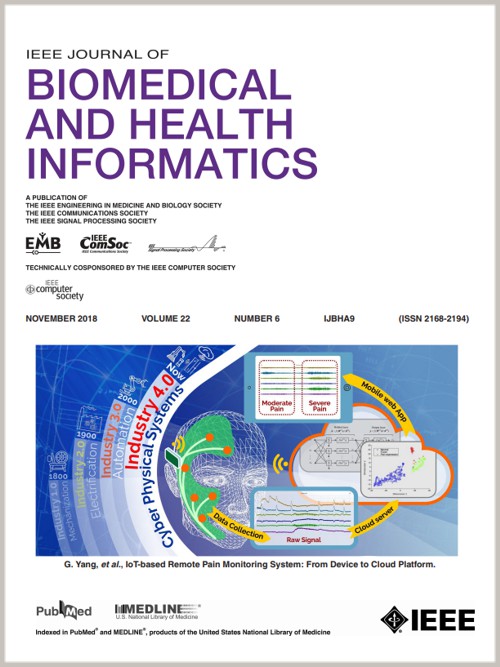
IEEE Journal of Biomedical and Health Informatics publishes original papers presenting recent advances where information and communication technologies intersect with health, healthcare, life sciences, and biomedicine. Topics include acquisition, transmission, storage, retrieval, management, and analysis of biomedical and health information. The journal covers applications of information technologies in healthcare, patient monitoring, preventive care, early disease diagnosis, therapy discovery, and personalized treatment protocols. It explores electronic medical and health records, clinical information systems, decision support systems, medical and biological imaging informatics, wearable systems, body area/sensor networks, and more. Integration-related topics like interoperability, evidence-based medicine, and secure patient data are also addressed.

 求助内容:
 应助结果提醒方式:


 京公网安备 11010802042870号


