
Microenvironment-Directed Galvanostatic Base Generation for Near-Neutral Hydrolysis of a Nerve-Agent Simulant

IF 16.6 1区 化学 Q1 CHEMISTRY, MULTIDISCIPLINARY
Sohui Kim,Mansu Kim,Hyung-Suk Oh,Dongmok Whang,Joseph T. Hupp
{"title":"Microenvironment-Directed Galvanostatic Base Generation for Near-Neutral Hydrolysis of a Nerve-Agent Simulant","authors":"Sohui Kim,Mansu Kim,Hyung-Suk Oh,Dongmok Whang,Joseph T. Hupp","doi":"10.1021/jacs.6c15372","DOIUrl":null,"url":null,"abstract":"Organophosphate hydrolysis under near-neutral conditions is intrinsically slow and generally requires strongly basic media or tailored catalysts. Here, we demonstrate that the electrolyte microenvironment can promote hydrolysis of dimethyl 4-nitrophenyl phosphate (DMNP) through an electrochemically generated base. Chemical controls show that DMNP hydrolysis depends on the combined effects of bulk pH, phosphate speciation, electrolyte concentration, and substrate accessibility. Under galvanostatic operation, cathodic water reduction generates OH– in situ, coupling hydrogen evolution to specific-base SN2(P) hydrolysis of DMNP. Time-resolved 31P NMR shows reciprocal DMNP consumption and dimethyl phosphate formation, while complementary UV–vis spectroscopy is consistent with formation of p-nitrophenolate. Although K2HPO4 and NaClO4 provide similar DMNP conversion at the same current, phosphate lowers the required overpotential and substantially improves energy-normalized conversion efficiency. Translation to a zero-gap membrane-electrode assembly enables stable full-cell operation and quantitative DMNP consumption within 1 h in a larger-volume, flow-compatible configuration. These findings establish galvanostatic in situ base generation as a controllable and modular strategy for organophosphate treatment in near-neutral aqueous media.","PeriodicalId":49,"journal":{"name":"Journal of the American Chemical Society","volume":"13 1","pages":""},"PeriodicalIF":16.6000,"publicationDate":"2026-10-20","publicationTypes":"Journal Article","fieldsOfStudy":null,"isOpenAccess":false,"openAccessPdf":"","citationCount":"0","resultStr":null,"platform":"Semanticscholar","paperid":null,"PeriodicalName":"Journal of the American Chemical Society","FirstCategoryId":"92","ListUrlMain":"https://doi.org/10.1021/jacs.6c15372","RegionNum":1,"RegionCategory":"化学","ArticlePicture":[],"TitleCN":null,"AbstractTextCN":null,"PMCID":null,"EPubDate":"","PubModel":"","JCR":"Q1","JCRName":"CHEMISTRY, MULTIDISCIPLINARY","Score":null,"Total":0}
引用次数: 0

Abstract

Organophosphate hydrolysis under near-neutral conditions is intrinsically slow and generally requires strongly basic media or tailored catalysts. Here, we demonstrate that the electrolyte microenvironment can promote hydrolysis of dimethyl 4-nitrophenyl phosphate (DMNP) through an electrochemically generated base. Chemical controls show that DMNP hydrolysis depends on the combined effects of bulk pH, phosphate speciation, electrolyte concentration, and substrate accessibility. Under galvanostatic operation, cathodic water reduction generates OH– in situ, coupling hydrogen evolution to specific-base SN2(P) hydrolysis of DMNP. Time-resolved 31P NMR shows reciprocal DMNP consumption and dimethyl phosphate formation, while complementary UV–vis spectroscopy is consistent with formation of p-nitrophenolate. Although K2HPO4 and NaClO4 provide similar DMNP conversion at the same current, phosphate lowers the required overpotential and substantially improves energy-normalized conversion efficiency. Translation to a zero-gap membrane-electrode assembly enables stable full-cell operation and quantitative DMNP consumption within 1 h in a larger-volume, flow-compatible configuration. These findings establish galvanostatic in situ base generation as a controllable and modular strategy for organophosphate treatment in near-neutral aqueous media.

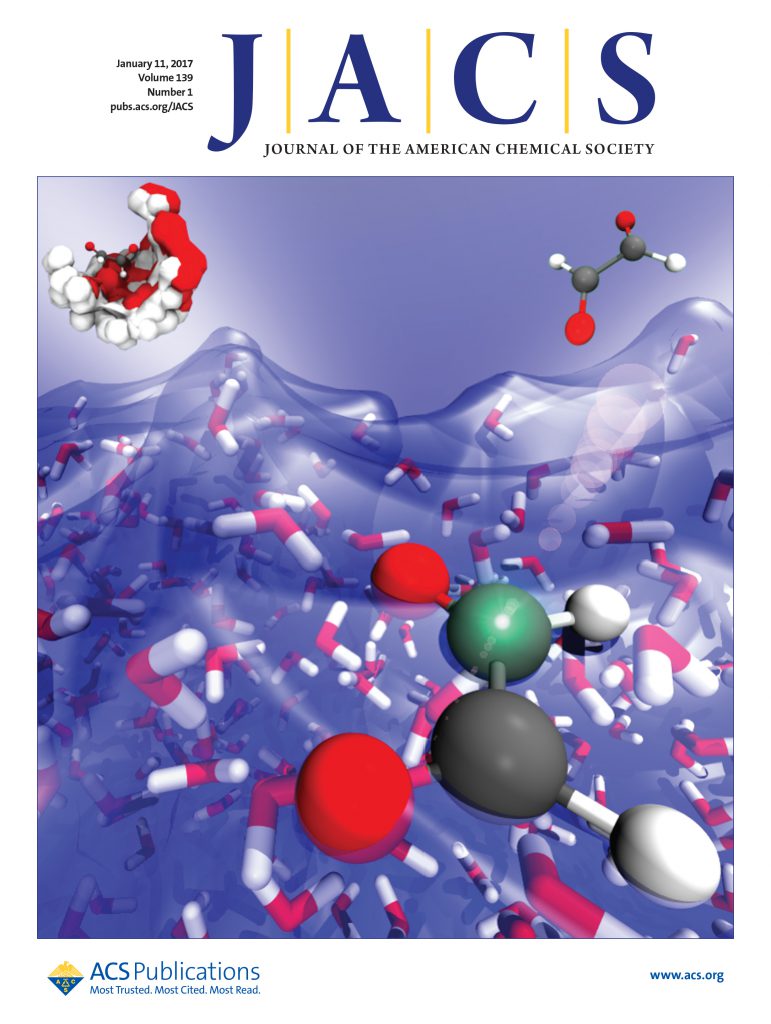
Abstract Image

神经毒剂模拟物近中性水解的微环境定向恒流碱生成
在接近中性的条件下,有机磷酸盐的水解本质上是缓慢的,通常需要强碱性介质或定制的催化剂。在这里,我们证明了电解质微环境可以通过电化学生成的碱促进磷酸二甲基4-硝基苯基(DMNP)的水解。化学控制表明,DMNP水解取决于总体pH、磷酸盐形态、电解质浓度和底物可及性的综合影响。在恒流操作下,阴极水还原原位生成OH -,将析氢与DMNP的特异碱SN2(P)水解耦合在一起。时间分辨31P核磁共振显示DMNP消耗和磷酸二甲酯形成相互作用,互补紫外-可见光谱显示对硝基苯酚形成相一致。虽然K2HPO4和NaClO4在相同电流下提供相似的DMNP转换,但磷酸盐降低了所需的过电位,并大大提高了能量归一化转换效率。转换为零间隙膜电极组件,在更大体积、流量兼容的配置下,可以在1小时内实现稳定的全细胞操作和定量DMNP消耗。这些发现建立了恒流原位碱基生成作为一种可控和模块化的策略,用于近中性水介质中有机磷的处理。
本文章由计算机程序翻译,如有差异,请以英文原文为准。
求助全文
约1分钟内获得全文 求助全文
来源期刊
CiteScore
24.40
自引率
6.00%
发文量
2398
审稿时长
1.6 months
期刊介绍: The flagship journal of the American Chemical Society, known as the Journal of the American Chemical Society (JACS), has been a prestigious publication since its establishment in 1879. It holds a preeminent position in the field of chemistry and related interdisciplinary sciences. JACS is committed to disseminating cutting-edge research papers, covering a wide range of topics, and encompasses approximately 19,000 pages of Articles, Communications, and Perspectives annually. With a weekly publication frequency, JACS plays a vital role in advancing the field of chemistry by providing essential research.

×
引用
GB/T 7714-2015
复制
MLA
复制
APA
复制
导出至
BibTeX EndNote RefMan NoteFirst NoteExpress
×
提示
您的信息不完整,为了账户安全,请先补充。
现在去补充
×
提示
您因"违规操作"
具体请查看互助需知
我知道了
×
提示
确定
请完成安全验证×
copy
已复制链接
快去分享给好友吧!
我知道了
右上角分享
点击右上角分享
0
联系我们:info@booksci.cn Book学术提供免费学术资源搜索服务,方便国内外学者检索中英文文献。致力于提供最便捷和优质的服务体验。 Copyright © 2023 布克学术 All rights reserved.
京ICP备2023020795号-1
ghs 京公网安备 11010802042870号
Book学术文献互助
Book学术文献互助群
群 号:604180095
Book学术官方微信
小红书


