{"title":"[Medicinal Alcohol in <i>Treating Sixty diseases and the Qi Harmony Decoction Method</i> in <i>the Tian Hui Yi Jian</i>].","authors":"X Liu, J Wang, Q Luo","doi":"10.3760/cma.j.cn112155-20260508-00074","DOIUrl":null,"url":null,"abstract":"<p><p><i>Treating Sixty diseases and the Qi Harmony Decoction Method</i> (hereafter <i>He Qi Tang Fa</i>) in <i>the Tian Hui Yi Jian</i> presents abundant information on medicinal substances and formula construction, in particular, the fully-developed use of medicinal alcohols. This paper examines <i>He Qi Tang Fa</i> in this book, <i>The Prescriptions for Fifty-Two Diseases</i> and <i>The Prescriptions for Nourishing Life</i> from the Mawangdui tombs, analyses the various terms and types of fermented liquors recorded in the texts, explores their functional differentiation in medical practice from the perspectives of modes of application and producing techniques. It was found that the use of medicinal alcohols in <i>He Qi Tang Fa</i> was grounded in a sophisticated understanding of the nature of fermented beverages. The nature of different types of alcohol, such as its body, quality, or whether they have to be heated, were drawn on to fulfill multiple functions, including facilitating the effects of drugs, processing medicinal substances, and serving as a basis for compound formulas. It was found that the formula \"Medicinal Fermented Mash for Treating Cold-Heat Cough\" seems to be the most complete medicinal alcohol prescription preserved in excavated medical texts to date. Its production process shows notable continuity with later traditions of medicinal alcoholic beverage, demonstrating its foundational significance and its long-term influence.</p>","PeriodicalId":35995,"journal":{"name":"中华医史杂志","volume":"56 5","pages":"265-271"},"PeriodicalIF":0.0000,"publicationDate":"2026-09-28","publicationTypes":"Journal Article","fieldsOfStudy":null,"isOpenAccess":false,"openAccessPdf":"","citationCount":"0","resultStr":null,"platform":"Semanticscholar","paperid":null,"PeriodicalName":"中华医史杂志","FirstCategoryId":"1090","ListUrlMain":"https://doi.org/10.3760/cma.j.cn112155-20260508-00074","RegionNum":0,"RegionCategory":null,"ArticlePicture":[],"TitleCN":null,"AbstractTextCN":null,"PMCID":null,"EPubDate":"","PubModel":"","JCR":"Q4","JCRName":"Medicine","Score":null,"Total":0}
引用次数: 0
Abstract
Treating Sixty diseases and the Qi Harmony Decoction Method (hereafter He Qi Tang Fa) in the Tian Hui Yi Jian presents abundant information on medicinal substances and formula construction, in particular, the fully-developed use of medicinal alcohols. This paper examines He Qi Tang Fa in this book, The Prescriptions for Fifty-Two Diseases and The Prescriptions for Nourishing Life from the Mawangdui tombs, analyses the various terms and types of fermented liquors recorded in the texts, explores their functional differentiation in medical practice from the perspectives of modes of application and producing techniques. It was found that the use of medicinal alcohols in He Qi Tang Fa was grounded in a sophisticated understanding of the nature of fermented beverages. The nature of different types of alcohol, such as its body, quality, or whether they have to be heated, were drawn on to fulfill multiple functions, including facilitating the effects of drugs, processing medicinal substances, and serving as a basis for compound formulas. It was found that the formula "Medicinal Fermented Mash for Treating Cold-Heat Cough" seems to be the most complete medicinal alcohol prescription preserved in excavated medical texts to date. Its production process shows notable continuity with later traditions of medicinal alcoholic beverage, demonstrating its foundational significance and its long-term influence.
期刊介绍:
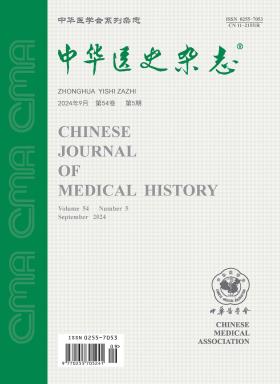
The Chinese Journal of Medical History is the only professional academic journal on medical history in the country. The first publication was named "Journal of Medical History" and was designated as a quarterly publication. In 2009, it was changed from quarterly to bimonthly.
The Chinese Journal of Medical History has columns such as special articles, reviews, expert talks, medical history treatises, literature research, forums and debates, historical accounts, figures, short essays, graduate forums, lectures, historical materials, medical history, and book reviews.
Chinese Journal of Medical History has been included in the US Medline online database.

 求助内容:
 应助结果提醒方式:


 京公网安备 11010802042870号


