Gazi Hao, Tianxu Xi, Yong Kou, Cheng Zhang, Ronghuan Yang, Jiahao Yu, Qiangqiang Lu, Hongyu Yang, Chong Chen, Lei Xiao, Jun Di, Fengqi Zhao, Wei Jiang
{"title":"Architecting nano-Al/HMX/CuO energetic micro-units unlocks superior interface and highly efficient combustion","authors":"Gazi Hao, Tianxu Xi, Yong Kou, Cheng Zhang, Ronghuan Yang, Jiahao Yu, Qiangqiang Lu, Hongyu Yang, Chong Chen, Lei Xiao, Jun Di, Fengqi Zhao, Wei Jiang","doi":"10.1002/inf2.70167","DOIUrl":null,"url":null,"abstract":"<p>The combustion performance and interfacial-mechanical properties of the Al/HMX composite are pivotal to its application in propellant and explosive formulations. Although nano-aluminum (n-Al) possesses high reactivity, issues such as particle agglomeration and surface oxidation limit its combustion efficiency and mechanical properties, hindering its direct application. Spherical Al/HMX/CuO composite energetic micro-units were designed using multiscale simulations combining molecular dynamics and computational fluid dynamics. Using fluororubber F<sub>2603</sub> as the binder, the micro-units were precisely and controllably fabricated employing coaxial microfluidic technology. Characterization indicates that the n-Al particles are pre-dispersed within the micro-units, suppressing their agglomeration. The addition of F<sub>2603</sub> as an interfacial modifier enhances hydrophobicity and delays n-Al oxidation. The spherical morphology improves dispersion and flame propagation, while the encapsulation structure promotes efficient mass and heat transfer between n-Al and HMX, significantly enhancing combustion. In the optimized formulation with an Al/HMX mass ratio of 1:2 and 2% CuO content, the micro-unit exhibited a 100% increase in combustion rate, a stable heating rate of 1.04 × 10<sup>4</sup> K s<sup>–1</sup>, and a 5.5% rise in combustion temperature, outperforming physically mixed samples. By revealing the combustion mechanism and structure–performance relationship of energetic micro-units, this study demonstrates precision fabrication advantages of microfluidics to support designing high-performance energetic composites.</p><p>\n <figure>\n <div><picture>\n <source></source></picture><p></p>\n </div>\n </figure></p>","PeriodicalId":48538,"journal":{"name":"Infomat","volume":"8 10","pages":""},"PeriodicalIF":19.6000,"publicationDate":"2026-10-19","publicationTypes":"Journal Article","fieldsOfStudy":null,"isOpenAccess":false,"openAccessPdf":"https://onlinelibrary.wiley.com/doi/epdf/10.1002/inf2.70167","citationCount":"0","resultStr":null,"platform":"Semanticscholar","paperid":null,"PeriodicalName":"Infomat","FirstCategoryId":"88","ListUrlMain":"https://onlinelibrary.wiley.com/doi/10.1002/inf2.70167","RegionNum":1,"RegionCategory":"材料科学","ArticlePicture":[],"TitleCN":null,"AbstractTextCN":null,"PMCID":null,"EPubDate":"2026/7/12 0:00:00","PubModel":"Epub","JCR":"Q1","JCRName":"MATERIALS SCIENCE, MULTIDISCIPLINARY","Score":null,"Total":0}
引用次数: 0
Abstract
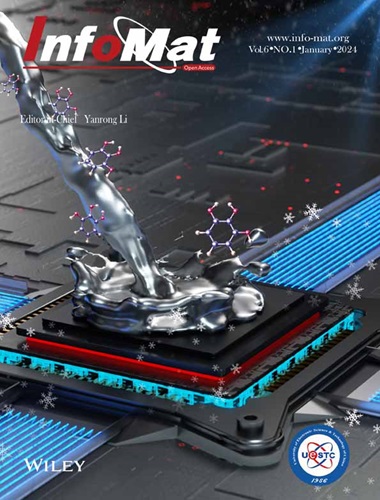
The combustion performance and interfacial-mechanical properties of the Al/HMX composite are pivotal to its application in propellant and explosive formulations. Although nano-aluminum (n-Al) possesses high reactivity, issues such as particle agglomeration and surface oxidation limit its combustion efficiency and mechanical properties, hindering its direct application. Spherical Al/HMX/CuO composite energetic micro-units were designed using multiscale simulations combining molecular dynamics and computational fluid dynamics. Using fluororubber F2603 as the binder, the micro-units were precisely and controllably fabricated employing coaxial microfluidic technology. Characterization indicates that the n-Al particles are pre-dispersed within the micro-units, suppressing their agglomeration. The addition of F2603 as an interfacial modifier enhances hydrophobicity and delays n-Al oxidation. The spherical morphology improves dispersion and flame propagation, while the encapsulation structure promotes efficient mass and heat transfer between n-Al and HMX, significantly enhancing combustion. In the optimized formulation with an Al/HMX mass ratio of 1:2 and 2% CuO content, the micro-unit exhibited a 100% increase in combustion rate, a stable heating rate of 1.04 × 10⁴ K s–1, and a 5.5% rise in combustion temperature, outperforming physically mixed samples. By revealing the combustion mechanism and structure–performance relationship of energetic micro-units, this study demonstrates precision fabrication advantages of microfluidics to support designing high-performance energetic composites.
Al/HMX复合材料的燃烧性能和界面力学性能对其在推进剂和炸药配方中的应用至关重要。虽然纳米铝具有较高的反应活性,但颗粒团聚和表面氧化等问题限制了其燃烧效率和力学性能,阻碍了其直接应用。采用分子动力学和计算流体力学相结合的多尺度模拟方法,设计了球形Al/HMX/CuO复合材料高能微单元。采用同轴微流控技术,以氟橡胶F2603为粘结剂,精确、可控地制备了微单元。表征表明,n-Al颗粒在微单元内预分散,抑制了它们的团聚。加入F2603作为界面改性剂增强了疏水性,延缓了n-Al的氧化。球形形貌改善了扩散和火焰传播,而包封结构促进了n-Al和HMX之间有效的质量和热量传递,显著增强了燃烧。在Al/HMX质量比为1:2、CuO含量为2%的优化配方中,微单元的燃烧速率提高了100%,升温速率稳定在1.04 × 104 K s-1,燃烧温度提高了5.5%,优于物理混合样品。通过揭示含能微单元的燃烧机理和结构性能关系,说明微流体的精密制造优势,为高性能含能复合材料的设计提供支持。
期刊介绍:
InfoMat, an interdisciplinary and open-access journal, caters to the growing scientific interest in novel materials with unique electrical, optical, and magnetic properties, focusing on their applications in the rapid advancement of information technology. The journal serves as a high-quality platform for researchers across diverse scientific areas to share their findings, critical opinions, and foster collaboration between the materials science and information technology communities.

 求助内容:
 应助结果提醒方式:


 京公网安备 11010802042870号


