
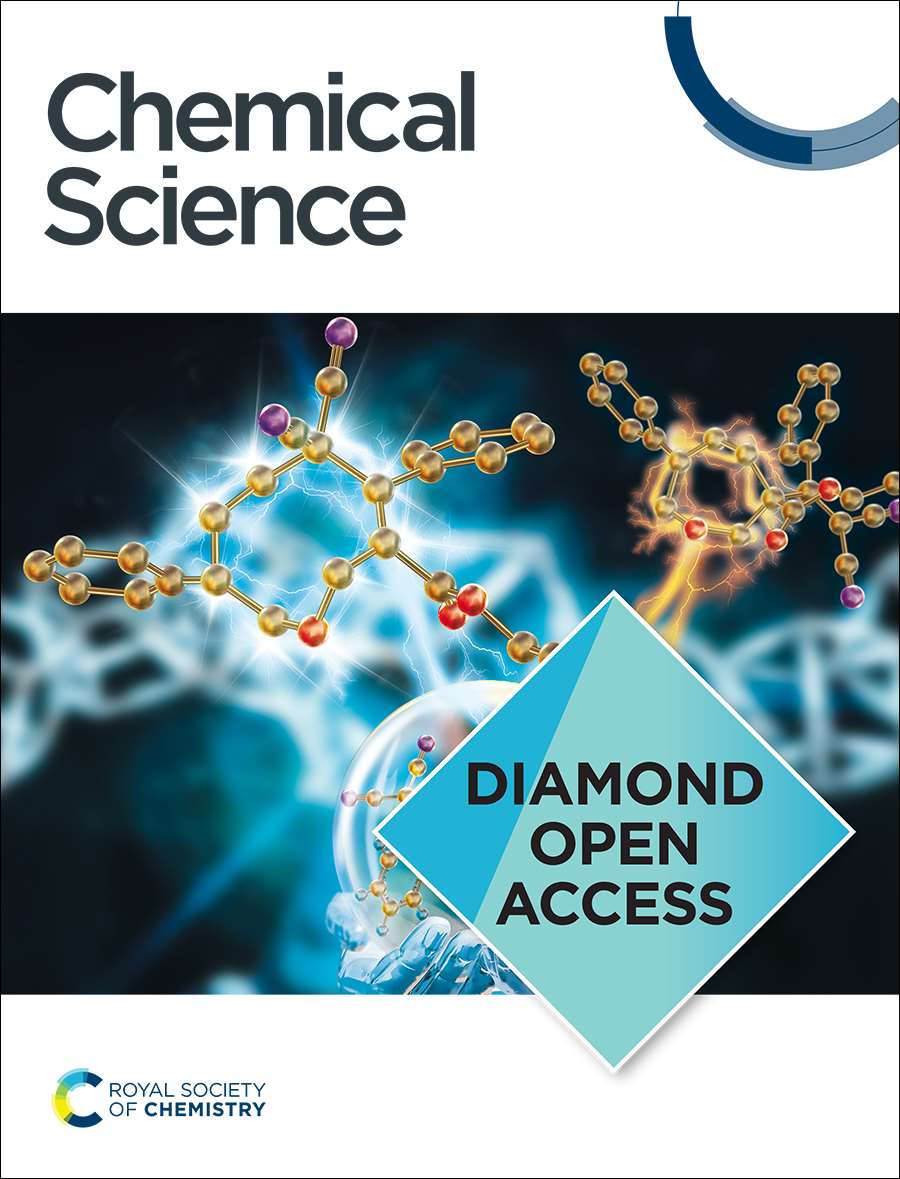
A focus on caging radicals: a catch-and-release mechanism for BODIPY photocages
IF 8.1
1区 化学
Q1 CHEMISTRY, MULTIDISCIPLINARY
引用次数: 0
Abstract
Photocages enable the on-demand release of a payload in a closed chemical system upon irradiation with a suitable wavelength of light. Most photocages are described as releasing their payload through heterolytic cleavage of the photolabile bond, producing anionic and cationic fragments. Homolytic cleavage to form radicals is less commonly exploited as they react more indiscriminately and can generate unintended products. Poryvai and co-workers (A. Poryvai, A. Vasiļevska, K. Bangievská, J. Tarábek, S. Gerber-Lemaire and T. Slanina, Chem. Sci., 2026, 17, 11430, https://doi.org/10.1039/D6SC01848C) show how homolytic bond scission can instead be used to achieve a catch-and-release mechanism for radical payloads. Using a BODIPY-based photocage that responds to green light (525 nm), they demonstrate the capture of TEMPO and its subsequent release on demand. This behaviour was also applied to radical-based polymerisation. This work establishes design principles for the catch-and-release mechanism, and draws attention back to the often overlooked homolytic pathway in photocage chemistry.

聚焦于笼自由基:BODIPY光笼的捕获和释放机制
光笼能够在适当波长的光照射下按需释放封闭化学系统中的有效载荷。大多数光笼被描述为通过异裂解裂解光性键释放其有效载荷,产生阴离子和阳离子碎片。形成自由基的均溶裂解很少被利用,因为它们的反应更加不加区分,并且可以产生意想不到的产物。Poryvai及其同事(A. Poryvai, A. Vasiļevska, K. bangievsk, J. Tarábek, S. Gerber-Lemaire和T. Slanina, Chem.)科学。(2026,17,11430, https://doi.org/10.1039/D6SC01848C)表明如何使用均溶键断裂来实现自由基有效载荷的捕获和释放机制。他们使用一种基于bodip的响应绿光(525 nm)的光笼,演示了TEMPO的捕获及其随后的按需释放。这种行为也适用于基于自由基的聚合。这项工作建立了捕获和释放机制的设计原则,并将人们的注意力吸引回光笼化学中经常被忽视的同溶途径。
本文章由计算机程序翻译,如有差异,请以英文原文为准。
求助全文
约1分钟内获得全文
求助全文
来源期刊
Chemical Science
CHEMISTRY, MULTIDISCIPLINARY-
CiteScore
14.40
自引率
4.80%
发文量
1352
审稿时长
2.1 months
期刊介绍:
Chemical Science is a journal that encompasses various disciplines within the chemical sciences. Its scope includes publishing ground-breaking research with significant implications for its respective field, as well as appealing to a wider audience in related areas. To be considered for publication, articles must showcase innovative and original advances in their field of study and be presented in a manner that is understandable to scientists from diverse backgrounds. However, the journal generally does not publish highly specialized research.
 求助内容:
 应助结果提醒方式:


 京公网安备 11010802042870号


