UVC-to-NIR-II Ultra-Broadband Response Photochromism of Stilbene Enabled by Donor-Acceptor Complexation Strategy Through One-Step Mechanochemical Synthesis
IF 7.2 2区 材料科学Q1 MATERIALS SCIENCE, MULTIDISCIPLINARY
Siya Huang, Xiaotong He, Jie-Cheng Chen, Bo-Wei Ye, Qian-Ying Zhu, Jiayu Li, Yu Wang, Meng-Meng Zhang, Wenbin Chen, Shao-Fei Ni, Li Dang, Xin-Da Huang, Ming-De Li, Shun-Li Chen
{"title":"UVC-to-NIR-II Ultra-Broadband Response Photochromism of Stilbene Enabled by Donor-Acceptor Complexation Strategy Through One-Step Mechanochemical Synthesis","authors":"Siya Huang, Xiaotong He, Jie-Cheng Chen, Bo-Wei Ye, Qian-Ying Zhu, Jiayu Li, Yu Wang, Meng-Meng Zhang, Wenbin Chen, Shao-Fei Ni, Li Dang, Xin-Da Huang, Ming-De Li, Shun-Li Chen","doi":"10.1002/adom.71832","DOIUrl":null,"url":null,"abstract":"<div>\n \n <p>We introduce a supramolecular approach to substantially expand the response wavelength of photoswitchable stilbene(<i>E</i>) from UVC (274 nm) to NIR-II (1064 nm) region, which doesn't depend on <i>E</i>-to-<i>Z</i> photoisomerization. Stilbene(<i>E</i>) acts as an electron donor and is co-assembled with a matched acceptor (e.g., F<i>x</i>TCNQ, <i>x</i> = 1/2/4) to form a solid complex with a loose stack and broadband absorption of 250–1100 nm through one-step mechanochemical synthesis. Reversible green-to-yellow chromism is observed for the complex exposed to 808 nm-light irradiation/heating treatment, which corresponds to the disappearance/appearance of the absorption band of ∼550-1100 nm. This behavior is attributed to photo-induced ultrafast torsion (<0.23 ps) of the stilbene(<i>E</i>) skeleton and resulting destruction of donor-acceptor π-π stacking, and subsequent heating-induced recovery. Besides, the complex can also serve as a UV-excited fluorescence switch and NIR-photothermal material. Hence, donor-acceptor complexation effectively reduces the photo-activation energy of stilbene(<i>E</i>) by π-π interaction and provides a promising route to design a multi-functional photoswitch with ultra-broadband light response.</p>\n </div>","PeriodicalId":116,"journal":{"name":"Advanced Optical Materials","volume":"14 38","pages":""},"PeriodicalIF":7.2000,"publicationDate":"2026-10-16","publicationTypes":"Journal Article","fieldsOfStudy":null,"isOpenAccess":false,"openAccessPdf":"","citationCount":"0","resultStr":null,"platform":"Semanticscholar","paperid":null,"PeriodicalName":"Advanced Optical Materials","FirstCategoryId":"88","ListUrlMain":"https://onlinelibrary.wiley.com/doi/10.1002/adom.71832","RegionNum":2,"RegionCategory":"材料科学","ArticlePicture":[],"TitleCN":null,"AbstractTextCN":null,"PMCID":null,"EPubDate":"2026/9/23 0:00:00","PubModel":"Epub","JCR":"Q1","JCRName":"MATERIALS SCIENCE, MULTIDISCIPLINARY","Score":null,"Total":0}
引用次数: 0
Abstract
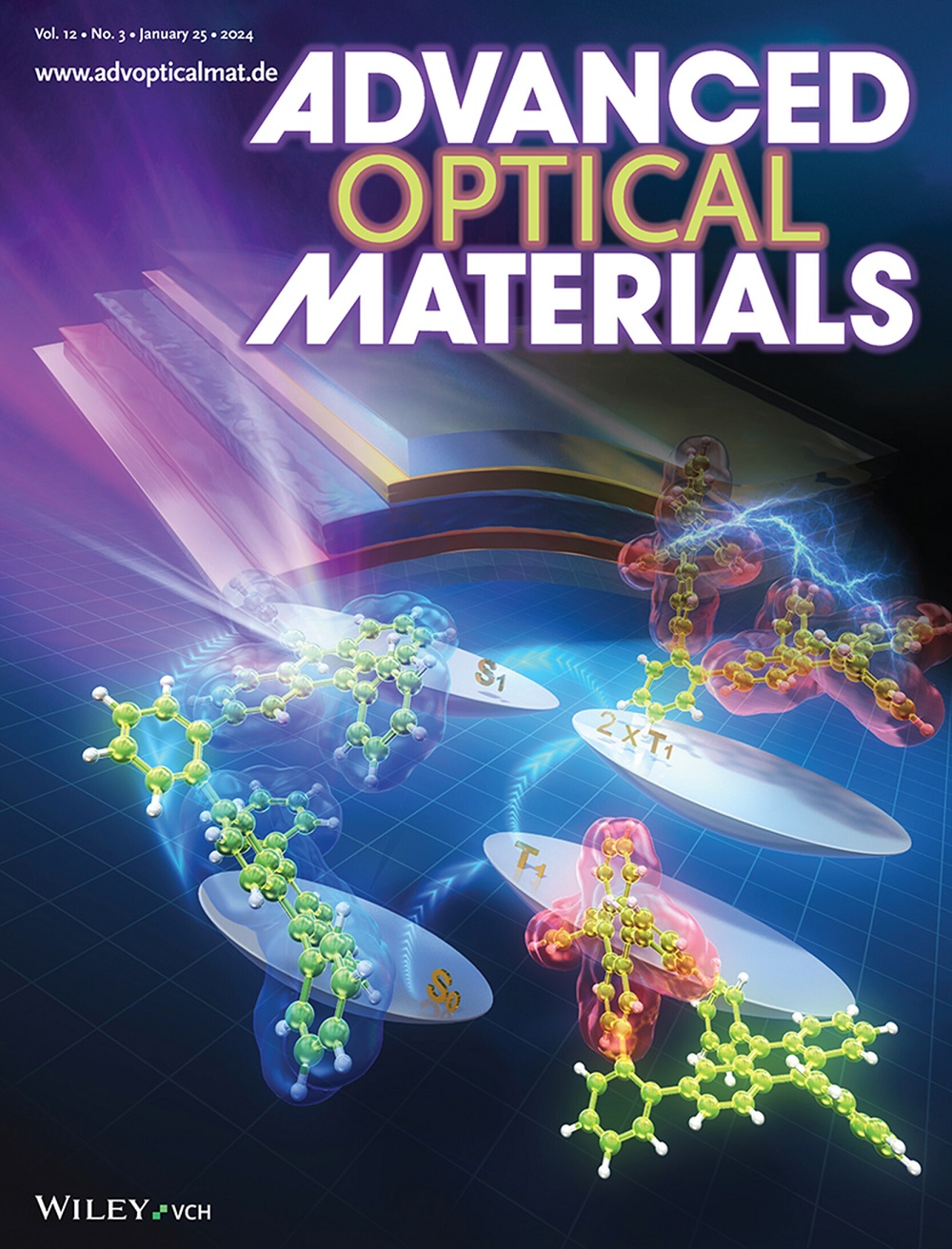
We introduce a supramolecular approach to substantially expand the response wavelength of photoswitchable stilbene(E) from UVC (274 nm) to NIR-II (1064 nm) region, which doesn't depend on E-to-Z photoisomerization. Stilbene(E) acts as an electron donor and is co-assembled with a matched acceptor (e.g., FxTCNQ, x = 1/2/4) to form a solid complex with a loose stack and broadband absorption of 250–1100 nm through one-step mechanochemical synthesis. Reversible green-to-yellow chromism is observed for the complex exposed to 808 nm-light irradiation/heating treatment, which corresponds to the disappearance/appearance of the absorption band of ∼550-1100 nm. This behavior is attributed to photo-induced ultrafast torsion (<0.23 ps) of the stilbene(E) skeleton and resulting destruction of donor-acceptor π-π stacking, and subsequent heating-induced recovery. Besides, the complex can also serve as a UV-excited fluorescence switch and NIR-photothermal material. Hence, donor-acceptor complexation effectively reduces the photo-activation energy of stilbene(E) by π-π interaction and provides a promising route to design a multi-functional photoswitch with ultra-broadband light response.
期刊介绍:
Advanced Optical Materials, part of the esteemed Advanced portfolio, is a unique materials science journal concentrating on all facets of light-matter interactions. For over a decade, it has been the preferred optical materials journal for significant discoveries in photonics, plasmonics, metamaterials, and more. The Advanced portfolio from Wiley is a collection of globally respected, high-impact journals that disseminate the best science from established and emerging researchers, aiding them in fulfilling their mission and amplifying the reach of their scientific discoveries.

 求助内容:
 应助结果提醒方式:


 京公网安备 11010802042870号


