W Fan, J J Li, L Zhang, Z X Zhang, Z L Song, R H Tang, M Yue, B H Zou, H H Qin, T Hu, J H Li, S Q Feng, L T Xuan, M Z Hu, D F Shao, X N Chen, M N Zhai, D Q Luo, R Liu
{"title":"[Clinical analysis of modified Chinese Children Leukemia Group-Acute Myeloid Leukemia 2019 regimen in treating pediatric acute myeloid leukemia].","authors":"W Fan, J J Li, L Zhang, Z X Zhang, Z L Song, R H Tang, M Yue, B H Zou, H H Qin, T Hu, J H Li, S Q Feng, L T Xuan, M Z Hu, D F Shao, X N Chen, M N Zhai, D Q Luo, R Liu","doi":"10.3760/cma.j.cn112140-20260828-00670","DOIUrl":null,"url":null,"abstract":"<p><p><b>Objective:</b> To evaluate the clinical efficiency and prognosis of a modified regimen based on the Chinese Children Leukemia Group-Acute Myeloid Leukemia 2019 (CCLG-AML2019) protocol for childhood acute myeloid leukaemia (AML) (non-acute promyelocytic leukaemia, non-APL). <b>Methods:</b> In this retrospective cohort study, clinical data including sex, age, French-American-British (FAB) classification, genetics, molecular biology, treatment, therapeutic efficacy and prognosis of 41 newly diagnosed non-APL AML children treated at Capital Institute of Pediatrics, Capital Pediatric Medical Center, Capital Medical University from November 2019 to December 2023 were analyzed. All children received chemotherapy according to the CCLG-AML2019 protocol. For high-risk (HR) children with persistent high-level minimal residual disease (MRD) after induction therapy, a cladribine-containing intensified salvage chemotherapy regimen was introduced in the third course. According to the risk stratification criteria, children were divided into high-risk and non-high-risk groups. High-risk children received allogeneic hematopoietic stem cell transplantation (allo-HSCT) after 3 or 4 courses of chemotherapy. Children were divided into two groups according to age (<2 years and ≥2 years group), and the clinical characteristics and prognosis between the two groups were compared using Fisher's exact test. Kaplan-Meier method was used to estimate the 5-year overall survival (OS) rate and event-free survival (EFS) rate, and Cox regression was employed for univariate analysis. <b>Results:</b> Among the 41 children, there were 22 males and 19 females, with an age of 5.8 (2.6, 8.0) years. Twenty-four children (59%) were classified as the high-risk group, and 17 (41%) as the non-high-risk group. The follow-up duration was 51(38, 62) months. The 5-year OS rate was (85±7)%, and the 5-year EFS rate was (79±7)%. Non-HR children achieved 100% for both, whereas in the high-risk group, the corresponding rates were (75±10)% and (65±11)%, respectively. The difference in EFS rate between the two groups had statistically difference (<i>P</i>=0.018). There were 10 children in the <2 years age group, among them FAB M5 or M7 subtypes were observed in 9 children, KMT2A gene rearrangements were observed in 5 children, and high-risk stratification were defined in 8 children. Core binding factor (CBF)-AML (19 children) had a KIT gene variation in 10 children, and with no relapse. During follow-up, 5 deaths occurred (2 due to relapse, 2 due to transplant-related complications, and 1 due to infection). <b>Conclusions:</b> The CCLG-AML2019 regimen offers favorable short-term survival for pediatric non-APL AML, especially in non-HR children. HR children still face the risks of relapse and transplant-related mortality after allo-HSCT. Children aged <2 years may benefit from chemotherapy combined with targeted therapy. CBF-AML has a favorable overall prognosis, and the high frequency of KIT gene variation did not attenuate this advantage.</p>","PeriodicalId":60813,"journal":{"name":"中华儿科杂志","volume":"64 11","pages":"1233-1239"},"PeriodicalIF":0.0000,"publicationDate":"2026-10-15","publicationTypes":"Journal Article","fieldsOfStudy":null,"isOpenAccess":false,"openAccessPdf":"","citationCount":"0","resultStr":null,"platform":"Semanticscholar","paperid":null,"PeriodicalName":"中华儿科杂志","FirstCategoryId":"3","ListUrlMain":"https://doi.org/10.3760/cma.j.cn112140-20260828-00670","RegionNum":0,"RegionCategory":null,"ArticlePicture":[],"TitleCN":null,"AbstractTextCN":null,"PMCID":null,"EPubDate":"","PubModel":"","JCR":"","JCRName":"","Score":null,"Total":0}
引用次数: 0
Abstract
Objective: To evaluate the clinical efficiency and prognosis of a modified regimen based on the Chinese Children Leukemia Group-Acute Myeloid Leukemia 2019 (CCLG-AML2019) protocol for childhood acute myeloid leukaemia (AML) (non-acute promyelocytic leukaemia, non-APL). Methods: In this retrospective cohort study, clinical data including sex, age, French-American-British (FAB) classification, genetics, molecular biology, treatment, therapeutic efficacy and prognosis of 41 newly diagnosed non-APL AML children treated at Capital Institute of Pediatrics, Capital Pediatric Medical Center, Capital Medical University from November 2019 to December 2023 were analyzed. All children received chemotherapy according to the CCLG-AML2019 protocol. For high-risk (HR) children with persistent high-level minimal residual disease (MRD) after induction therapy, a cladribine-containing intensified salvage chemotherapy regimen was introduced in the third course. According to the risk stratification criteria, children were divided into high-risk and non-high-risk groups. High-risk children received allogeneic hematopoietic stem cell transplantation (allo-HSCT) after 3 or 4 courses of chemotherapy. Children were divided into two groups according to age (<2 years and ≥2 years group), and the clinical characteristics and prognosis between the two groups were compared using Fisher's exact test. Kaplan-Meier method was used to estimate the 5-year overall survival (OS) rate and event-free survival (EFS) rate, and Cox regression was employed for univariate analysis. Results: Among the 41 children, there were 22 males and 19 females, with an age of 5.8 (2.6, 8.0) years. Twenty-four children (59%) were classified as the high-risk group, and 17 (41%) as the non-high-risk group. The follow-up duration was 51(38, 62) months. The 5-year OS rate was (85±7)%, and the 5-year EFS rate was (79±7)%. Non-HR children achieved 100% for both, whereas in the high-risk group, the corresponding rates were (75±10)% and (65±11)%, respectively. The difference in EFS rate between the two groups had statistically difference (P=0.018). There were 10 children in the <2 years age group, among them FAB M5 or M7 subtypes were observed in 9 children, KMT2A gene rearrangements were observed in 5 children, and high-risk stratification were defined in 8 children. Core binding factor (CBF)-AML (19 children) had a KIT gene variation in 10 children, and with no relapse. During follow-up, 5 deaths occurred (2 due to relapse, 2 due to transplant-related complications, and 1 due to infection). Conclusions: The CCLG-AML2019 regimen offers favorable short-term survival for pediatric non-APL AML, especially in non-HR children. HR children still face the risks of relapse and transplant-related mortality after allo-HSCT. Children aged <2 years may benefit from chemotherapy combined with targeted therapy. CBF-AML has a favorable overall prognosis, and the high frequency of KIT gene variation did not attenuate this advantage.
期刊介绍:
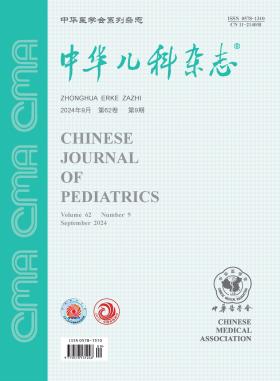
Chinese Journal of Pediatrics is the only high-level academic journal in the field of pediatrics in my country, supervised by the China Association for Science and Technology and sponsored by the Chinese Medical Association. It was founded in 1950. The purpose of the journal is to combine theory with practice, with emphasis on practice; to combine basic and clinical, with major clinical; to combine popularization with improvement, with emphasis on improvement. It is to promote academic exchanges in the field of pediatrics in my country; to serve the development and improvement of my country's pediatric medicine; to serve the training of pediatric medical talents in my country; and to serve the health of children in my country. Chinese Journal of Pediatrics is mainly composed of columns such as monographs, clinical research and practice, case reports, lectures, reviews, conference (symposium) minutes, clinical pathology (case) discussions, international academic exchanges, expert explanations, and new technologies.

 求助内容:
 应助结果提醒方式:


 京公网安备 11010802042870号


